
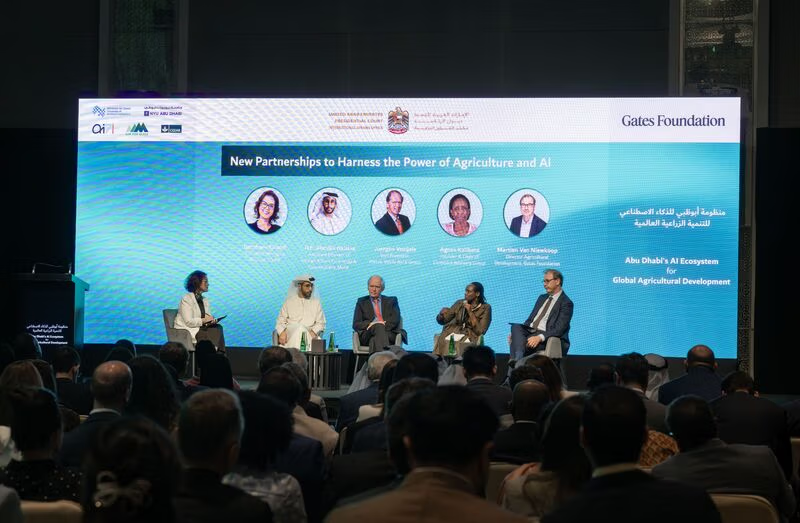
Global leaders and specialists in agriculture and advanced technologies convened on Monday in Abu Dhabi to discuss how artificial intelligence (AI) can bolster sustainable agriculture and strengthen the resilience of global food supply chains.
The panel took place alongside Abu Dhabi’s launch of the AI Ecosystem for Global Agricultural Development.
Participants emphasized that AI supports more effective responses to agricultural challenges by supplying precise, timely information to smallholder farmers and policymakers. They added that AI also helps unify fragmented data into actionable tools for governments, researchers and private-sector stakeholders.
Addressing the use of AI in water management and agriculture, Abdulla Balalaa, Assistant Minister of Foreign Affairs for Energy and Sustainability Affairs, noted that water is the backbone of agriculture. He highlighted that the sector uses 70 percent of the world’s freshwater resources, underscoring the need for careful water management.
He explained that AI, together with emerging technologies, helps forecast weather patterns and respond to issues such as desertification, floods, declining rainfall and groundwater depletion. Balalaa added that the upcoming UN Water Conference will offer an opportunity to apply these technologies in smart agriculture and support leaders in tracking concerns like rising sea levels and enhancing policy decisions.
Discussing AI’s contribution to global smart agriculture initiatives, Juergen Voegele, Vice President of Planet at the World Bank Group, said AI can better integrate smallholder farmers into value chains by providing comprehensive information, ranging from weather forecasts and market prices to pest-control advice.
Focusing on empowering farmers and building community trust, Dr. Agnes Kalibata, Founder and Chair of the C4Impact Advisory Group in Rwanda, said the success of AI-driven agricultural services relies on trust between farmers, communities and service providers. She stressed the importance of strong government leadership, clear guidance and reliable service delivery, along with respect for farmers’ traditional knowledge.
Highlighting the significance of open data and global infrastructure, Martien Van Nieuwkoop, Director of Agricultural Development at the Gates Foundation, said AI acts as a global backbone that turns agricultural knowledge into practical services. He underscored the need to make data and models available as global public goods so that recommendations can reach hundreds of millions of smallholder farmers by 2030.
He affirmed that collaborations between the UAE, global research bodies and the World Bank play a vital role in enabling farmers to access agricultural knowledge and tools broadly and at scale.
(Inputs from WAM)