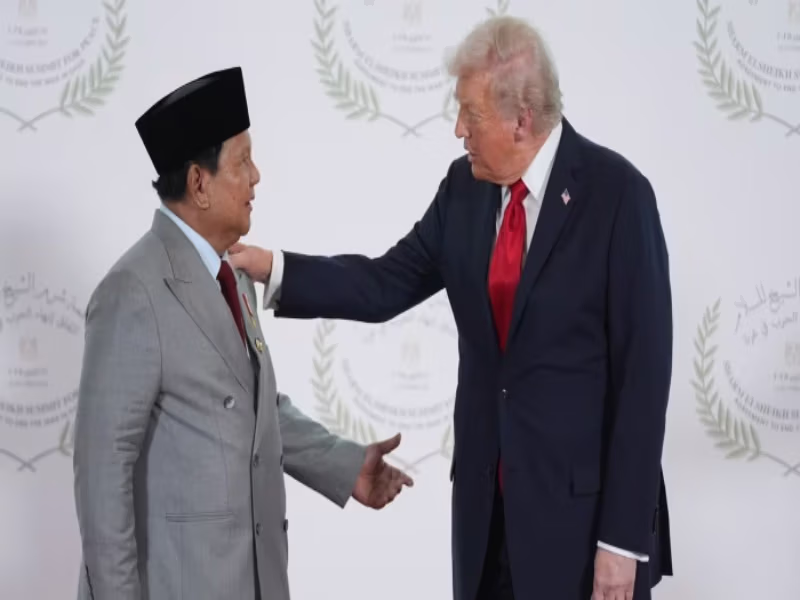
The Financial Times reported that the trade agreement between the U.S. and Indonesia is on the verge of collapsing as Washington officials believe that Jakarta is reversing the terms of the agreement.
The report, as per people familiar with the matter, indicates that U.S. trade representative Jamieson Greer on Monday asserted that Indonesia was “backtracking” on several commitments it had made.
Indonesian authorities are reportedly agreeing to certain binding commitments that were made in the deal and have communicated the same to the USTR. Washington assumes that Indonesia is “backsliding” on removing non-tariff barriers to U.S. industrial and agricultural exports and commits to taking action on digital trade issues.
Reuters stated on Wednesday that an Indonesian official informed the agency that the tariff negotiations were still being held and no particular problems had emerged in the talks.
U.S.U.S. President Donald Trump had already agreed to a deal with Indonesia in mid-July, reducing the so-called “reciprocal” tariff rate on the Southeast Asian country to 19 percent from the 32 percent he had threatened in his “tariff letter” to the country earlier this month.ump had stated that Indonesia had “committed” to buy $15 billion of U.S. Energy, $4.5 billion in American agricultural products, and 50 Boeing jets as part of the agreement.
Therefore, Trump also added that “U.S. Exports to Indonesia are to be Tariff and Non-Tariff Barrier FREE.” USTR and Indonesia’s trade ministry did not respond immediately to CNBC’s request for comments.
A person familiar with the matter informed the FT that Indonesia was “outright saying they cannot implement what they agreed to and need to renegotiate the initial commitments to be nonbinding,” citing that the stance was “extremely problematic and is not being well-received by the United States. Indonesia may be at risk of losing its deal.”
Meanwhile, this is not the first occasion that Washington and Jakarta have experienced some tension over a trade agreement.
The FT said in November that Indonesia had turned down a “poison pill” provision in its agreement that other economies in Southeast Asia, like Malaysia, had accepted.
The poison pill provision poses a threat of rescission of a trade agreement in case the nation signs a competing agreement that the U.S. deems to undermine its vital interests.
Other economies in the region have also responded with other trade deals that Trump had made with the Asian countries, even after these initial deals had been announced.
However, Trump had said that South Korea would invest $350 billion in the country, but Seoul stated that it could not return the amount in cash.
South Korea later committed to invest $200 billion in cash within 10 years and $150 billion fund to be expended in investments in shipbuilding.
Trump had declared that Japan might invest $550 billion in the country, with the U.S. taking 90 percent of the profit from these investments. Thus, Tokyo subsequently indicated that the profit would be divided between the U.S. and Japan, as per the amount contributed by either side.