
The Middle East’s role in the blockbuster bid for Warner Bros. Discovery is deeper and more interconnected than the headline number suggests, according to Bloomberg.
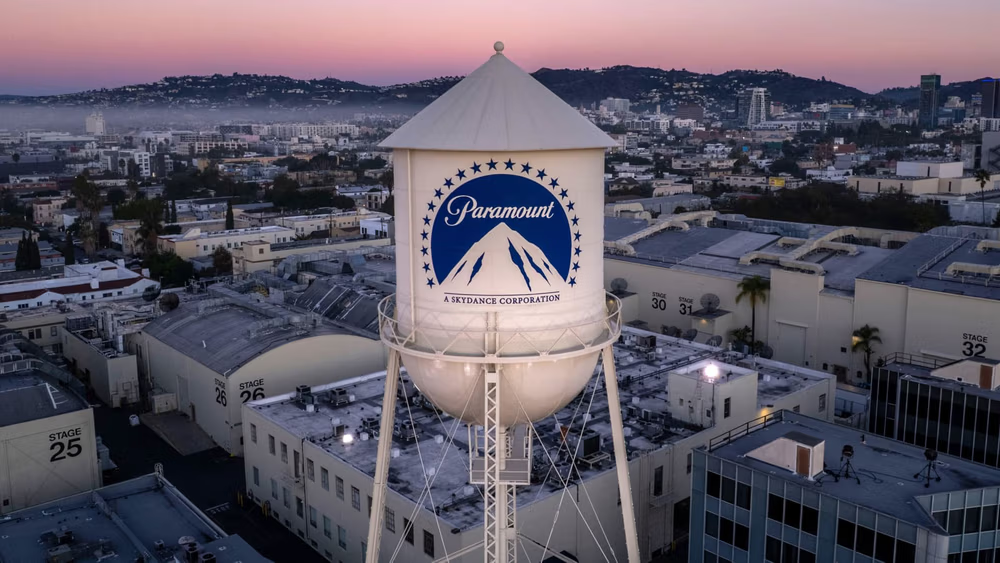
Earlier this week, three major regional investors, Saudi Arabia’s Public Investment Fund (PIF), the Qatar Investment Authority (QIA), and Abu Dhabi–based L’imad Holding Co., agreed to provide $24 billion to support Paramount Skydance Corp.’s hostile offer for Warner Bros. Discovery Inc.
But their true exposure to the deal is likely far larger once long-standing ties to the private equity firms behind the financing are taken into account.
Deep Links to Apollo and Global Buyout Capital
One of the most significant players in the financing structure is Apollo Global Management Inc., which, along with others, is supplying up to $54 billion in debt for the Paramount bid.
Apollo’s connections with the Gulf run deep. Abu Dhabi’s Mubadala Investment Co. has maintained a long relationship with Apollo, while the PIF’s venture arm has committed capital to Apollo-managed funds. This means regional money is indirectly threaded throughout multiple layers of the deal — not just the headline equity contribution.
Shared Investments Through Affinity Partners
The collaboration extends further through Affinity Partners, Jared Kushner’s investment firm, which has itself received billions of dollars from the PIF, QIA and Abu Dhabi’s Lunate.
Affinity and Mubadala share investment ties as well. Both participated in a joint investment in a Brazil-based fast-food company, illustrating the dense web of cross-border partnerships that anchor today’s global dealmaking.
This network was on display earlier this year when the PIF and Affinity mounted a $55 billion bid for Electronic Arts Inc. Kushner acted as a key intermediary, according to Bloomberg News, a role that underscores how political networks, private capital and sovereign wealth intertwine.
A Cast of Influential Backers
The current Paramount Skydance offer also involves heavyweight figures such as Oracle co-founder Larry Ellison, who maintains close ties with Gulf governments and investors.
Under the agreed structure, Middle Eastern backers will provide capital through non-voting equity, waiving governance rights to avoid triggering scrutiny from the Committee on Foreign Investment in the United States (CFIUS).
The Gulf as the World’s Dealmakers
For the Middle East, the bid is the latest example of sovereign wealth funds positioning themselves as major financiers of global industry.
According to Global SWF, five wealth funds from Abu Dhabi, Qatar and Saudi Arabia deployed $82 billion in 2023 — more than 60% of all sovereign wealth fund investments worldwide. Their capital has supported deals across finance, technology and artificial intelligence as the region seeks to diversify beyond oil.
Soft Power and Strategic Assets
If the bid succeeds, Gulf investors would indirectly gain exposure to some of the world’s most influential media assets: Warner Bros. film and TV studios, HBO, and cable networks including CNN. Such holdings carry not only financial value but also cultural and geopolitical influence, amplifying the region’s growing soft power.
A Rare Unified Front
Perhaps most striking is that the deal marks one of the few recent instances where the UAE, Saudi Arabia and Qatar, countries with significant geopolitical differences, have aligned on a single transaction.
Together, their sovereign funds control more than $3 trillion in assets, yet joint deals involving all three remain uncommon.
This unprecedented collaboration signals both the scale of the opportunity and the region’s ambitions to shape the future of the global media landscape.