

The Indian rupee has slipped to a fresh record low, crossing the 91-per-dollar level, deepening pressure across currency, bond, and equity markets. What began as stress in foreign exchange has now started to weigh on broader investor sentiment, with analysts warning that equity returns could remain subdued in the near term.
The weakening currency has unsettled foreign investors concerned about currency-adjusted returns, while domestic investors are navigating tighter liquidity conditions. Market participants increasingly view the move as structural rather than cyclical, shaped by a challenging global backdrop and domestic imbalances.
Structural Factors Driving the Rupee Lower
Analysts note that the rupee’s decline of more than six percent this year reflects longer-term erosion rather than short-term volatility. Despite sustained intervention efforts, the currency has steadily weakened over the past decade.
“The current phase of rupee depreciation appears to be driven by structural factors rather than temporary market dislocations,” analysts said, pointing to rising global protectionism, persistent trade pressures, and limited room for aggressive intervention.
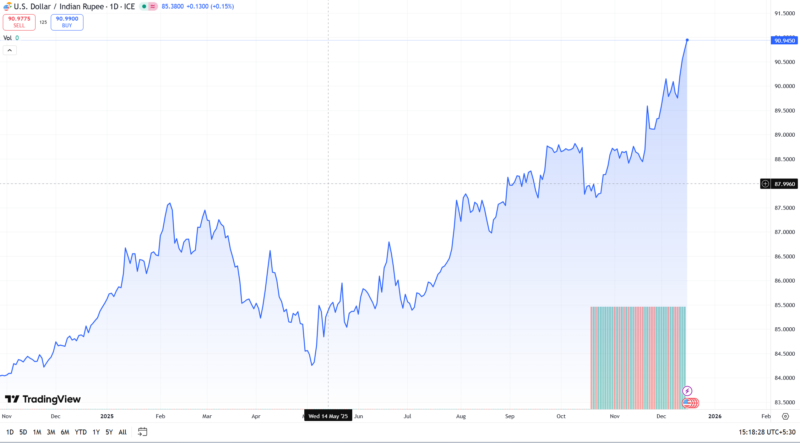
While the Reserve Bank of India has sought to smooth volatility, strategists argue that the currency’s relative stability in recent years did not necessarily reflect stronger fundamentals.
“Currency stability has often masked deeper demand-side challenges in the economy,” analysts said, adding that sustained recovery would require stronger private investment and external competitiveness.
Impact on Equity Markets
The rupee’s weakness is now feeding into equity market expectations, with investors becoming more selective. Analysts expect overall market returns to remain muted, particularly for sectors sensitive to imports, funding costs, and domestic demand.
Export-oriented sectors such as information technology, pharmaceuticals, automobiles, and metals are expected to benefit from a weaker currency, as overseas revenues translate into higher local earnings. On the other hand, banks, public-sector enterprises, oil and gas, energy, and infrastructure companies may face margin pressure due to rising input costs and tighter liquidity conditions.
“Periods of sustained currency weakness tend to favour exporters while creating challenges for domestically focused sectors,” market participants said.
Liquidity and External Account Risks
Beyond equities, pressure on the external account remains a key concern. Analysts say that without durable improvements in trade flows and capital inflows, currency volatility could persist.
“Financial markets remain vulnerable to intermittent bouts of risk aversion as long as currency and liquidity pressures continue,” analysts noted, advising investors to maintain a defensive bias in the near term.
Some market participants believe that progress on trade agreements and structural reforms could help stabilise sentiment over time, though near-term uncertainty remains elevated.
Long-Term Outlook Remains Mixed
Despite near-term caution, analysts say the broader economic outlook is not uniformly negative. Recent data suggest a gradual improvement in domestic demand and early signs of an earnings recovery.
“The current volatility is likely a passing phase, though markets may remain choppy in the coming months,” analysts said, adding that long-term investors may still find opportunities in structurally strong sectors.
However, valuation concerns persist, with Indian equities trading at premium multiples compared to many global peers. Analysts caution that sustained currency weakness, combined with slowing earnings growth, could limit upside unless growth accelerates meaningfully.
For investors, the rupee’s move past 91 against the dollar has emerged as a key signal, underscoring the importance of selectivity, currency awareness, and disciplined portfolio positioning.