

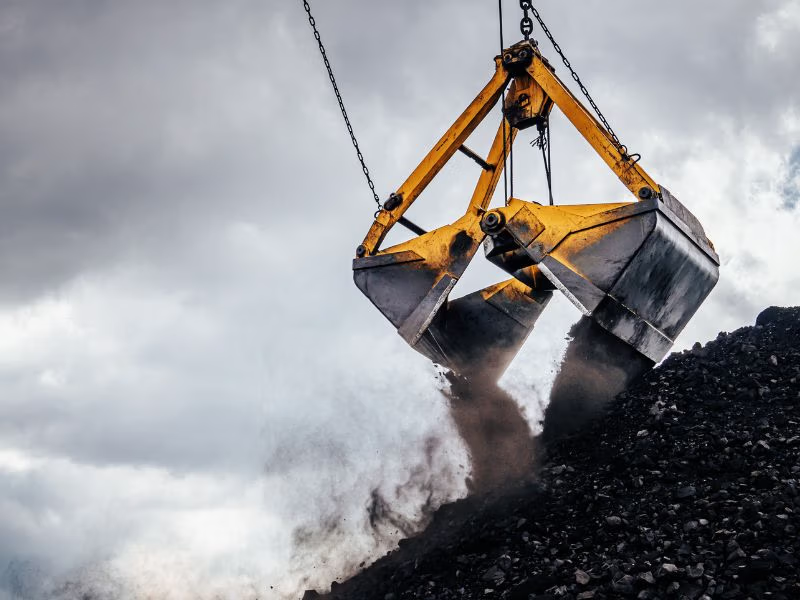
Global coal demand has climbed to a record high in 2025, but is expected to plateau and begin a gradual decline by the end of the decade as renewable energy, nuclear power, and natural gas increasingly displace coal in power generation, according to the International Energy Agency (IEA).
In its annual Coal 2025 report released on Wednesday, the Paris-based agency said global coal consumption is forecast to rise by 0.5% this year to an all-time high of 8.85 billion metric tonnes, reinforcing coal’s continued role as the world’s largest source of electricity despite growing climate pressures.
“Weaning the world off coal is considered vital to achieving global climate targets,” the IEA noted, even as coal remains the most carbon-intensive fossil fuel and a cornerstone of energy systems across much of the world.
Demand set to peak, then ease
Meanwhile, the IEA expects global coal demand to reportedly stabilize before entering a slow and gradual decline through 2030. “Looking ahead, we observe that the global coal demand plateaus and will start a very slow and gradual decline through the end of the decade,” said Keisuke Sadamori, IEA director of Energy Markets and Security, during a press briefing.
The outlook is broadly unchanged from last year’s forecast, although regional trends in 2025 varied significantly.
Indian markets see a decline
In India, coal consumption declined for only the third time in five decades, largely due to intense monsoon rains that boosted hydropower generation and dampened electricity demand. In contrast, coal use in the United States rebounded sharply, driven by higher natural gas prices and policy support from President Donald Trump, who signed an executive order aimed at preserving coal-fired power plants and expanding domestic coal production, as per reports.
As a result, US coal consumption is expected to surge by 8% this year, a reversal from the average annual decline of around 6% over the past 15 years, according to the IEA.
China remains pivotal
China, the world’s largest coal consumer, saw demand remain largely flat in 2025 and is expected to record a slight decline by 2030 as renewable capacity continues to expand. However, the IEA cautioned that China’s trajectory will be decisive for global coal markets. “China… which consumes 30% more coal than the rest of the world put together, is the main driver of global coal trends,” Sadamori said. The agency warned that faster-than-expected growth in electricity demand or slower integration of renewable energy in China could push global coal demand above current forecasts.
Global trade and pressure on exporters
While overall demand has hit a record, the global coal trade is set to decline. The IEA forecasts a 5% drop in coal trade volumes in 2025 from record levels, with further modest contractions through to 2030. Global coal trade is expected to ease from a peak of 1.544 billion tonnes this year.
Thermal coal exporters, particularly Australia, are expected to face mounting pressure. The IEA warned that declining imports of thermal coal in China and India, both prioritising domestic production, could weigh heavily on Australian exports. Australia is reportedly currently the world’s second-largest exporter of thermal coal, with China and Japan as its two biggest buyers.
Soft prices are already contributing to signs of financial stress among some Australian coal miners, squeezed by higher operating costs. Benchmark prices fell to a four-year low of US$89 a tonne in March before rebounding, with top-quality New South Wales thermal coal trading at around US$109.64 a tonne in mid-December, roughly one-quarter of its September 2022 peak.
Australia’s government commodities forecaster is projecting a gradual decline in thermal coal export earnings, from A$32 billion last financial year to A$26 billion by 2026–27. In contrast, metallurgical coal exports used in steelmaking are expected to remain relatively stable at A$36–37 billion over the next two years.
Regional trends diverge
Europe’s coal consumption continued to fall in 2025, though the pace of decline slowed compared with previous years due to periods of low wind and hydropower output. Demand in Europe shrank only modestly this year, following double-digit declines in each of the prior two years.
Meanwhile, India’s coal demand is forecast to resume growth, rising by around 3% annually through the remainder of the decade, while South-East Asia is expected to record the fastest growth rate, with demand increasing by more than 4% per year.
Despite expectations of a gradual decline after 2030, the IEA emphasised that uncertainty remains high, driven by China’s outsized influence on global markets and the pace of electricity demand growth worldwide.
Brett Morgan, head of Australian campaigns at activist investor group Market Forces, said the risks facing coal exporters and investors were mounting. He warned that Australian producers could face increasing financial strain as the global energy transition accelerates.
Coal demand may have reached historic highs in 2025, but the IEA’s message is clear: competition from renewables, natural gas and nuclear power is steadily reshaping the global energy mix, setting the stage for a slow but structural decline in coal use over the coming decade.
Inputs from International Energy Agency (Coal 2025 report); statements by Keisuke Sadamori, IEA Director of Energy Markets and Security; government commodity forecasts; Market Forces commentary.