

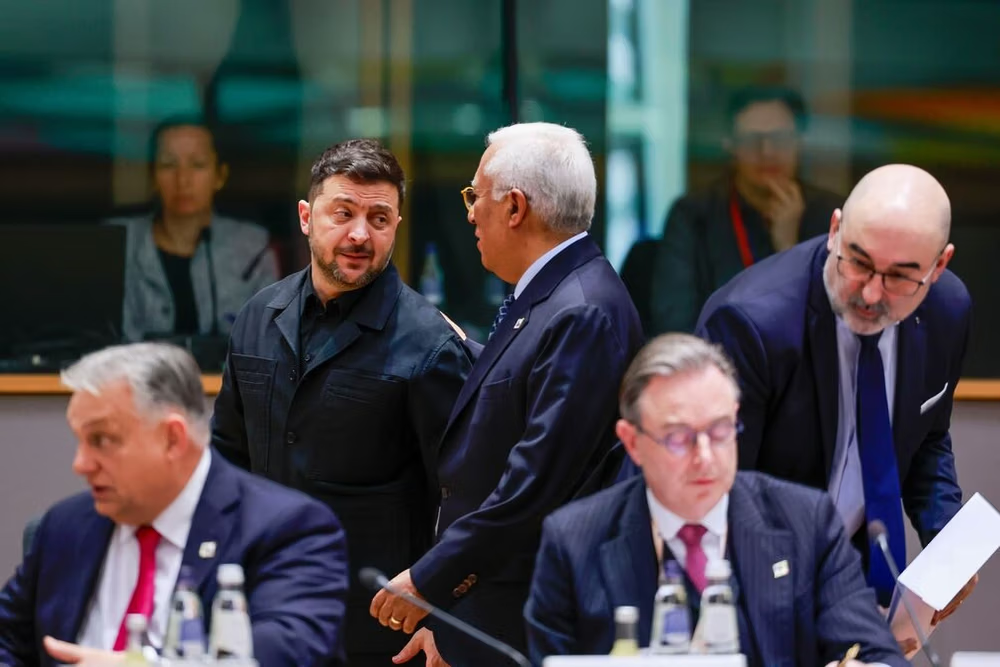
European Union leaders have agreed to provide Ukraine with a $105 billion interest-free loan to meet its military and economic needs over the next two years, choosing to raise the funds from capital markets rather than immediately using frozen Russian assets.
EU Council President Antonio Costa confirmed the decision early on Friday, marking a pivotal moment in Europe’s financing strategy for Ukraine as legal, political, and financial concerns slow efforts to tap Russian central bank reserves frozen since Moscow’s invasion.
Under the agreement, the EU will jointly borrow money on financial markets to finance Ukraine’s defence, a move diplomats say was driven by the legal and political complexities surrounding the use of Russian central bank assets frozen in Europe since the invasion of Ukraine.
At the same time, EU governments and the European Parliament will continue discussions on a longer-term loan structure that could eventually be backed by those frozen Russian assets.
“It’s good in the sense that Ukraine will secure funding for two years,” one unnamed EU diplomat told Reuters.
Why the EU Stepped Back From Using Russian Assets
The decision followed hours of intense negotiations among EU leaders over whether frozen Russian assets could be used directly to fund Ukraine. According to diplomats, those talks revealed that such a move was too complex and politically demanding to resolve at this stage.
“We have gone from saving Ukraine to saving face, at least that of those who have been pushing for the use of the frozen assets,” a second EU diplomat said.
Roughly 210 billion euros ($246 billion) of Russian central bank assets are frozen in the EU, with about 185 billion euros ($217 billion) held in Belgium through the financial services firm Euroclear. The concentration of assets in one jurisdiction has become a major obstacle.
The main concern has been shielding Belgium from financial and legal retaliation from Moscow should the assets be seized or repurposed. The Kremlin has repeatedly warned it would respond by launching legal action and confiscating Western assets in Russia.
We have a deal.
— António Costa (@eucopresident) December 19, 2025
Decision to provide 90 billion euros of support to Ukraine for 2026-27 approved.
We committed, we delivered.
Belgium’s Central Role And Its Concerns
Belgium has emerged as the pivotal player in the debate. Prime Minister Bart De Wever has voiced deep reservations, warning of potentially massive legal liabilities if courts later ruled the use of frozen Russian assets unlawful.
Belgium has demanded binding commitments from other EU states to share any future compensation costs and has also sought assurances that Russian assets held outside Belgium would be used alongside those under its jurisdiction.
Before Friday’s agreement, analysts widely viewed the use of frozen Russian assets as the only viable long-term funding option for Ukraine. However, the proposal would be unprecedented; even during World War II, German state assets were not seized in this manner.
German Chancellor Friedrich Merz had cautioned ahead of the summit that the chances of reaching an agreement were “50-50”.
While countries such as Germany and the Netherlands signaled willingness to backstop the loan, others, including Italy and Bulgaria remained hesitant.
Early on Friday, De Wever welcomed the pivot to market borrowing, saying EU leaders had avoided “chaos and division”.
“We remained united,” he said.
What the Deal Means for Ukraine And The EU
Under the agreed framework, Ukraine will only repay the loan once it receives war reparations from Moscow. Until then, Russian assets will remain frozen. The EU has also reserved the right to use those assets in the future to repay the loan if needed, according to the text of the agreement.
The deal explicitly does not affect the financial obligations of Hungary, Slovakia, and the Czech Republic, which declined to contribute to Ukraine’s financing.
For Brussels, the compromise preserves unity at a time when many EU states are under fiscal strain and domestic political pressure to curb foreign spending.
Russia Warns of Retaliation
Russia has responded sharply to any discussion of using its frozen assets. On Thursday, Russia’s central bank said it would sue European banks in Russian courts if the assets were used to finance Ukraine.
Chris Weafer, chief executive of consultancy Macro-Advisory, told Al Jazeera that Moscow would view such steps as the opening of a broader financial conflict.
“Moscow is now drawing a line on this issue,” Weafer said, adding that Russia would likely “retaliate based on what Europe does”.
Russia’s central bank has already launched legal proceedings against Euroclear, as well as financial institutions in France, Austria, and the United Kingdom, according to Weafer.
Although the EU technically requires only a qualified majority, not unanimity, to move forward, Weafer said it was unlikely the bloc would proceed without Belgium’s support.
“So the EU is desperately looking for an alternative source of money,” he said.