

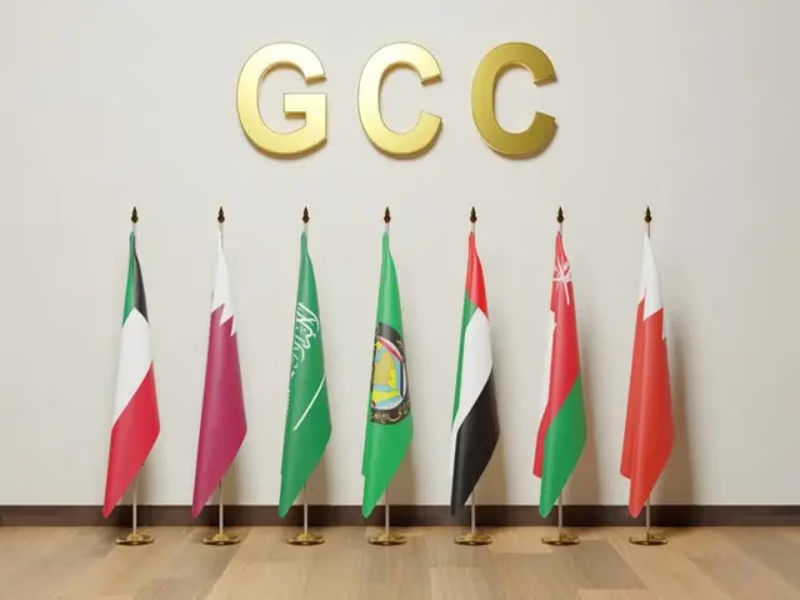
According to an analysis, GCC economies will remain resilient in 2026, supported by robust domestic demand and a generally stable global economy.
In its most recent report, Oxford Economics pointed out that the real gross domestic product of the GCC region is set to grow by 4.4 percent in 2026, compared to the 4 percent that was projected in 2016.
This forecast aligns with the World Bank’s, which predicts GCC growth at 3.2 percent in 2025 and 4.5 percent in 2026. Similarly, the IMF anticipates average GCC economic output growth of 3.3 percent by 2025, up from 1.7 percent in 2024.
Oxford Economics reported that “Growth in the GCC will likely beat our expectations this year following two years of disappointment. US trade policy under President Donald Trump has had no notable impact on regional growth, and non-energy sectors have sustained their robust momentum.”
It has been stated that “Meanwhile, oil production has gradually increased, providing a boost to the region’s economies. We expect GCC growth will rise to 4.4pc in 2026, from 4pc this year.”
Therefore, the GCC Statistical Centre reported in November that the region would experience an economic growth of 4.3 percent in 2027, fueled by the growth of non-oil sectors.
The GCC Statistical Center announced that the economies in the region grew by 3 percent during the first half of this year, with combined GDP increasing to $588.1 billion, compared to $570.9 billion in the same period last year.
However, the non-oil activities contributed 73.2 percent of total GDP, compared to 70.6 percent towards the end of 2024, which shows that the region is still moving towards diversification.
Oxford Economics has forecasted that GCC consumers will perform as the most outstanding consumers in 2026 and will perform better than those in other countries.
Oxford Economics indicated that low inflation has allowed it to shield the increase in real disposable income, which has been strengthened by high demand and extremely low unemployment rates.
The report stated that “We do not envision any let-up, as governments continue to push for greater foreign direct investment in their push to diversify their economies away from oil and gas.”
The IMF reported in October that GCC region inflation is projected to remain at 1.7 percent in 2025 and 2 percent in 2026, highlighting the strength of the bloc against global price pressures.
The IMF further added in December that headline inflation will remain, on average, below 2 percent in Bahrain, Oman, and Qatar, near 2 percent in Saudi Arabia and the UAE, and marginally above 2 percent in Kuwait in 2025–2026.
Oxford Economics predicts that credit growth will continue to be high in the GCC region in 2026 because the availability of financial services is projected to rise, and the further reduction in interest rates is likely to encourage lending.
The report indicated that “Owing to their currency pegs to the US dollar, GCC central banks are expected to follow the US Federal Reserve by easing monetary policy further, which in turn will lower debt servicing costs and boost disposable income and demand.”
The report also identified that the OPEC+ will probably extend the oil output pause to the second quarter of next year, with a slight effect on the growth momentum of the countries in the region.
Oxford Economics said that “The announcement from Opec+ of a pause in the recent re-expansion of oil production came as no surprise, as excess inventories surpassed two million barrels per day.”
It added, “Our forecast has the price of Brent crude oil falling below $60 per barrel in early 2026, which should prompt Opec+ to extend its pause to the second quarter. This is likely to stall the contribution from oil extraction to GDP.”
The report estimated that the GCC nations will resume increasing oil supplies once again in the second half of next year, and a complete unfreezing of the remaining production caps will probably occur in the mid of 2027.
The economy of Qatar is expected to be the most prosperous one in the region, since the country will have significantly grown the production and export of its gas in 2026.
Oxford Economics also quoted that GCC nations are becoming more aware of the need to diversify their economy, and these countries are viewing AI-related industries as strategic opportunities for the region.