

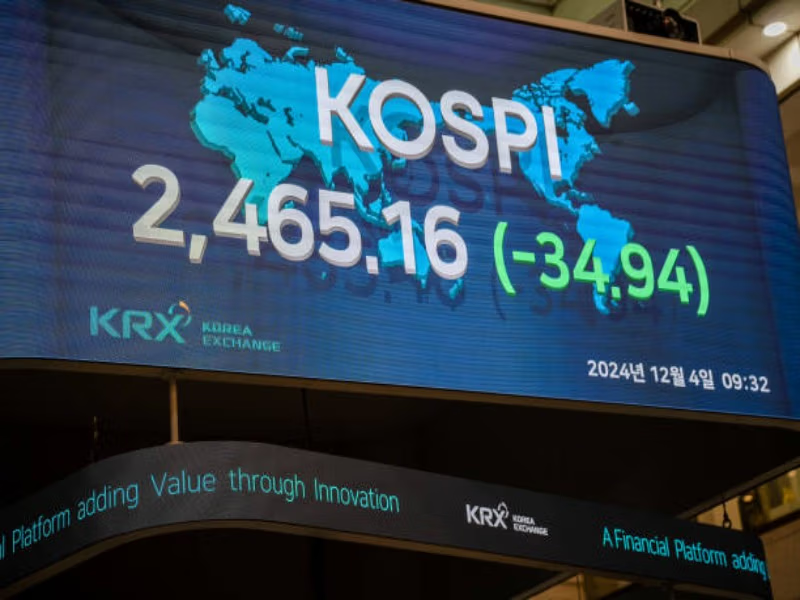
The Kospi of South Korea reached a new record on Friday since Asia-Pacific markets began the new year on a mixed note. Kospi went up 0.65 percent, and it reached a record high.
Heavyweight Samsung Electronics improved by roughly 3 percent following the purported assertion by the company that customers reviewed its high memory bandwidth, or HBM chips. The small-cap Kosdaq surged 1.47 percent.
Other Asian markets were still on holiday, such as Japan and mainland China. South Korea’s markets will open an hour later, at 10 a.m. local time. Australia’s S&P/ASX 200 was high at 0.13 percent.
The Hang Seng index of Hong Kong rose by 1.48 percent, and stocks of educational services are at the top. Artificial intelligence chip designer Shanghai Biren shot more than 100 per cent when it debuted on the HSI on a 5.58 billion ($717 million) in Hong Kong IPO.
Therefore, the public offering was subscribed to more than 2,300 times after the upsize option was exercised, and the international offering was subscribed to 25.95 times.
The fourth quarter has seen Singapore grow its economy by 5.7 percent per year, with the booming manufacturing in the three months up to December being the main driver. The current reading is higher than the re-read, a 4.3 percent gain in the last quarter.
Prime Minister Lawrence Wong announced on Wednesday in his New Year message that the nation had recorded a higher-than-anticipated 4.8 percent growth throughout the entire year of 2025.
U.S. stock futures were also performing well during the early Asian hours as the S&P futures increased by 0.15 percent and the Nasdaq -100 futures rose by 0.12 percent. The Dow Jones Industrial Average futures increased by 0.16 percent.
However, the S&P 500 declined 0.74 percent on Wednesday stateside, whereas the Nasdaq Composite declined 0.76 percent and the Dow Jones Industrial Average declined 0.63 percent. The S&P 500 still rose by 16.39 percent year to date.
The Nasdaq Composite capitalized on AI enthusiasm with a 20.36 percent gain, and the Dow gained 12.97 percent in 2025, with a minor disadvantage in not having tech representation.