

The United States has carried out a major operation in Venezuela, capturing President Nicolás Maduro and flying him out of the country. While details are still emerging, the move immediately raises questions about the future of Venezuela — and its massive oil reserves, which hold the potential to reshape global energy markets.
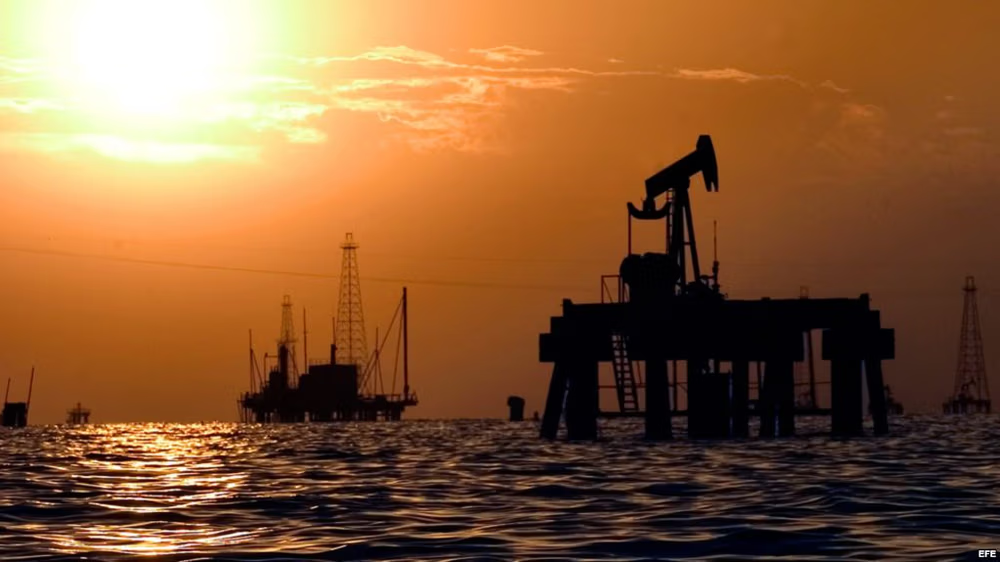
Venezuela sits atop 303 billion barrels of proven crude, roughly one-fifth of global reserves, according to the U.S. Energy Information Administration (EIA). Yet despite this wealth, the country produces barely a fraction of its potential. Its oil output today stands at about 1 million barrels per day, less than a third of the 3.5 million barrels it pumped before Maduro’s socialist government consolidated power in 2013.
The decline reflects a mix of factors: sanctions, economic crises, underinvestment, and deteriorating infrastructure, according to the EIA. Even if Venezuela’s supply were fully removed from global markets, experts note the immediate impact on oil prices may be limited because the country’s current output is relatively small.
Why Oil Prices Might Stay Steady
Oil futures do not trade over the weekend, making immediate price predictions difficult. But analysts note that Venezuela’s current production is too low to move markets dramatically, even after a major political upheaval.
Global oil markets have been under pressure this year from oversupply concerns and softer demand, driven by high inflation and affordability issues following post-pandemic price shocks. OPEC has increased output, and US oil recently stabilized near $57 per barrel, despite earlier spikes when the Trump administration began seizing Venezuelan shipments.
Phil Flynn, senior market analyst at Price Futures Group, told CNN, “If indeed this continues to go smoothly — and it looks like a masterful operation so far — and US companies are allowed to go back and rebuild the Venezuelan oil industry, it could be a game-changer for the global oil market.”
Maduro’s Departure Could Create a Power Vacuum
While Maduro’s removal marks a dramatic political shift, the immediate path forward remains unclear. Vice President Delcy Rodríguez, a long-time member of the socialist regime, could temporarily assume control, maintaining much of the current status quo.
At the same time, the U.S. recognizes Edmundo Gonzalez as Venezuela’s rightful president, backed by 2025 Nobel Peace Prize winner María Corina Machado. A transition to a pro-market government could fundamentally alter the country’s oil policy, potentially opening the sector to international investment for the first time in years.
The Opportunity of Venezuelan Crude
Venezuela’s oil is heavy, sour crude, which requires specialized equipment and expertise to refine. Unlike US light, sweet crude, heavy crude is essential for diesel, asphalt, and industrial fuels, which remain in tight supply in many parts of the world due in part to sanctions on Venezuelan oil.
International oil companies have the technical capability to produce and refine Venezuela’s crude but have faced legal and political restrictions for years. Unlocking this potential could have far-reaching implications for global energy markets, particularly for diesel and other heavy products.
What Investors Should Watch
In the near term, oil markets may remain relatively calm. But the long-term implications are substantial:
- Political uncertainty: Who controls Venezuela’s government will determine whether oil policies remain restrictive or become investment-friendly.
- Global supply potential: Venezuela’s untapped 303 billion barrels could alter the balance of energy markets if production is modernized.
- Strategic oil products: Heavy crude is vital for diesel and industrial fuels — sectors where shortages persist worldwide.
For investors and energy analysts, the U.S. strike is more than a headline. It is a potential pivot point in global oil supply, political risk, and market strategy — especially for those watching the interplay between geopolitics and energy markets.
As Venezuela navigates its next chapter, oil prices may not spike immediately, but the long-term stakes for both the country and the world’s energy markets are enormous.