

An annual report by venture capital firm Beyond Earth Ventures shows that the space economy in the Middle East has reached a turning point in 2025, with ambition turning into execution in areas of regulation, infrastructure, satellite programmes, and involvement of the private sector.
The report, The Middle East Space Economy: 2025 Review and 2026 Outlook, reported that the governments, sovereign-backed organizations, and private operators in the region shifted to continuity, commercialization, and governance, rather than isolated flagship projects.
MENA General Partner at Beyond Earth Ventures, Viktor Shpakovsky, said, “In 2025, governments, sovereign-backed entities, and private operators across the Middle East shifted from isolated flagship projects to a focus on continuity, commercialisation, and governance.”
He added that the region is constructing interconnected ecosystems that connect regulation, launch capabilities, satellite services, talent development, and international partnerships.
The report discusses developments in satellite launches and missions in operation by the UAE, deep-space and lunar programs, including the Emirates Mission to the Asteroid Belt and Rashid Rover 2, and sovereign launch capabilities in the UAE and Oman.
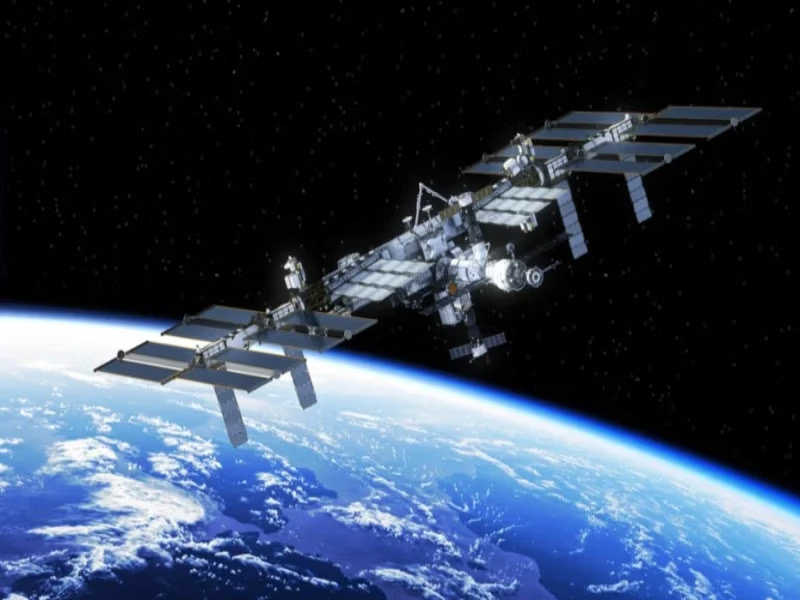
It also points out such developments in technology as AI-powered satellites, 3D-printed engines and near-space platforms, and human spaceflight achievements, space research on board the International Space Station, and increased collaboration with partners in the United States, Europe, and Asia.
Participation by the private sector, start-up activity, and deep-tech investment are among the focus elements in the evaluation, as well as talent development, STEM education, and constructing multi-node economic infrastructure, including manufacturing, launch, services, and innovation.
Beyond Earth Ventures forecasts that in 2026, with reference to 2025, the groundwork will have been established in 2025 and can facilitate faster growth in 2026, as regulation becomes clearer, more services are commercialized, and more funds are privately invested into satellite services.
The report added that the orientation towards global trends, such as AI-driven satellite activities, mega-constellations, reusable launch systems, advanced Earth observation, and new manufacturing opportunities in orbit, will make the region stronger in the global space economy.