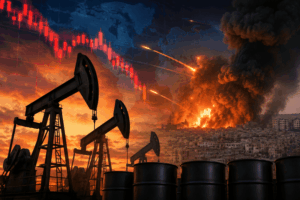

The Strait of Hormuz comes back into the spotlight with the possibility of the U.S. intervention in Iran, increasing the possibility of Tehran interfering with one of the world’s most important energy chokepoints.
U.S. President Donald Trump is also contemplating various alternatives towards Iran, as outlined in several media outlets on Sunday, as it suppressing on domestic demonstrations.
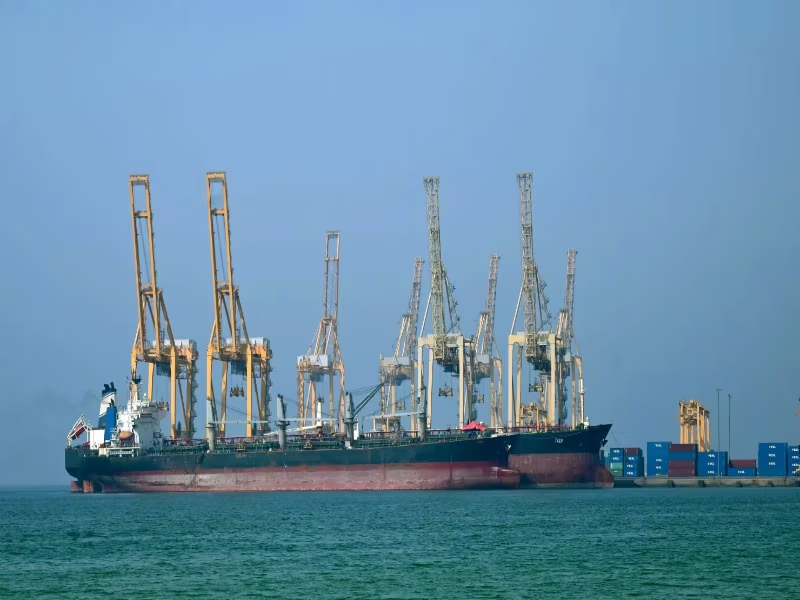
Experts in the industry warned that military confrontation would trigger an Iranian effort to close the Strait of Hormuz, a narrow waterway that connects the Persian Gulf and the Arabian Sea and through which nearly a third of the world’s seaborne crude flows.
Head of Energy Research at MST Marquee, Saul Kavonic, stated that “A disruption through the Strait of Hormuz could cause a global oil and gas crisis,” especially when considering the “desperate and ill-advised lengths the current Iranian regime may go to,” they might find themselves increasingly backed into a corner with the power and lives at stake.
Data provided by market intelligence firm Kpler reported that approximately 13 million barrels per day of crude oil transited the Strait of Hormuz in 2025, which constitutes about 31 percent of the worldwide seaborne crude flows.
Therefore, the risk of the waterway being congested had also emerged in the outburst between Washington and Tehran in June last year.
Senior crude Analyst at Kpler, Muyu Xu, added that since the production and exports of Iran are significantly larger than those of Venezuela, the ripple effects would inevitably be felt more globally, citing that the Chinese refiners would have no choice but to find alternatives.
President of Rapidan Energy Group, Bob McNally, said that in contrast to Venezuela, any military activity against Iran would pose materially greater risks based on the amount of the exposure of crude and refined products supply and transit, which estimates a 70 percent probability of selective U.S. attacks on Iran.
Analysts reported that in a severe escalation situation, in which tankers cannot pass or energy facilities are destroyed, oil prices would increase in the double digits.
President of Lipow Oil Associates, Andy Lipow, stated that “The fear of a closure will cause the price of oil to rise a few dollars per barrel, but it is the complete closure of the Strait that can result in a $10 to $20 per barrel spike.”
Kavonic envisions an “immediate oil price spike” following any U.S. attack on Iran, but it will ease on any indication that the disruption would be temporary.
Therefore, the global benchmark Brent when last hovered around 63 a barrel, with U.S. West Texas Intermediate futures at 59 per barrel. The majority of analysts emphasise that any disastrous results are still events with low probability.
Kpler’s Xu added that although Iran can always threaten to close the Strait of Hormuz, it might not desire to close it fully, considering the complexity of power relations in the area and the potential inability to close it completely, considering the U.S. Navy is cruising the area.
In a case where Iran is trying to disrupt supply temporarily, whether by harassing tankers or temporarily obstructing transit, the actual physical effect would be minimal.
Kpler estimates the oil market is now leaning toward oversupply, with an estimated 2.5 million barrels per day of excess supply in January, and more than 3 million barrels per day in February and March.
Kavonic indicated that any such shutdown will probably be encountered by the U.S. and allies using force to resume flows once more. Analysts advised against making direct comparisons of Iran to Venezuela, where the Trump administration applied pressure on the Venezuelan government through sanctions, seizures, and then seized President Nicolás Maduro.
Xu reported that the U.S. would struggle so hard to pursue a similar approach to Iran like Venezuela, since Iran is not within its territory, and the geopolitical environment in the Middle East is much more complicated than it is in Latin America.
He further added, “Plus, Trump’s priority right now appears to be consolidating U.S. power in the Western Hemisphere.”
Lipow shared that sentiment, noting that a Venezuela-style playbook in Iran is more apt to feature sanctions and enforcement than military occupation or infrastructure attacks.