

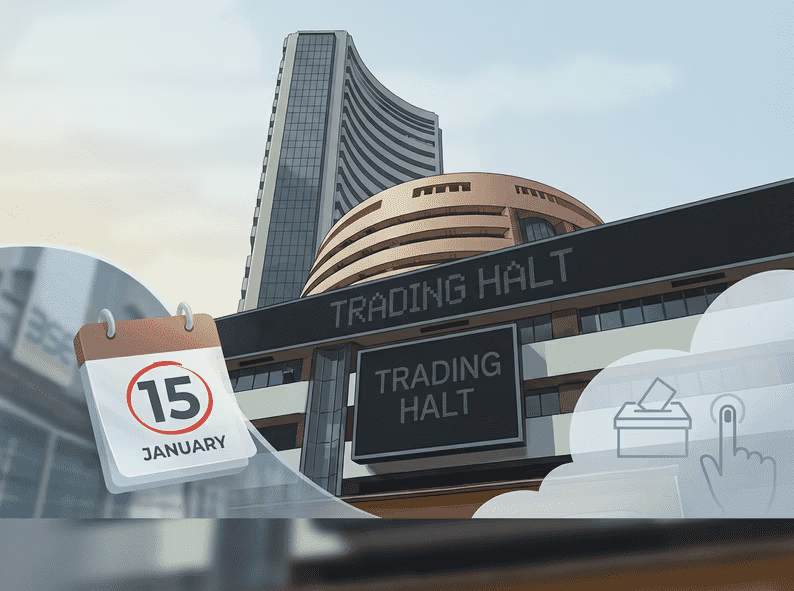
India’s equity markets will take an unscheduled pause this week, not because of global volatility or policy shocks, but due to local democracy at work.
Stock exchanges across the country will remain closed for trading on January 15 following the Maharashtra government’s decision to declare a public holiday for municipal corporation elections, including the high-stakes polls for the Brihanmumbai Municipal Corporation (BMC).
The closure affects all major market segments and has prompted changes to derivatives expiry timelines, making it a key date for traders and investors to track.
Markets to Remain Shut Across Segments
The Bombay Stock Exchange (BSE) announced in a circular that no trading will take place on January 15 in the equity segment, equity derivatives, commodity derivatives, and electronic gold receipts.
The exchange further clarified that equity derivatives contracts scheduled to expire on January 15, 2026, will now expire a day earlier on January 14, 2026. BSE said these changes will be reflected in the end-of-day contract master files released today.
The National Stock Exchange (NSE) also revised its earlier communication, confirming that January 15 will be observed as a trading holiday for both the capital market segment and futures and options (F&O).
Why January 15 Is a Market Holiday
The shutdown follows the Maharashtra government’s decision to declare January 15 a public holiday under the Negotiable Instruments Act, 1881, to ensure the smooth conduct of elections across 29 municipal corporations, including Mumbai City and Mumbai Suburban districts, which fall under the BMC.
The notification was issued under Section 25 of the Negotiable Instruments Act, exercising powers delegated to the state government by the Ministry of Home Affairs in 1968.
Elections for the BMC, one of India’s most influential civic bodies in terms of political and administrative power, along with 28 other municipal corporations, will be held on January 15, with vote counting scheduled for January 16.
From Settlement Holiday to Full Trading Halt
Last week, both stock exchanges had indicated that January 15 would be observed as a settlement holiday, implying that trading could continue while clearing and settlement would be deferred.
However, that guidance has now been amended.
Settlement holidays are typically declared during elections or major public events that disrupt banking and clearing operations. With January 15 designated as a state-wide public holiday, most banks in Maharashtra will remain closed, making normal settlement impossible. As a result, exchanges opted for a full trading holiday instead.
How Many Market Holidays in 2026?
With the latest update, Indian stock exchanges will be closed for a total of 16 days in 2026.
January 26 will mark the second market holiday of the year.
Other notable holidays in the first half of 2026 include:
- Holi on March 3
- Ram Navami on March 26
- Mahavir Jayanti on March 31
- Good Friday on April 3
- Ambedkar Jayanti on April 14
- Maharashtra Day on May 1
- Bakri Id on May 28
Market Snapshot: Indices End Volatile Session Higher
Ahead of the holiday announcement, Indian equity benchmarks ended Monday’s session on a positive note, snapping a five-day losing streak in a volatile trading environment.
The Nifty 50 closed near 25,800, recovering sharply intraday to finish close to the day’s highs.
At the close, the Sensex rose 301.93 points, or 0.36 percent, to 83,878.17, while the Nifty 50 gained 106.95 points, or 0.42 percent, to settle at 25,790.25.
What Investors Should Watch
With trading halted mid-week, investors will need to factor in the holiday while planning derivatives positions, settlements, and portfolio adjustments. The shift in expiry timelines and the temporary pause in liquidity could also influence short-term trading strategies once markets reopen.
For now, all eyes are on January 16, when election results roll in and markets return to business as usual.