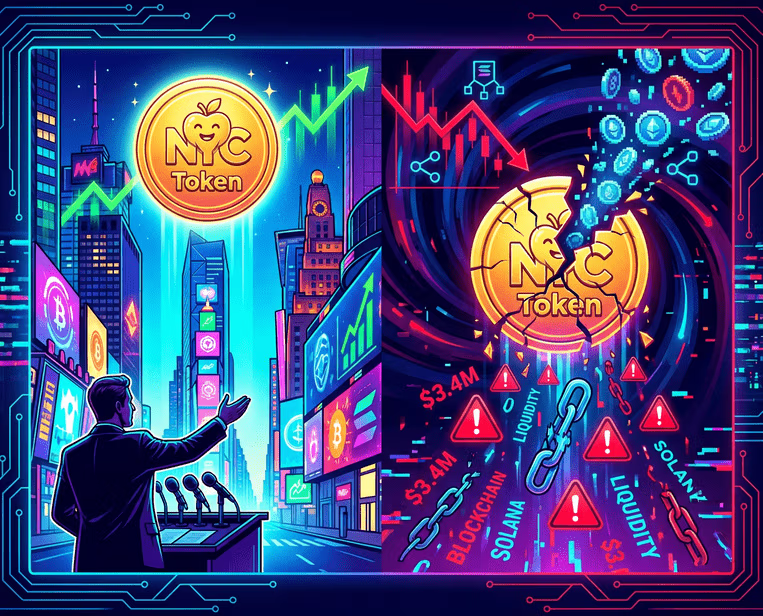
A meme coin backed by a former New York City mayor. A launch at Times Square. A market cap that briefly touched $600 million, and then collapsed.
That is the sequence of events now placing Eric Adams, New York City’s former mayor and a vocal crypto advocate, at the center of a growing controversy in the digital asset world.
Adams is facing allegations that a meme coin he publicly promoted, known as NYC Token, experienced a suspicious liquidity drain resembling a classic crypto “rug pull,” with as much as $3.4 million feared to be at risk, according to on-chain data analysts.
While Adams has not yet publicly responded to the allegations, the episode is raising fresh questions about political figures promoting speculative crypto assets, and about investor protections in the meme coin economy.
The Rise And Sudden Fall Of NYC Token
Eric Adams unveiled NYC Token earlier this week during a press event at Times Square, one of the most visible launchpads imaginable.
Speaking at the event, the 65-year-old Democrat said the token would be used to “fight antisemitism and anti-Americanism.” The message resonated quickly with traders.
According to data reported by Bubblemaps, an on-chain intelligence and token analysis firm, NYC Token’s market capitalization surged rapidly, peaking at around $600 million, reflecting strong early demand and speculative interest.
Within hours of its peak, the token experienced large and unexplained liquidity movements, triggering alarm across crypto-tracking platforms. The market capitalization soon plunged to below $100 million, wiping out a significant portion of investor value.
What On-Chain Data Shows
Bubblemaps flagged wallet activity linked to the token’s deployer that has become central to the controversy.
According to the firm’s analysis:
A wallet connected to the NYC Token deployer removed approximately $2.5 million in USDC from the liquidity pool when the token was near its peak valuation.
After the token fell by roughly 60 percent, about $1.5 million in USDC was added back.
By earlier today, Bubblemaps said the liquidity movements remain unexplained, raising concerns about transparency and governance.
In the crypto world, such activity often raises fears of a rug pull, a scam in which insiders artificially inflate a token’s price before withdrawing liquidity, leaving retail investors holding near-worthless assets.
Allegations Mount, Denials Follow
As speculation spread on social media and crypto forums, the official X (formerly Twitter) account representing NYC Token denied any wrongdoing, rejecting allegations of a rug pull.
However, Eric Adams himself has not yet addressed the situation publicly. Notably, he has also not removed a promotional video for NYC Token from his official account.
In the video, Adams wrote:
Proud to launch @buynyctoken, a new token built to fight the rapid spread of antisemitism and anti-Americanism across this country and now in New York City.
Critics argue that the absence of a public response from Adams has only fueled investor uncertainty.
Is NYC Token Officially Linked to New York City?
The token’s own website explicitly distances itself from any government affiliation.
It states: “NYCTOKEN is not affiliated with, endorsed by, or connected to the City of New York, any government agency, or any official New York City organization. This is a community-driven project created by independent developers.”
That disclaimer contrasts sharply with the optics of a Times Square launch and promotion by a sitting mayor at the time.
Tokenomics: How NYC Token Was Structured
According to the project’s official disclosures:
Total supply: 1 billion tokens
Day-one tradable supply: 80 million tokens
Planned circulating supply: To expand to 300 million tokens over 36 months
Reserve allocation: “70 percent of the total token supply (700,000,000 $NYC) is allocated to the NYC Token Reserve and is not part of the planned circulating supply.”
The website also clarifies: “$NYC does not represent equity, ownership, or a right to distributions.”
Funds were intended to support creators, liquidity pools, and charitable initiatives, according to project materials.
A Crypto-Friendly Mayor, Now Facing Crypto Backlash
Eric Adams served as New York City’s 111th mayor from January 2022 to December 2025 and built a reputation as one of the most crypto-friendly political leaders in the United States.
He famously took his early mayoral paychecks in Bitcoin and Ethereum and, in October last year, launched New York’s first Office of Digital Assets and Blockchain, signaling his ambition to position the city as a global crypto hub.
That history makes the NYC Token controversy particularly consequential, not just for Adams personally, but for broader debates around political endorsement, crypto ethics, and investor protection.