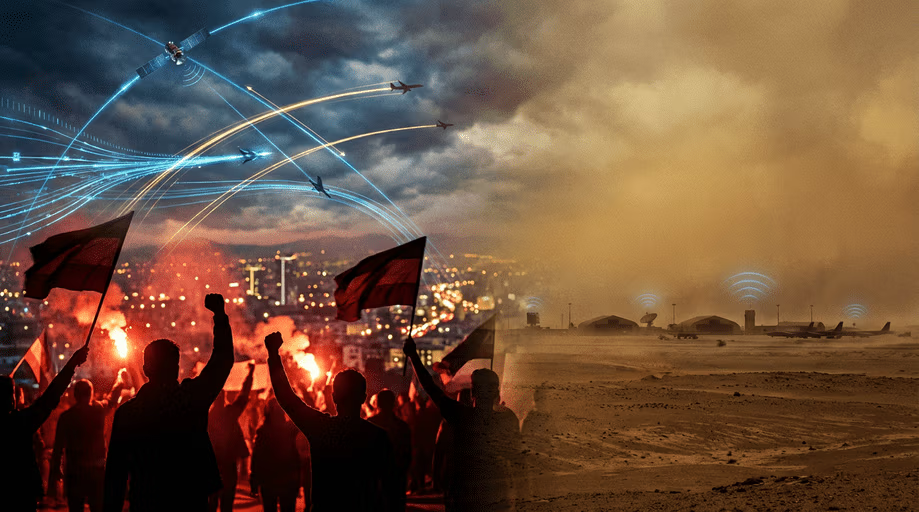
As protests spread across Iran and regional tensions raise alarms from airline routes to U.S. military bases, Tehran is pushing back forcefully, accusing foreign powers of inflaming unrest and warning against outside interference in its internal affairs.
Iran’s government has framed the unrest not only as a domestic security challenge but as part of a wider geopolitical confrontation involving the United States and its allies, a narrative that is increasingly shaping diplomatic, military and commercial decisions across the Middle East.
Iran Accuses Foreign Actors of Stoking Violence
Iran’s Foreign Minister Abbas Araghchi accused “foreign actors” of turning initially peaceful protests violent and condemned what he described as “the interventionist and provocative policies of U.S. officials” toward Iran.
According to Iran’s state news agency IRNA, Araghchi made the remarks during a phone call late Wednesday with India’s External Affairs Minister Subrahmanyam Jaishankar. Araghchi stressed what he described as the unity and determination of the Iranian people to defend the country’s independence and sovereignty.
Jaishankar, according to IRNA, emphasised the need for comprehensive efforts to preserve stability and prevent tensions from escalating further, adding that India stood ready to support initiatives aimed at maintaining regional calm.
Trump Signals Restraint, Urges Iran to Avoid Escalation
Even as rhetoric sharpened publicly, Iranian officials signalled that private messages from Washington struck a more cautious tone.
Iran’s envoy to Pakistan, Reza Amiri Moghadam, told Pakistani media outlet Dawn that U.S. President Donald Trump had conveyed he did not intend to attack Iran and had urged Tehran to exercise restraint. Moghadam said he received the message around 1am Pakistan time (20:00 GMT) on Wednesday.
According to the envoy, Trump asked Iran not to target U.S. interests in the region, signalling a desire to avoid open conflict despite heightened military posturing in recent weeks.
Moghadam added that Iranians had a legitimate right to protest and said the government had engaged in talks with demonstrators. He also said armed groups were responsible for killings inside Iran and for attacks on mosques, according to the Dawn report.
Airlines Reroute Flights as Airspace Risks Persist
The unrest and military tension have had immediate commercial consequences.
European airlines continue to avoid flying over Iran, even after Tehran reopened its airspace following an earlier closure of nearly five hours. Airlines are also steering clear of neighbouring Iraq, Reuters reported, citing flight-tracking data.
British Airways, Wizz Air, Lufthansa and TUI are among the carriers rerouting flights to mitigate regional risks amid fears of potential U.S. military action against Iran.
“We avoid Iraqi and Iranian airspaces, therefore some westbound flights from Dubai and Abu Dhabi airports will have to make [refuelling and crew change] stops in Larnaca, Cyprus or Thessaloniki, Greece,” a Wizz Air spokesperson told Reuters.
Such diversions add cost and complexity to airline operations, with knock-on effects for fuel consumption, scheduling and ticket pricing.
US Military Presence in Qatar Adjusts Amid Tensions
Military movements have also reflected the shifting risk environment.
The security warning level at Qatar’s Al Udeid airbase, the largest US military facility in the Middle East, has been lowered after being elevated earlier in the week, Reuters reported, citing three sources briefed on the situation.
Some US personnel had temporarily left the base after repeated warnings from Washington that it was considering striking Iran, and counter-threats from Tehran that it would respond by targeting US bases in the region.
Two diplomatic sources told Reuters that some staff previously advised to leave Al Udeid had since been allowed to return. Another source said US aircraft that had been moved out as a precaution were gradually being brought back.
Roughly 10,000 U.S. military personnel are stationed at the base, which serves as the forward headquarters of US Central Command.
Trump Welcomes “Good News” on Iranian Protester Case
President Trump also weighed in publicly on developments inside Iran, welcoming what he described as “good news” after posting on social media that an Iranian protester would no longer face the death penalty.
“An Iranian protester will no longer be sentenced to death after President Trump’s warnings,” Trump wrote, adding: “This is good news. Hopefully, it will continue.”
The comments appeared to refer to the case of Erfan Soltani. Iran’s judiciary has denied that Soltani was ever sentenced to death, and Araghchi has also denied that Tehran plans to execute anti-government protesters.
Araghchi’s remarks followed Trump’s claim that he had received assurances killings of demonstrators had stopped.
Why Al Udeid Matters
The easing of precautions at Al Udeid comes against the backdrop of a serious escalation last year.
In June, Iran launched short- and medium-range ballistic missiles at the base in retaliation for a US strike on Iranian nuclear sites, carried out in support of Israel’s 12-day military campaign against Iran. The attack caused no casualties.
The 24-hectare base, established in 1996 southwest of Doha, plays a central role in U.S. military operations across a vast region stretching from Egypt to Central Asia.
Following last year’s attack, Qatar temporarily closed its airspace, citing the need to protect residents and visitors, a reminder of how quickly geopolitical shocks can disrupt global transport and markets.
A Region on Edge
As Iran pushes back against foreign pressure and Washington signals restraint without de-escalation, the situation remains fluid.
For investors, airlines and regional governments alike, the unrest underscores how domestic protests in Iran can quickly spill into diplomatic standoffs, military repositioning and economic disruption — keeping the Middle East firmly on edge.