
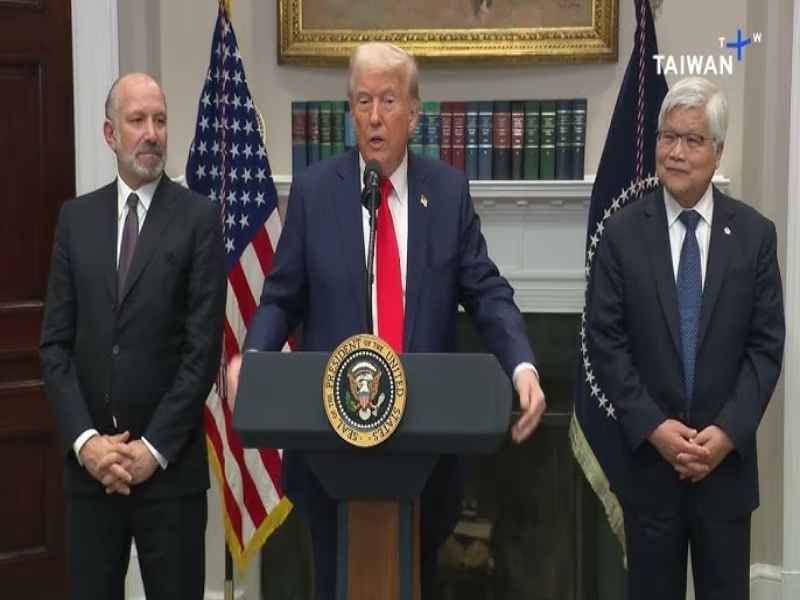
The Department of Commerce announced on Thursday that the U.S and Taiwan have come into a trade deal to construct chips and chip factories on American soil.
Under the deal, Taiwanese chip and technology firms will make at least a $250 billion investment in the U.S. manufacturing capacity, and the Taiwanese government will ensure that these firms receive $250 billion in credit.
The U.S., in exchange, will restrict the “reciprocal” tariffs on Taiwan to 15 percent, dropped from 20 percent, and will promise zero reciprocal tariffs on generic pharmaceuticals, their ingredients, aircraft components, and some natural resources.
Commerce Secretary Howard Lutnick informed CNBC’s Brian Sullivan in an interview on Thursday that the Taiwan Semiconductor Manufacturing Co. has purchased land and may even expand in Arizona as part of this deal.
Lutnick said, “They just bought hundreds of acres adjacent to their property. I’ll let them go through with their board and give them time.”
A spokesperson of TSMC stated to CNBC that “Regarding TSMC’s plans, the market demand for our advanced technology is very strong, we continue to invest in Taiwan and expand overseas, all the investment decisions are based on market conditions and customer demands.”
The announcement further indicated that future tariffs made using the Section 232 framework will exclude certain companies that are constructing chips within the U.S. Taiwanese firms constructing new U.S. chip fabs, including TSMC, will be capable of importing up to 2.5 times the capacity they are constructing at the time of the factories being constructed without payment of tariffs under the framework.
Therefore, the announcement also added that Taiwanese auto parts, lumber, and related products will not have to pay tariffs exceeding 15 percent under Section 232. Commerce said that when the factories are completed, businesses will be able to import 1.5 times what they would have produced in the United States.
The trade deal offers certainty to the chip firms and technology companies, which have been confused over the course of the last year with the Trump administration regarding changes in tariffs within the semiconductor sector.
It also encourages TSMC, the largest fab company in the world, to further establish more plants on American soil, even as it becomes apparent that it is still able to produce chips on behalf of U.S. companies in Taiwan.
TSMC representative reported in a statement, “As a semiconductor foundry serving customers worldwide, we welcome the prospect of robust trade agreements between the United States and Taiwan.”
During the interview, Lutnick added that Taiwan-based chip firms that do not manufacture in the U.S would likely face a 100 percent tariff. He claimed that the government was aiming to transfer 40 percent of Taiwan Semiconductor’s supply network to the U.S.
Lutnick indicated, “That’s what they get if they don’t build in America, the tariff’s likely to be 100%.”
TSMC has already established facilities in Arizona, spending up to $40 billion to produce chipsets for companies such as Apple and Nvidia with grants of U.S. government money previously under the CHIPS Act.
The fight to control access to artificial intelligence semiconductors has emerged as a major topic on the geopolitical agenda of the U.S. government, which has prioritized American production of leading-edge chips.
U.S. officials have also reported that there is a high risk to the U.S. economy in the event of an invasion of China into Taiwan and its ability to cut off access to TSMC chips.
Lutnick added, “We’re going to bring it all over so we become self-sufficient in the capacity of building semiconductors.”