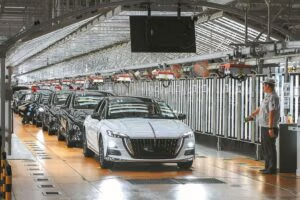

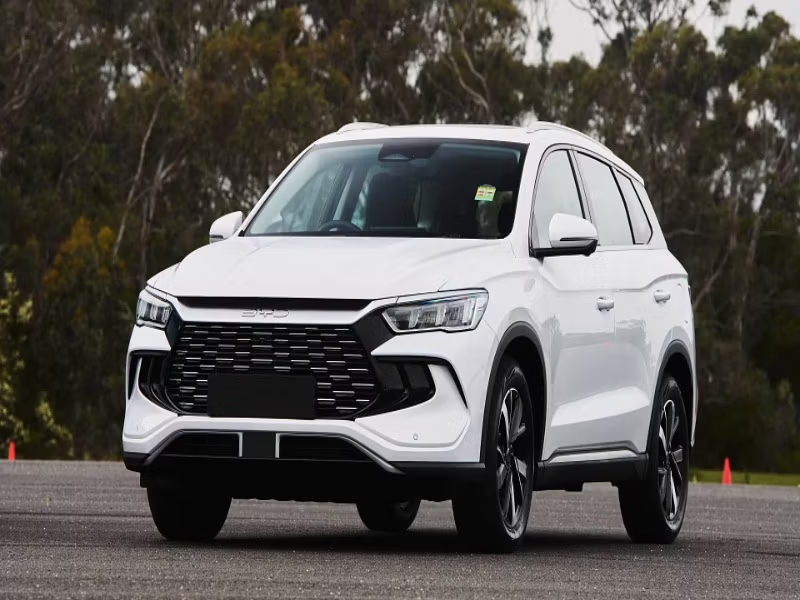
Canada and China had the first trade agreement on Friday, which will cut tariffs on electric vehicles and canola, as the two countries pledged to dismantle trade barriers and establish new strategic relationships during the Prime Minister’s visit to Canada by Mark Joseph Carney.
The first Canadian prime minister to visit China since 2017, aims to re-establish relationships with the second-largest trading partner of his country after the United States, following months of diplomatic talks.
Carney stated after talks with Chinese leaders, including President Xi Jinping, that Canada will initially allow in up to 49,000 Chinese electric vehicles at a tariff of 6.1 percent on most-favored-nation terms.
That will be in contrast to the 100 percent tariff on Chinese electric vehicles introduced under former Prime Minister Justin Trudeau in 2024, after comparable U.S. penalties. Therefore, China exported 41,678 EVs to Canada in 2023.
Carney informed reporters that “This is a return to levels before recent trade frictions, but under an agreement that promises much more for Canadians.” He added later that the quota would go up slowly, with an average of 70,000 vehicles in five years.
“For Canada to build its own competitive EV sector, we will need to learn from innovative partners, access their supply chains, and increase local demand,” Carney said, turning away from Trudeau’s rationale that tariffs were required to protect domestic producers against subsidized Chinese manufacturers.
The move to remove EV tariffs was against U.S. policy, and a few members of the U.S. President Donald Trump cabinet criticized the move before a review of the U.S.-Canada-Mexico trade deal was expected.
However, Trump himself expressed support for Carney. Trump stated to reporters at the White House, “That’s what he should be doing. It’s a good thing for him to sign a trade deal. If you can get a deal with China, you should do that.”
Meanwhile, the Premier Doug Ford of Ontario, Canada’s main auto manufacturing province, denounced the agreement.
In a post on X (formerly known as Twitter), he added, “The federal government is inviting a flood of cheap made-in-China electric vehicles without any real guarantee of equal or immediate investments in Canada’s economy, auto sector or supply chain.”
As a response to the tariffs issued by Trudeau, China in March imposed tariffs on over $2.6 billion of Canadian farm and food items, including canola oil and meal, after which it imposed tariffs on canola seed in August.
However, that led to a 10.4 percent surge in China’s imports of Canadian goods in 2025. In the new deal, Canada anticipates that China will reduce tariffs on its canola seed by March 1, to an integrated rate of approximately 15 percent of the present 84 percent.
Canada also anticipates anti-discrimination tariffs to be removed on its canola meal, lobsters, crabs, and peas on March 1, at least until the end of the year. Canadian canola contracts increased.
Carney reported that the agreements will open up close to $3 billion worth of Canadian farmers, fish harvesters, and processors’ export orders. In a statement that China issued, the Commerce Ministry stated that China was modifying anti-dumping rules on canola and anti-discrimination rules on certain Canadian agricultural and aquatic goods in reaction to a cut of EV tariffs in Canada. Carney also indicated that Xi pledged visa-free entry to Canadians visiting China, though he did not state the specifications.
According to a statement released by the state-operated Xinhua news agency, China and its counterpart committed to resuming high-level economic and financial discussions, expanding trade and investment, and enhancing their collaboration in agriculture, oil, gas, and green energy.
Carney indicated that Canada will more than double its energy grid in the next 15 years, and it offered Chinese opportunities in the investments, such as offshore wind.
He further added that Canada was increasing its LNG exports to Asia and that it will supply 50-million tonnes of LNG every year, all to Asian markets, by 2030.
“Given current complexities in Canada’s trade relationship with the U.S., it’s no surprise that Carney’s government is keen to improve the bilateral trade and investment relationship with Beijing, which represents a massive market for Canadian farmers,” said Beijing-based Trivium China’s Even Rogers Pay.
Trump has already put tariffs on certain Canadian products and hinted that the long-standing U.S ally would be the 51st state of the country. China, which was also targeted by tariffs imposed by Trump, is eager to collaborate with a Group of Seven country in a traditional area of influence of the U.S.
“In terms of the way our relationship has progressed in recent months with China, it is more predictable, and you see results coming from that,” Carney said when asked if China was a more predictable and reliable partner than the U.S.
Carney also said he had discussions with Xi about Greenland. “I found much alignment of views in that regard,” he added.
In recent days, Trump has repeated his assertion of the semi-autonomous Danish region, as NATO members have scrambled to respond to U.S. criticism that Greenland is under-secured.
Analysts added that the rapprochement between Canada and China would alter the political and economic environment within which Sino-U.S. competition is playing out, though Ottawa will not radically shift the relationship with Washington.
Sun Chenghao, a member at Tsinghua University’s Centre for International Security and Strategy, said, “Canada is a core U.S. ally and deeply embedded in American security and intelligence frameworks.”He added, “It is therefore very unlikely to realign strategically away from Washington.”