

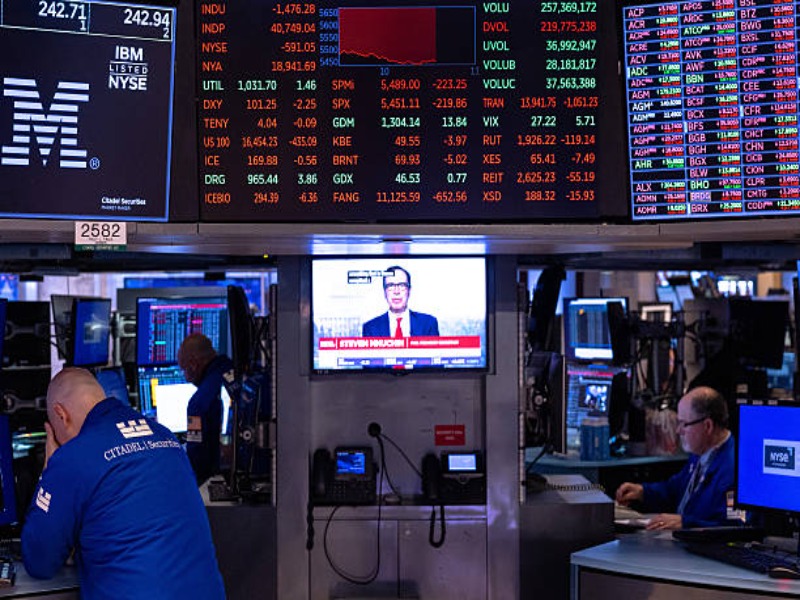
The S&P 500 closed on Friday slightly below the flatline and reported a negative week as traders considered the most recent remarks by President Donald Trump regarding the Federal Reserve and geopolitics.
The broad market index dropped 0.06 percent and ended at 6,940.01. The Nasdaq Composite inched down 0.06 percent to end at 23,515.39. The Dow Jones Industrial Average dropped 83.11 points, or 0.17 percent, to end at 49,359.33.
The three main averages reached their session lows following Trump’s statements in the White House on Friday, as the president stated he would prefer that National Economic Council Director Kevin Hassett remain in his present position and that he may not be nominated to be the next chairman of the Federal Reserve.
Trump said, “I actually want to keep you where you are, if you want to know the truth.”
Hassett was considered as a candidate to be named as a replacement for Fed Chair Jerome Powell, whose term will end in May, but prediction markets had the former Fed Governor Kevin Warsh leapfrog ahead of his other competitors following the president’s comments.
Hassett is regarded as being more market-friendly than Powell, which traders believe should replace Powell, and Wall Street anticipates that Hassett will be more accommodating than Warsh to maintain low rates.
David Krakauer, Vice President of Portfolio Management at Mercer Advisors, added, “Whether it’s Hassett or someone else, I think the assumption that we — at least most of us — have is that whoever it’s going to be, this person is going to certainly have a political motive and not the more traditional, trying-to-be-fully-objective mindset in regards to leading the Fed. That threat to the independence of the Fed is certainly, you know, a concern for us and everyone.”
The major averages are ending a winning session on the strength of gaining chip stocks. Taiwan Semiconductor was in the lead following a blowout fourth-quarter report.
Moreover, the U.S. and Taiwan had signed an agreement of trade according to which Taiwanese chip and technology firms will invest at least $250 billion in production facilities in America.
However, the Taiwan Semi and other chip stocks such as Broadcom and Advanced Micro Devices rose on Friday. The weak performance of bank stocks in the weekly period was in spite of the high earnings because of the concerns that Trump had called for the reduction of the maximum interest rate on credit cards.
JPMorgan Chase and Bank of America were among the laggards, slipping 5 percent each on the week. Investors have been struggling with a list of Washington headlines that have been both worrying about threats to the independence of the Fed, and have been increasing the risk of geopolitical tensions in Iran and Greenland.
Geopolitical risk was exacerbated on Friday after Trump claimed that he might impose tariffs on countries “if they don’t go along with Greenland.”
During the week, the S&P 500 declined by 0.4 percent, and the 30-stock Dow declined by 0.3 percent. Nasdaq decreased by 0.7 percent on the week.