

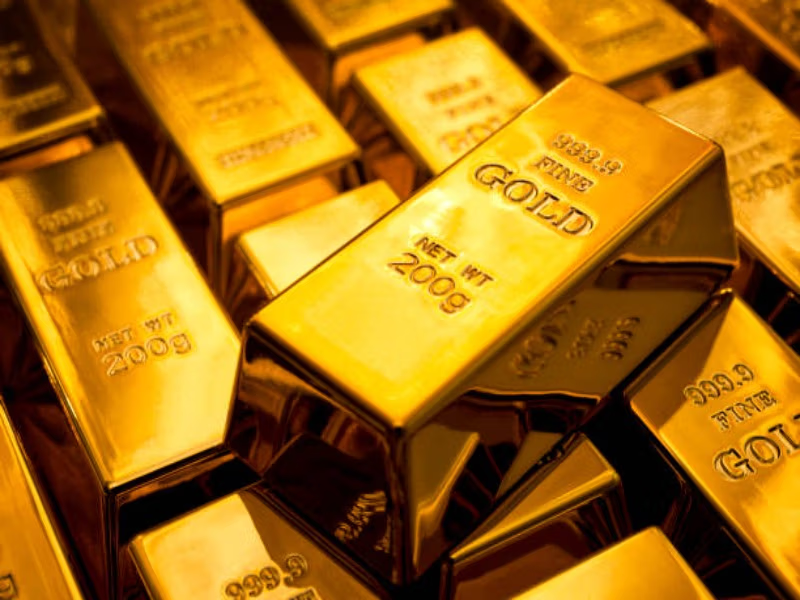
Gold prices surged with unprecedented momentum in 2026, creating mounting confidence in global markets that the precious metal is about to explode to the psychologically significant next plateau of above the $5,000-an-ounce mark.
Following a spectacular 64 per cent gain last year and a gain of over 6 per cent in the first two weeks of the new year alone, the bullion has become not just a conventional defensive hedge, but the centerpiece of a new geopolitical risk-driven, monetary-easing-driven, relentless central bank buying-driven, and structural portfolio reallocation supercycle.
Standard Chartered has become one of the most powerful bullish players. Manpreet Gill, chief investment officer Africa, Middle East, and Europe of the bank, indicated that gold, as a core overweight position in the bank’s global asset allocation, was indicative of what he called resilient and broad-based demand that still underpins the multi-year rally of gold.
The bank has ambitious price goals of $4,350 per ounce in three months and $4,800 in 12 months, but the larger picture of Gill is that these are stepping stones rather than the end goals.
Gill opined that new market central banks will have an even greater role to play in supporting the further progress of gold as they begin to diversify reserves away from the dollar at a faster pace.
He stated that this demand structure, in conjunction with deteriorating real yields and a weaker dollar climate, sets up an immensely strong macro environment in favor of bullion.
Although he does not observe present conditions to reflect historical financial crises, Gill cautioned that the growing dispersion among asset classes brings more and more importance to diversification, which makes gold a stabilising anchor when the optimism surrounding risk assets goes negative.
He further stated that although volatility may follow the interest rate cuts by the US Federal Reserve in the immediate future, any reversal in the gold prices will be superficial.
These moves should not indicate a reversal of the trend, but instead indicate periods of consolidation where a more powerful base will be laid to support the next leg higher. In this regard, the rise in gold is turning into a structural re-rating as opposed to a temporary speculative wave.
However, the market action is already solidifying that story. Spot gold soared to an all-time high of about $4,630 an ounce, and silver rose to an all-time peak of about $86 an ounce.
The rally has been supercharged by a powerful combination of geopolitical uncertainty on central bank independence in the United States, mounting tensions in the Middle East and Latin America, and hopes that the world monetary policy is in a long period of a relaxation phase.
ANZ has already made a stronger step ahead, predicting that gold will go above $5,000 an ounce this year as the safe-haven demand continues to grow. A widespread consensus among major brokerages is that geopolitical risk, combined with ETF inflows and central bank accumulation, is establishing an unusually strong demand floor.
The World Gold Council reports record gold prices 53 times in 2025, and inflows into physically backed gold exchange-traded funds reached a record of $89 billion.
The largest gold-backed ETF in the world, SPDR Gold Trust, increased its holdings to over 1,073 metric tonnes by the close of the month, the highest it has been in over three years.
This bull market has turned out to be the preserve of central banks. China’s central bank expanded its buying streak to 14 consecutive months in December, lifting its gold reserves to more than 74 million fine troy ounces. Analysts believe that this trend will go on till 2026 as the emerging economies aim to protect their reserves against currency volatility and geopolitical concerns.
Ross Norman, an independent precious metals analyst, told Reuters that real assets are gaining prominence as the conventional financial rules are being rewritten. He indicates that gold is a sign of a world in which geopolitical and monetary uncertainty is no longer a passing event but a structural phenomenon.
Tim Waterer, the Chief Market Analyst at KCM Trade, shared the same views by saying that should geopolitical risks continue to be high and the rate-cut anticipations persist, then gold might soon form a lasting break above the level of $4,600, which would provide a path to new heights in the future.
Although there are occasional cautions about excessive technical indications, the vast majority of analysts do not believe that any minor corrections will interrupt the overall uptrend.
Lukman Otunuga, the Senior Market Analyst of FXTM, indicated that fundamentals have been strongly in favour of gold, owing to the continued apprehension of monetary policy credibility in the US, trade tensions, and the central bank’s predictable and constant demand. He believes that despite the consolidation stages, there is still a long-run structure that is decidedly bullish.
Naeem Aslam, Chief Investment Officer at Zaye Capital Markets, explained that the growth of geopolitical risks is strengthening the attractiveness of gold as the primary hedge asset. Amidst growing tensions around the world at various flashpoints, he claimed that investors are beginning to flock to bullion as the final store of value.
Precious metal analysts claim that all these forces are redefining the gold market. What started as a defensive disposition is currently developing into a main strategic resource to institutions, both central and retail investors.
He added, “With supply growth constrained, demand structurally rising and macro uncertainty becoming the new normal, the path toward $5,000 gold is fast becoming the market’s base case.”