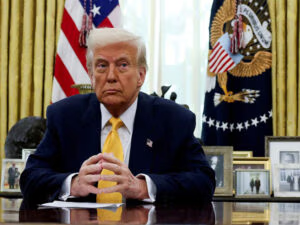

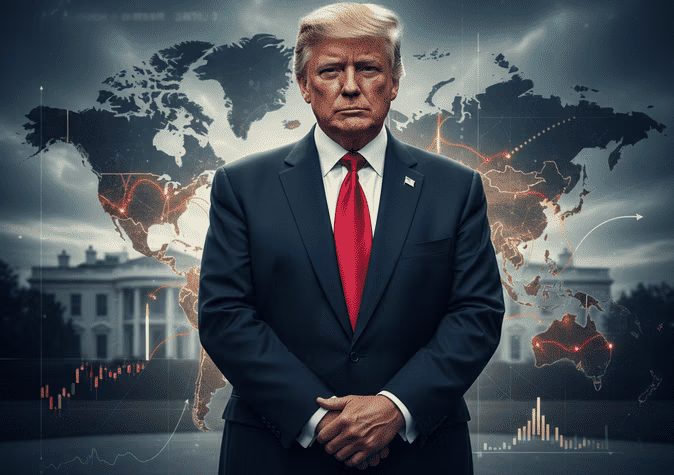
One year ago, Donald Trump returned to the Oval Office.
The former 45th president was sworn in as the 47th president of the United States on January 20, 2025. In the twelve months since, Trump has unsettled allies, disrupted trade relationships, and openly challenged the post-war global order.
More than anything else, Trump has spent the past year trying to expand American influence by reshaping borders, control points, and spheres of power.
This week, Trump posted a map of the United States that showed Canada, Venezuela, and Greenland as American territory. The White House has said Trump wants to “restore American pre-eminence in the western hemisphere.”
Here is a closer look at how that vision has played out.
Gulf of Mexico becomes the “Gulf of America”
Just weeks after returning to office, Trump announced plans to rename the Gulf of Mexico as the “Gulf of America.”
He signed Executive Order 14172 titled Restoring Names That Honor American Greatness. The order declared February 9 as “Gulf of America Day.”
According to the proclamation, the renamed area includes the US continental shelf bordered by Texas, Louisiana, Mississippi, Alabama, and Florida, extending to maritime boundaries with Mexico and Cuba.
“I took this action in part because, as stated in that order, ‘the area formerly known as the Gulf of Mexico has long been an integral asset to our once burgeoning Nation and has remained an indelible part of America,’” Trump wrote.
“As my administration restores American pride in the history of American greatness, it is fitting and appropriate for our great Nation to come together and commemorate this momentous occasion and the renaming of the Gulf of America,” he added.
Some US agencies, including the Coast Guard, have begun using the new name. Most of the world has not.
Experts say executive orders have no authority beyond US borders. The name Gulf of Mexico has been in international use since the 16th century.
Matthew Zierler, a political science professor at Michigan State University, told Business Insider that disputes over geographic names are political, not legal.
“Names reflect culture, history, and identity,” he said. “But the core of the issue is political rather than legal.”
Mexican President Claudia Sheinbaum has dismissed the move. She joked that North America should instead be called “Mexican America,” a name that appeared on early regional maps.
Trump has also accused Mexican drug cartels of running the country and threatened strikes inside Mexico. Sheinbaum has responded by saying the United States must address its own drug consumption.
“This consumption crisis they have over there also has to be addressed from a public health perspective,” she told Al Jazeera.
Panama Canal back in Trump’s sights
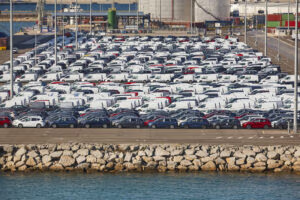
Trump has also revived long-standing US grievances over the Panama Canal. The canal handles about 5 percent of global maritime trade and roughly 40 percent of US container traffic. It was completed in 1914 and controlled by the US until 1999.
Trump has accused Panama of charging US ships excessive tolls. He has called the fees “ridiculous” and “very unfair.”
He has also claimed China controls the canal and could use it against American interests.
According to the Council on Foreign Relations, China accounts for around 21 percent of canal trade. Chinese companies own two of the canal’s five major ports and operate logistics hubs nearby.
US lawmakers argue this gives Beijing leverage over one of the world’s most critical trade chokepoints.
Panama’s President José Raúl Mulino has made limited concessions to Washington. Analysts say the pressure campaign leaves Panama with few good options.
“This all-stick, no-carrot approach is not going to work in South America,” Will Freeman of the Council on Foreign Relations told CFR. He noted the region’s deep economic ties with China.
Venezuela and the return of resource politics
In Venezuela, Trump has taken his most aggressive steps.
US Delta Force units were sent to Caracas. President Nicolás Maduro and his wife Cilia Flores were captured and transferred to the United States. They are now set to stand trial.
Trump has unveiled what he calls the “Donroe Doctrine,” a play on the Monroe Doctrine. He claims the United States now owns Venezuela’s oil.
The stance echoes Trump’s earlier remarks about Iraq, where he argued US forces should have taken oil to pay for the war.
Trump has invited oil companies to operate in Venezuela and hosted executives at the White House. Interest has been muted.
Venezuela nationalised its oil industry decades ago. Its infrastructure has badly deteriorated. Energy experts say restoring production could take years.
Trump has also said Secretary of State Marco Rubio and Defense Secretary Pete Haggis would be “running” Venezuela. The US has no troops on the ground.
Venezuelan Vice President Delcy Rodríguez has taken over as interim president following a Supreme Court order. Most of Maduro’s inner circle remains in place.
“In practice, the president’s policies smack of neo-imperialism, not neo-isolationism,” wrote Charles Kupchan of the Council on Foreign Relations.
Greenland and the Arctic power race
Trump’s interest in Greenland predates his second term.
During his first presidency, he floated buying the autonomous Danish territory. The idea was widely mocked. That reaction has faded.
Trump now says the United States must own Greenland to prevent Russia or China from gaining a foothold in the Arctic. Greenland hosts a major US air base and sits near emerging shipping lanes.
He has not ruled out taking the territory by force. Denmark and the US are both NATO members.
“In opting out of this consensus, the US risks assuming the position of a rogue state within the international system,” Marc Weller of Chatham House said.
Greenland’s strategic value is growing. Melting ice is opening Arctic shipping routes. The island holds rare earth minerals, uranium, and other critical resources.
Rebecca Pincus of the Wilson Center told Radio Free Europe that Greenland is vital for missile defense, space surveillance, and competition with China.
Greenland’s Prime Minister Múte B Egede has rejected both Danish and American control.
“We don’t want to be Danish, we don’t want to be American, we want to be Greenlandic,” he said in January 2025.
Brent Sadler of the Heritage Foundation told GBH that Greenland’s geography makes it central to US security.
“We don’t want a Chinese economic or military presence right there,” he said.
Canada, trade tensions, and rhetoric
Canada has also felt the impact of Trump’s return.
Trump has repeatedly referred to Canada as a potential “51st state.” He has accused Ottawa of unfair trade practices in dairy, lumber, and energy.
He has threatened tariffs and questioned Canada’s reliance on US security guarantees.
In late 2025, Prime Minister Mark Carney said Canada was ready to resume trade talks. The Trump administration suspended parts of the negotiations over political disputes.
Analysts say the rhetoric reflects Trump’s belief that North America should sit firmly within a US sphere of influence.
Ukraine and shifting priorities
Trump has also altered US policy toward Ukraine.
He has questioned continued military and financial support for Kyiv. He argues Europe should bear more of the burden.
The White House is pushing a peace plan critics say aligns closely with Russian demands.
“The new strategy is weak on Russia,” Daniel Fried of the Atlantic Council said. He warned it risks leaving Ukraine vulnerable.
Trump has also failed to deliver on his pledge to quickly end the Gaza war.
Gaza and accusations of imperial thinking
In Gaza, Trump has taken a firmly pro-Israel position.
He has proposed a temporary governance structure run by a “Board of Peace” chaired by himself.
UN special adviser Jeffrey Sachs called the idea “imperialism masquerading as a peace process.”
Several UN experts have said the plan resembles colonial governance.
Torrey Taussig of the Atlantic Council warned that the strategy alienates allies even as the US needs them to counter rivals.
Is Trump simply saying the quiet part out loud?
Some scholars say Trump has only made explicit what US power has long been.
“The idea that this is new is ridiculous,” Kehinde Andrews told The Guardian. “The US has been doing this all along.”
Historian Daniel Immerwahr notes that the US still controls five permanently inhabited territories and maintains hundreds of overseas military bases.
Others argue Trump’s style exaggerates reality.
“A lot of this is bombast and bluster,” Dan Hamilton of the Brookings Institution told GBH. He said Trump often uses shock tactics to gain leverage.
One year into Trump 2.0, the question is no longer whether America is changing course. It is how far this new approach will go.