
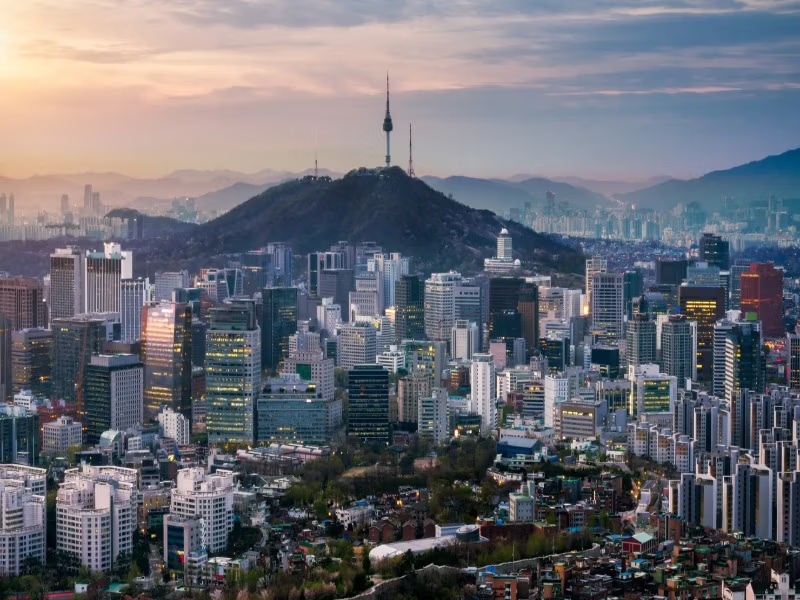
The economic growth of South Korea decelerated in the final quarter of last year due to a sudden decrease in construction investment and a commercial withdrawal in exports, and small increases in consumption.
According to the central bank’s advance estimates, the economy grew 1.5 percent in the third quarter of October to December compared to 1.9 percent in the previous year, falling short of the expectations of economists. This was compared with 1.8 percent growth in the last quarter as the economy grew at its quickest rate in more than a year.
Gross domestic product shrank 0.3 percent on a quarterly basis, the sharpest decline since the fourth quarter of 2022. Economists polled by Reuters had projected a 0.1 percent expansion.
The South Korean economy increased 1 percent in the entire year, the slowest growth rate in the country since 2020, when output dropped by 0.7 percent due to the pandemic.
The Bank of Korea reported that the construction investment contracted 3.9 percent in the quarter compared with the previous quarter as building and civil engineering activity also decreased. The facilities investment declined by 1.8 percent, with the biggest decrease in transportation equipment.
However, the exports reversed 2.1 percent over the last three months because motor vehicle and machinery shipments declined. The manufacturing and utilities supply, such as electricity, gas, and water, fell by 1.5 percent and 9.2 percent, respectively.
Meanwhile, the growth of private consumption was at 0.3 percent on services expenditures, and government spending was up 0.6 percent, which is health care benefits.
The South Korean President Lee Jae Myung and his American counterpart, Donald Trump, in November agreed on a trade accord that involved Korean investing $150 billion in the U.S. shipbuilding industry and making another $200 billion in investment commitments.
In exchange, the Trump administration agreed to cut tariffs on South Korean cars and auto parts to 15 percent from 25 percent. The exports of the country have also been a major pillar that has supported the country even as trade uncertainties increased last year.
Its exports recorded a record of $709.7 billion in 2025, an increase of 3.8 percent over the previous year, with semiconductor shipments accounting for the rise, fueled by artificial intelligence chips at high levels.
The future of the export-oriented economy remained tainted by tariff tension. Trump initiated tariffs on some imported AI chip types at 25 percent last week as part of his efforts to get semiconductor manufacturing started in the United States.
U.S. Commerce Secretary Howard Lutnick had threatened to impose tariffs on South Korean and Taiwanese chip manufacturers as high as 100 percent without pledging to produce more of their chips in America.
Lee, on Wednesday, minimized the revived threat of semiconductor tariffs, claiming that the tariff costs would probably be transferred to American consumers.
The rate of inflation has been low, easing to 2.1 percent last year compared to 2.3 percent in 2024, generally within the range of the central bank’s target of 2 percent.
The Bank of Korea maintained its baseline interest rate at 2.5 percent last week due to the reason that the policymakers are more concerned with the financial system stability in the face of a sharply depreciating won and the rapid increase in capital outflow.
The won has fallen by over 6 percent against the dollar since July last year, moving about 16-year low, fuelled partly by a rush by Korean retail investors to invest in U.S. equities.
The intervention measures in the market, such as the waiving of the foreign-exchange stability levy on banks to increase the supply of U.S. dollars, have not yet succeeded in stopping the fall of the currency.
The won has become one of the poorest performing currencies in Asia since it has lost almost 2 percent against the greenback this year, as of Thursday.
The Ministry of Economy and Finance last week increased its 2026 GDP projection, anticipating an increase in economic growth to 2.0 percent, compared to its August forecast of 1.8 percent.