

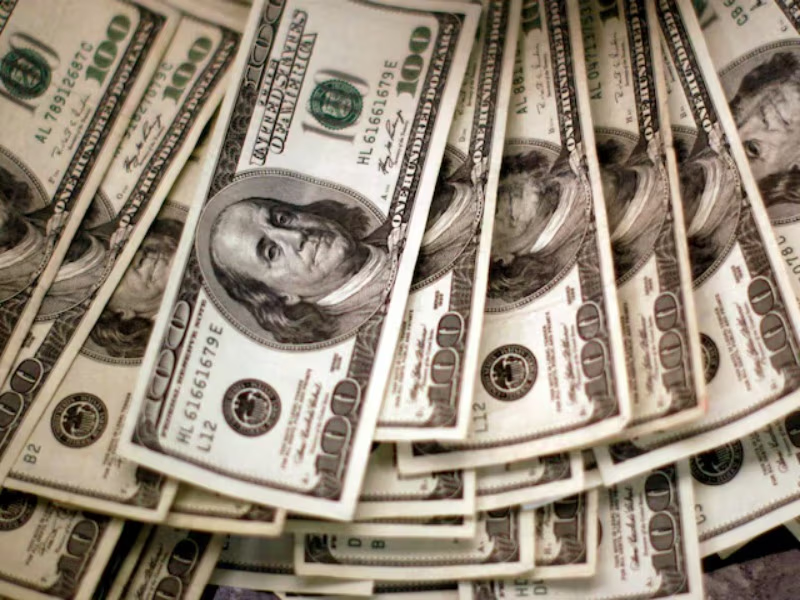
The US dollar is sliding toward its worst weekly performance since June, and investors are paying attention.
This time, it is not interest rates driving the move. It is politics.
The Bloomberg Dollar Spot Index fell to a three-week low on Friday and is down 0.9 percent for the week. That marks the steepest drop in nearly seven months.
According to Bloomberg data, options traders are now paying a premium to protect against further dollar weakness over the next month. Just a week ago, bullish positioning on the greenback was the strongest since November.
The sudden shift highlights how quickly sentiment has turned.
Policy Whiplash Hits the Greenback
Markets were rattled by sharp swings in US policy signals this week. President Donald Trump initially threatened tariffs on Europe as part of his push to expand US influence over Greenland. Days later, he abruptly dropped the plan after announcing a framework understanding with NATO Secretary General Mark Rutte at the World Economic Forum in Davos.
The reversal eased immediate trade tensions, but the damage to confidence lingered.
Notably, the dollar weakened even as US Treasury yields climbed. That divergence suggests political uncertainty is now outweighing monetary policy in currency markets. Investors are increasingly treating the dollar as a pressure valve for US-specific risks.
“The distribution of 2026 returns for the dollar must almost certainly be heavily skewed to the downside at this point,” Brent Donnelly, president of Spectra Markets, wrote in a note. “The world is realizing that the US policy nightmare is not over.”
Fed Expectations Take a Back Seat
Attention now turns to the Federal Reserve meeting next week. Money markets are pricing in two quarter-point rate cuts this year, but see almost no chance of a move at the upcoming meeting. One-week implied volatility, which captures the Fed decision on January 28, eased slightly on Friday after jumping to its highest level in more than a month earlier in the week.
Still, uncertainty around the Fed’s future leadership is weighing on the dollar.
Concerns about central bank independence have resurfaced amid expectations that Trump’s eventual pick to succeed Chair Jerome Powell could favor faster rate cuts. Trump said this week that he has completed interviews for the role and reiterated his criticism of Powell for moving too slowly on borrowing costs.
“With policy volatility rising, the US dollar has become the release valve for US risk premia,” said Erica Camilleri, senior global macro analyst at Manulife Investment Management, Bloomberg reported. “This explains why the dollar took a sharp reversal this week, despite markets pricing out further Fed cuts.”
Strong Data Fails to Lift the Dollar
Recent economic data has done little to support the greenback. The US economy expanded at a revised 4.4 percent annualized pace in the third quarter, the fastest growth in two years, according to the Bureau of Economic Analysis. Labor market data also remains firm. Initial jobless claims rose by just 1,000 to 200,000 in the week ended January 17, well below the Bloomberg economist median forecast of 209,000, according to the Labor Department.
Despite the resilience, strategists remain cautious.
“US labor market optimism is not a threat to our moderately bearish dollar view just yet,” said Pat Locke, FX strategist at JPMorgan. “US policy event risks also skew net dollar bearish over the next few weeks.”
Technical Barriers Reinforce the Downtrend
From a technical perspective, the dollar’s struggles are becoming more entrenched. The Bloomberg dollar gauge touched its 200-day moving average last week before retreating. Since April, that level has repeatedly capped rebounds. The greenback briefly broke above it in November and earlier this month, only to resume its downward trend soon after.
For investors, the message is becoming clearer. Strong growth and higher yields are no longer enough. Until US policy uncertainty fades, the dollar may remain under pressure.