
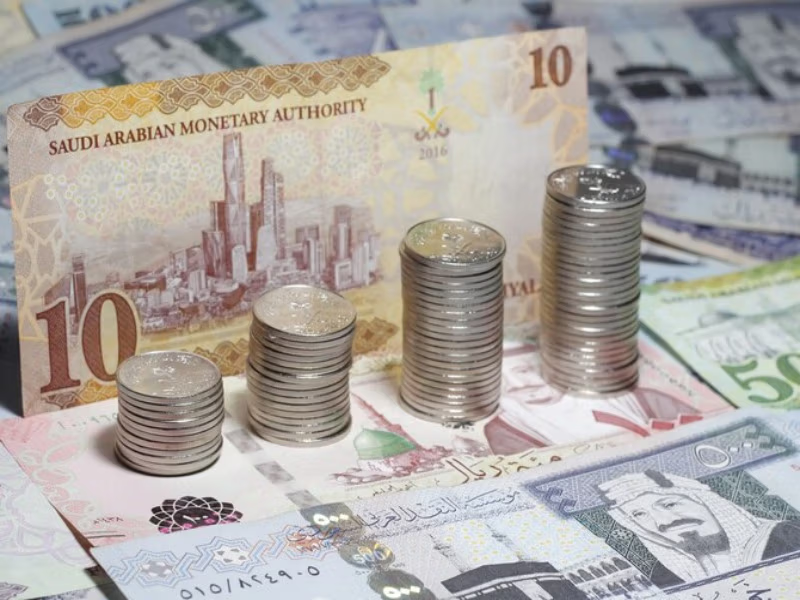
Saudi Arabia’s debt capital market is projected to have over $600 billion of outstanding issuance by the end of 2026, establishing it as the largest issuer of US dollar debts and sukuks in the emerging markets.
In a report released this week, Fitch Ratings indicated that the total Saudi debt surged to $520 billion in 2025, with an annual growth of 21 percent, with sukuk Shariah-compliant financial instruments accounting for roughly 62 percent of the total.
The consistent flow of the sukuk market in Saudi Arabia reflects the expansion at large in the debt markets of the Kingdom, as both domestic and international investors strive to diversify and ensure stable yields.
Bashar Al-Natoor, Global Head of Islamic Finance at Fitch Ratings, said, “Driven by cross-sector financing needs, fiscal deficits, regulatory initiatives, and expected lower oil prices and interest rates, Saudi Arabia’s DCM is likely to reach $600 billion outstanding in 2026.”
He stated, “Almost all Fitch-rated Saudi sukuk are investment grade, with issuers on Stable Outlooks and no defaults. Following reforms, foreign investors now contribute more than 10 percent of the government’s outstanding direct domestic issuance in primary local markets at end-2025.”
However, the dollar debt issuances of the Kingdom skyrocketed by 49 percent in 2025 to approximately $100 billion, with sukuk growth surpassing bonds.
Saudi Arabia was the largest dollar-debt issuer in 2025 in the emerging markets outside China with an 18 percent share, and the largest environmental, social, and governance dollar-debt issuer with over a 26 percent share.
Fitch added, “Subordinated sukuk issuances by banks are rising. Access to the Saudi riyal and dollar markets is bringing benefits amid tighter riyal liquidity. This is supported by no additional currency risk and established access to foreign investors.”
It further indicated that the annual borrowing plan, which has been approved by the National Debt Management Center of Saudi Arabia, is to borrow up to 50 percent of the sovereign funding requirements through the private markets, 25 percent to 30 percent through international debt capital markets, and 20 percent to 30 percent through the domestic debt capital markets.
The report also pointed out that private sources of funding, which include syndicated funding and certificates of deposit by banks, will continue to be one of the most prominent sources of funds in Saudi Arabia.
Fitch warned that the DCM of Saudi Arabia is vulnerable to oil price volatility, interest rates, changing Shariah demands of sukuk, and geopolitical risks that may impact the fiscal balances, cost of funds, and investor confidence.
Another report issued earlier this month by Fitch Ratings found that global sukuk issuances amounted to $300 billion in 2025, a 25 percent growth over the prior year, due to consistent issuances in the Gulf Cooperation Council countries.
The report further stated that this growth momentum is expected to persist in 2026 due to funding diversification efforts, future maturities, and refinancing activity among sovereigns, banks, and corporates.