

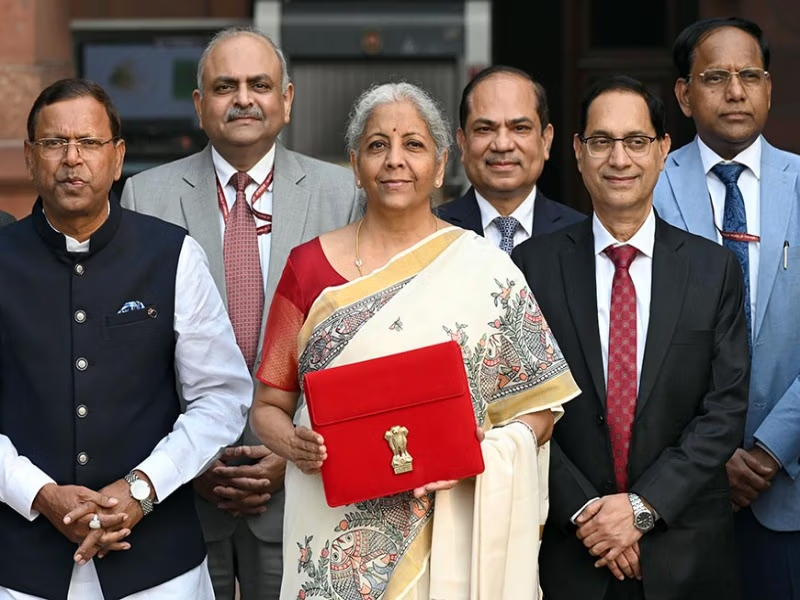
Finance Minister (FM) Nirmala Sitharaman presented her ninth consecutive budget on Sunday, February 1, and announced several major decisions, which will help to boost and sustain economic growth, in line with the vision of ‘Sabka Sath Sabka Vikas.’
The FM had provided several measures, including increased capex, high-speed rail corridors, and regional medical hubs. Here are 10 important takeaways in the budget speech of Finance Minister Nirmala Sitharaman:
Budget 2026: Key takeaways
1. Capex growth: Emphasizing the continuing growth of government capital expenditure (capex) over the years, the FM had suggested adding the government capex from ₹ 12.2 lakh crore in FY27 to ₹ 11.2 lakh crore in FY26. The 12.2 lakh crore expenditure on the capital expenditure budget as per Crisil represents an increment of 8.9 percent over the current fiscal budget and is within the expectation but below the probable requirement.
2. Seven new high-speed corridors: The FM proposed adding seven high-speed rail corridors: Mumbai to Pune, Pune to Hyderabad, Hyderabad to Bengaluru, Hyderabad to Chennai, Chennai to Bengaluru, Delhi to Varanasi, and Varanasi to Siliguri, to promote environmentally sustainable passenger travel.
3. Bond market fortification measures: The FM suggested a market-making structure, which had access to funds and derivatives of corporate bond indices. The action will be meant to stabilize the corporate bond market.
4. Target banking toward Viksit Bharat objective: The FM announced that Viksit Bharat will have a high-level banking committee established. The FM expressed that the committee will study the overall banking system and propose reforms to advance the next phase of economic development in India.
5. NRIs’ investment limit increased: The limit of investment by NRIs was raised by 5 percent to 10 percent, and the general limit of investment was raised to 24 percent by 10 percent. It is anticipated that the move will facilitate increased involvement of NRI capital and access to long-term foreign funds.
Moin Ladha, Partner at Khaitan & Co., said, “Increased flexibility for such investments can also support market liquidity and price discovery. Going forward, continued reforms in this space would be welcome, as further clarity and calibrated liberalisation can play a key role in boosting foreign investment inflows into India.”
Tanvi Kanchan, Associate Director & Head – NRI Business, Anand Rathi Share and Stock Brokers Limited, stated, “Individual persons resident outside India will be permitted to invest in Indian equities through the portfolio investment scheme with higher limits. These increases enable foreign investors to build more substantial positions in Indian companies, which could enhance market efficiency, broaden the shareholder base, and foster stronger long-term investment in Indian capital markets.”
6. Fiscal consolidation: The budget estimate that the fiscal deficit will constitute is 4.3 percent of GDP in FY27, and the revised estimate that the fiscal deficit will constitute is 4.4 percent of GDP in FY26.
7. Increase in Taxes on STT: The FM proposed to raise the securities transactions tax (STT) on options by 0.1 percent to 0.15 percent.
Now, NRIs and foreigners can directly purchase Indian stocks; here is how it will impact the Indian stock market:
In her 2026 Budget speech, the finance minister Nirmala Sitharaman made a proposal to permit foreigners or NRIs to purchase Indian stock on board, increasing the individual limit of purchase by 5 percent to 10 percent and the aggregate limit by 10 percent to 24 percent.
According to market experts, it is timely and strategically relevant, as the budget has focused more on the participation of NRI in Indian markets, since inflows of FPI have dwindled to close to their recent lows.
The measures significantly deepen the pool of long-term capital available to Indian companies by relaxing participation requirements under the Portfolio Investment Scheme and the general foreign ownership quotas.
Sonam Srivastava, Founder and Fund Manager at Wright Research PMS, added, “The expansion of the Portfolio Investment Scheme for overseas individuals is a meaningful signal that India wants to deepen and diversify foreign participation beyond large institutions. By allowing Persons Resident Outside India to invest directly in equity instruments and by doubling the per-investor limit from 5% to 10%, the government is clearly trying to widen the ownership base of Indian equities while keeping systemic risks contained through an overall cap.
Divam Sharma, Co-Founder and Fund Manager at Green Portfolio PMS, expects that the increased presence of evolved financial ecosystems like GIFT City enhances this framework by offering global competent regulatory and operational environments of cross-border investments.
Sharma reported, “Taken together, these measures improve India’s capital-market depth, diversify sources of foreign inflows, and reinforce the country’s positioning as a preferred destination for global investors seeking exposure to high-growth emerging-market opportunities.”
What does it imply for the Indian stock market?
Sonam Srivastava of Wright Research PMS stated that this is not as important to instant flows as it is to structure, from the market’s point of view.
She added, “PROI investors tend to be long-term, often with personal or economic links to India, and their capital is typically stickier than hot money flows. Increasing the aggregate cap from 10% to 24% meaningfully expands headroom, especially in mid- and large-cap names where foreign ownership limits often become binding constraints. Over time, this can improve liquidity, reduce volatility at the margin, and support better price discovery.”
Seema Srivastava, Senior Research Analyst at SMC Global Securities, pointed out that increased foreign involvement can also reduce the cost of capital in Indian companies, aid in more efficient price discovery, and reduce long-term volatility.
Srivastava indicated, “The move also signals regulatory confidence and openness, enhancing India’s attractiveness as a global investment destination and potentially driving sustained FPI inflows and valuation re-rating across sectors.”
What NRIs in the UAE need to know about the India Budget 2026: investing, property sales, tax filings
The Budget 2026 of India has several provisions that directly affect the NRIs, like an increase in investment limits in the Indian equities, easy tax and compliance laws, lower charge on foreign spending, and also ease of property transfers. This makes the UAE-based Indians more acceptable to invest, save, and remit money overseas.
New option to update ITRs
Taxpayers will have the flexibility of providing new income tax returns even after such returns have been reassessed by paying an extra 10 percent tax. The nominal fee has been charged for extending the time limit for revising returns.
Those who will submit ITR-1 and ITR-2 can do so up to July 31, and those who will submit non-audit cases and trusts will have until August 31.
Property transactions for NRIs
The compliance will be easier with NRIs of the UAE who will be selling property in India. Such transactions will be subject to tax deducted at source (TDS), which will now be charged to the resident buyer, eliminating the prior prerequisite associated with receiving a TAN.
Lower expenditure tax
Union Budget 2026 also incorporated changes to alleviate the financial strain among NRIs sending money abroad to travel, educate, or seek medical services.
The finance minister suggested reducing the Tax Collected at Source (TCS) on overseas transactions. The TCS charged on overseas tour packages is also lowered to 2 percent, lower than 5 to 20 percent, with no minimum criteria, which facilitates foreign travel and makes it less expensive to NRIs based in the UAE.
In the case of remittances, which are subject to the Liberalised Remittance Scheme (LRS) to fund education or medical fees, the TCS has also been reduced to 2 percent instead of the previous 5 percent, which reduces expenses for families sending money overseas.
A new small taxpayer scheme gives immunity against prosecution to NRIs who hold non-immovable foreign assets with a value below Rs2 million (Dh80,000), enabling them to have their compliance regularised without any fear of being prosecuted.
Investing in firms
The NRI restriction has also been eased in the Union Budget 2026, allowing NRIs to invest greater sums in Indian listed companies. The Portfolio Investment Scheme has increased the investment limit of the Person Resident Outside India (PROI), which includes NRIs and PIOs, to 10 percent instead of 5 percent.
Meanwhile, the total quota of all the PROIs investing in one listed company has risen to 24 percent as compared to the previous 10 percent. This presents an opportunity for UAE-based NRIs to gain more room to develop long-term equity exposure to Indian firms without having to exceed regulatory thresholds.
Unchanged investment
The Budget does not open up new channels of investment. NRIs are allowed to invest further in an Indian company via already established means of foreign portfolio investment (FPI) or foreign direct investment (FDI).
The critical reform is the increased ownership ceiling, which enables the overseas Indians to have bigger shares in the listed companies.
Markets overview
The increased investment limits match the overall effort of the government to make the Indian equities, which are long-term investments, available to global and NRI investors.
The move will make the equity market richer and more stable in the long term, as long as compliance and tax regulations are predictable, as more overseas Indians are permitted to participate in the market.
The finance minister approved that the new Income Tax Act will be effective from April 1, marking the next stage of India’s ongoing tax reforms.