
The United States is preparing a major intervention in global mineral markets.
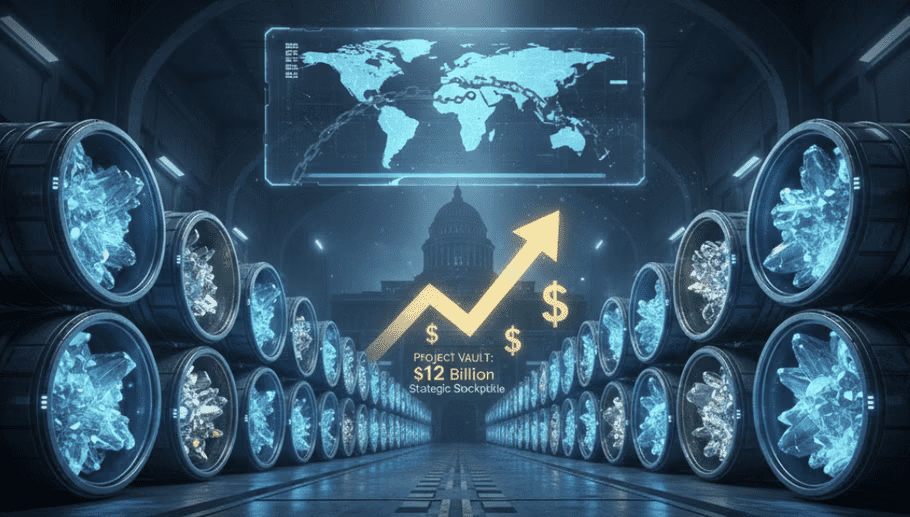
President Donald Trump is set to launch a strategic critical minerals stockpile backed by $12 billion in funding. The move aims to protect U.S. manufacturers from supply shocks and reduce reliance on China, the world’s dominant supplier of rare earths and key industrial metals.
The initiative, known as Project Vault, combines $1.67 billion in private capital with a $10 billion loan from the U.S. Export-Import Bank, according to senior administration officials. The funds will be used to procure and store minerals for automakers, technology firms, aerospace companies and energy producers.
The plan has not yet been formally announced. Officials spoke on condition of anonymity because details are still being finalized.
Markets React as Rare Earth Stocks Jump
U.S.-listed rare earth and critical minerals stocks rose in premarket trading following news of the plan.
Shares of USA Rare Earth Inc., Critical Metals Corp., United States Antimony Corp. and NioCorp Developments Ltd. all moved higher as investors priced in stronger government-backed demand.
Project Vault would be the first stockpile designed specifically for civilian manufacturers. The U.S. already maintains a national stockpile of critical minerals for defense purposes, but none for commercial industries.
Modeled on the Strategic Petroleum Reserve
The initiative is modeled loosely on the U.S. emergency oil stockpile. Instead of crude oil, the focus is on minerals used across modern supply chains.
These include rare earths and critical materials such as gallium and cobalt. These metals are essential for smartphones, electric vehicle batteries, semiconductors and jet engines. Many are subject to sharp price swings and geopolitical risk.
Administration officials said the stockpile will also include other strategically important elements with volatile pricing dynamics.
Big Industry Names Sign On
More than a dozen companies have joined the project so far.
Participants include General Motors, Stellantis, Boeing, Corning, GE Vernova and Alphabet’s Google. Three global commodities trading firms have been selected to manage procurement. They are Hartree Partners, Traxys North America and Mercuria Energy Group.
These firms will source raw materials and help fill the stockpile on behalf of participating manufacturers.
The Export-Import Bank’s board is scheduled to vote later Monday on authorizing the 15-year loan. At $10 billion, it would be the largest financing deal in the bank’s history. It is more than double its previous biggest transaction.
President Trump is also set to meet Monday with General Motors chief executive Mary Barra and mining billionaire Robert Friedland. The meeting brings together both users and producers of critical minerals.
Reducing China Risk Moves to the Forefront
China dominates global production and processing of rare earths and critical minerals. That concentration has become a growing concern for U.S. policymakers and corporate leaders.
The push gained urgency last year after China tightened export controls on several materials. According to administration officials, the restrictions forced some U.S. manufacturers to cut production and exposed the scale of Beijing’s leverage over global supply chains.
Trump’s administration has already taken unusual steps to counter that risk. These include direct U.S. government investments in domestic mining and processing companies.
Washington has also signed cooperation agreements with Australia, Japan, Malaysia and other partners. Officials said the U.S. will press additional countries to pursue similar deals at a summit of dozens of nations in Washington on Wednesday.
How Project Vault Will Work
Under the structure outlined by officials, participating manufacturers will commit to buying specific materials at a set inventory price in the future. They will also pay upfront fees.
Companies will submit a list of preferred materials to Project Vault. The project will then procure and store those materials on their behalf.
Manufacturers will be charged a carrying cost. This will cover interest on the loan and storage expenses. Exact fees have not yet been disclosed.
Companies can draw down their inventory as long as they replenish it. In the event of a major supply disruption, they will be allowed to access their full allocation.
A key design feature is a repurchase commitment. Firms that agree to buy a set amount of materials at a fixed price also commit to repurchase the same amount at that price later. The administration believes this will help stabilize prices and reduce volatility.
Why Volatility Matters for Balance Sheets
Sharp price swings in raw materials can have severe financial consequences.
Nickel is a recent example. Prices surged dramatically after Russia invaded Ukraine due to fears of supply disruptions from one of the world’s top producers. The move strained manufacturers and distorted balance sheets across multiple industries.
According to senior administration officials, Project Vault is designed to give companies price certainty without forcing them to build and manage their own stockpiles.
Some details remain undisclosed. The identities of the institutional investors providing the $1.67 billion in private capital have not been made public. Officials said the offering was oversubscribed, citing strong interest driven by long-term contracts, creditworthy manufacturers and the backing of a U.S. export credit agency.
For U.S. industry, Project Vault signals a shift. Critical minerals are no longer treated as a niche supply issue. They are now viewed as a core pillar of economic security.