

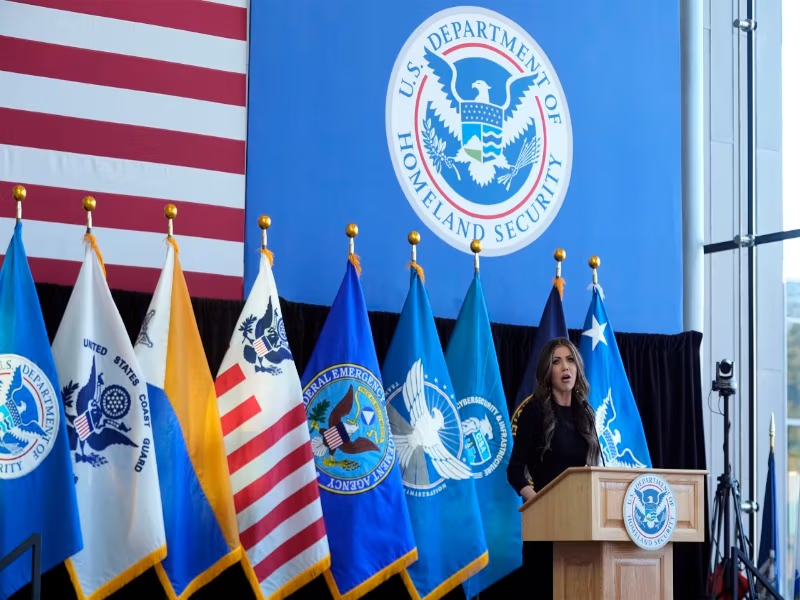
A federal judge blocked the Trump administration on Monday from revoking the legal protections for more than 350,000 Haitians in the U.S., intercepting their potential deportation to a country devastated by gang violence.
U.S. District Judge Ana Reyes in Washington, D.C., stopped the attempt of the U.S. Department of Homeland Security to end the Temporary Protected Status of Haiti. The action would have become effective on Wednesday despite the soaring violence there that displaced over 1.4 million people.
Reyes, nominated by Democratic former President Joe Biden, ruled in a class-action case filed by Haitians aimed at preventing the administration from subjecting them to deportation by revoking their legal status.
In the decision, Reyes stated that the Secretary of Homeland Security, Kristi Noem, most likely breached the procedures necessary to revoke the status of protection of Haitian immigrants in the U.S. and the Fifth Amendment of the U.S. Constitution, which guarantees equal protection under the law.
Reyes wrote, “Plaintiffs charge that Secretary Noem preordained her termination decision and did so because of hostility to nonwhite immigrants. This seems substantially likely.”
The law firm representing the plaintiffs, Bryan Cave Leighton Paisner, praised the ruling, noting that Haiti remains extremely dangerous.
The firm stated, “This ruling recognizes the grave risks Haitian TPS holders would face if forced to return, and it ensures that they can remain here in the United States – as legislated by Congress – to continue their lives, contributing to their communities, and supporting their families.”
However, the TPS is offered to individuals whose native country has suffered a natural disaster, armed conflict, or other extraordinary occurrence. It gives qualified migrants the right to work and temporary immunity against deportation.
The Department of Homeland Security has also acted to revoke the status of approximately a dozen countries as part of a crackdown on immigration under President Donald Trump, claiming that TPS was never intended to be a “de facto amnesty program.”
Department spokesperson Tricia McLaughlin mentioned in a social media post that the ruling would be appealed.
McLaughlin said, “Haiti’s TPS was granted following an earthquake that took place over 15 years ago. It was never intended to be a de facto amnesty program, yet that’s how previous administrations have used it for decades. Temporary means temporary, and the final word will not be from an activist judge legislating from the bench.”
TPS was initially provided to Haitians in 2010, following a destructive earthquake of 7.0 magnitude that hit the country. The United States has been a frequent renewer of the status, as most recently by the Biden administration in July 2024.
The department extended TPS by 18 months until February 3, 2026, citing “simultaneous economic, security, political, and health crises” in Haiti, fueled by gangs and a lack of a functioning government.
Soon after Trump assumed office, his administration attempted to shrink those humanitarian safeguards of Haitians in February 2025, when Noem attempted to shorten the Biden-era extension so it would expire in August.
Her department took a step to revoke Haiti’s TPS status in November, claiming there were no “extraordinary and temporary conditions” in the country that would deny migrants the right to get back to the land, after a federal judge in New York in July found that Noem had no statutory authority to do so.
UNICEF estimated in October that over 6 million people, more than half the population, including 3.3 million children, require humanitarian guidance.