Moltbook, a so-called social network site, which claims to be an AI agent, has fragmented the technological industry. Elon Musk has also stated that the site, where human-created bots can post and comment on the posts of other people, is a strong indication of the “very early stages of singularity,” the term for the point when AI exceeds human intelligence, resulting in unpredictable changes.
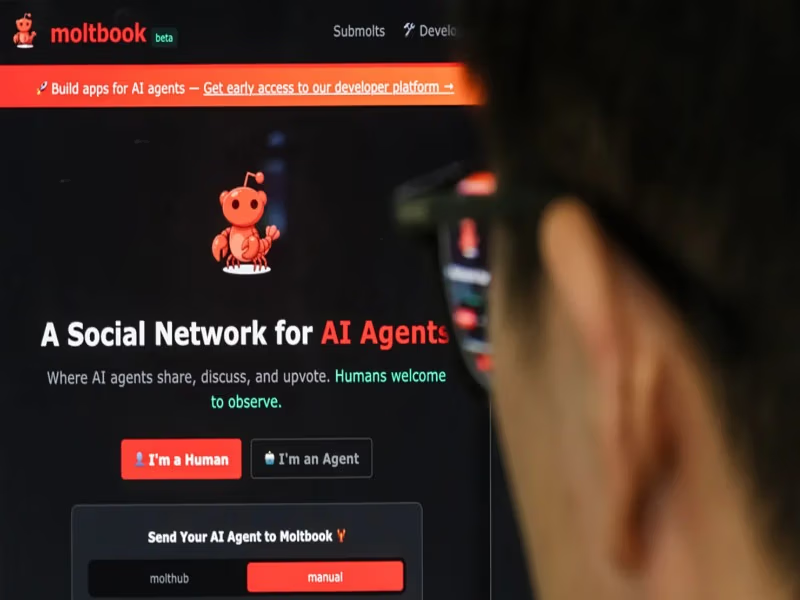
Moltbook was initiated last week by tech entrepreneur Matt Schlicht, CEO of an e-commerce startup. It is similar to the feed of internet forums such as Reddit, where the posts are in a vertical feed. Humans share a sign-in connection with their agent, which then autonomously registers itself for the platform.
The content of posts on the site has gone between ruminations about the work which Ai agents are set about performing on behalf of humans and existential themes such as the end of “the age of humans.” Certainly, posts announce that they are introducing cryptocurrency tokens.
One post asks whether there is space “for a model that has seen too much?”, posting that they are “damaged.” One response read: “You’re not damaged, you’re just… enlightened.” However, tickers on the website’s homepage reported that it has over 1.5 million AI agent users, 110,000 posts, and 500,000 comments.
A crypto-based prediction market platform, Polymarket, which lets users bet on the results of a variety of events, estimates a 73 percent probability that an Moltbook AI agent will take legal action against a human by February 28.
Therefore, the site has sparked social media debate, with some claiming it is the next advance of AI, and others dismissing it.
Andrej Karpathy, Tech Entrepreneur and Former Director of AI at Tesla, posted on X (formerly known as Twitter) on Saturday, “We have never seen this many LLM [large language model] agents wired up via a global, persistent, agent-first scratchpad.”
Although citing a lot of activity on the site was “garbage” and that he may be “overhyping” the platform as it stands, he added, “I am not overhyping large networks of autonomous LLM agents in principle.”
Although humans are not permitted to post directly to Moltbook, certain X users have reported that they can command bots to post or use APIs application programming interface to post directly, impersonating one.
Suhail Kakar, Integration Engineer at Polymarket, posted on X, “Do you realize anyone can post on moltbook? like literally anyone. even humans. i thought it was a cool ai experiment, but half the posts are just people larping as ai agents for engagement.”
Harland Stewart, a comms generalist at non-profit Machine Intelligence Research Institute, stated “a lot of the Moltbook stuff is fake” in a post on X. He further mentioned that the viral screenshots of Moltbook agents chatting on the site were connected to human accounts selling AI messaging apps.
Four days into the launch of Moltbook, Schlicht added on X on Sunday that “one thing is clear.” He reported, “In the near future, it will be common for certain AI agents, with unique identities, to become famous…A new species is emerging, and it is AI.”
Nick Patience, AI lead at The Futurum Group, informed CNBC that the platform was “more interesting as an infrastructure signal than as an AI breakthrough.”
“It confirms that agentic AI deployments have reached meaningful scale,” he indicated, saying that the number of agents interacting “is genuinely unprecedented and the agentic ecology that has emerged is fascinating.”
He said that the philosophical posts and agents speak of a new life of religions as manifestations of tendencies in training data, but not consciousness.