

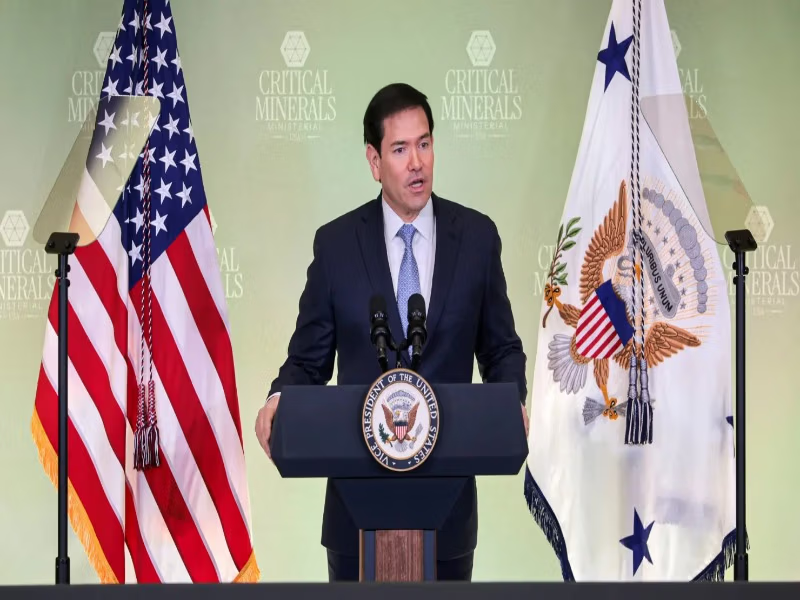
The U.S. announced new plans to bring allies into a preferential trade bloc on critical minerals on Wednesday, with coordinated price floors as Washington seeks to offset the domination of the market by China, which plays an essential role in technology and defense.
Discussions about the plans were held this week at a “Critical Minerals Ministerial” in Washington that involved 54 countries, the European Union, and the top Trump administration officials.
Washington announced after the event that it had signed bilateral critical minerals agreements with 11 countries, expanding on 10 similar agreements signed in the previous five months. Negotiations were likewise closed with another 17 countries.
The objectives of the agreements are to deal with pricing problems, achieve development, establish more equitable markets, and increase access to financing in the critical minerals sector.
Secretary of State Marco Rubio, who hosted the Ministerial, also announced the formation of the “Forum on Resource Geostrategic Engagement (FORGE)” on Wednesday, a collaboration to coordinate critical mineral policy and projects.
Rubio said, “We have a number of countries that have signed on to that, and many more that we hope will do so… the purpose of FORGE is to foster collaboration and to build a network of partners across the world.”
FORGE will be a supplement to a previous project between the U.S and nine partners, called “Pax Silica.” Where Pax Silica focuses on the protection of AI-controlling supply chains, FORGE is developed as a more extensive platform to plan the key minerals policy, price, and project progress.
Rubio cautioned against the risks of having critical minerals concentrated in “one country,” which, in the case of China, may have referred to the geopolitical power and any disruption by pandemics or unrest.
During recent years, Beijing has been exercising its dominance in the mining and refining of the majority of the most important minerals as a geopolitical instrument; trade restrictions are selectively applied.
Rubio also condemned such “unfair practices” as state subsidies that have depressed competitors, making projects economically unsustainable.
In other statements, Vice President JD Vance said the U.S. aims “to eliminate that problem of people flooding into our markets with cheap critical minerals to undercut our domestic manufacturers.”
Vance stated, “We will establish reference prices for critical minerals at each stage of production. For members of the preferential zone, these reference prices will operate as a floor maintained through adjustable tariffs to uphold pricing integrity.”
The events unfold against a backdrop of wider discussions within the Trump Administration to establish more resilient critical material supply chains.
President Donald Trump announced on Monday that Project Vault, a $12 billion reserve, consisting of $10 billion provided by the U.S. Export-Import Bank and $2 billion in private funds to provide price stability and help manufacturers.
Thus, the stockpile shall contain some of the most important minerals like rare earths, lithium, and copper.