

Saudi Arabia’s banking sector is on the cusp of a major transformation. A young, digitally fluent population, rising financial literacy, and bold regulatory reforms under Vision 2030 are creating fertile ground for a new generation of banks.
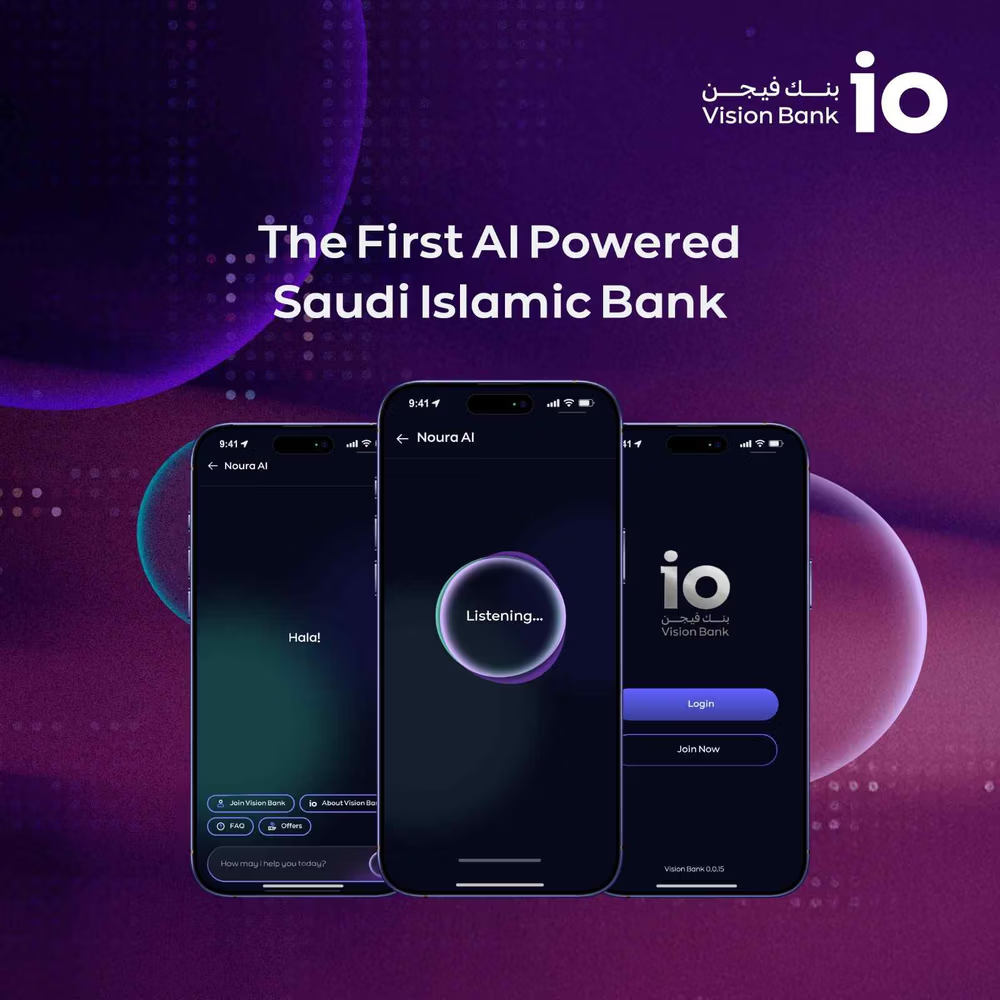
In this evolving landscape, one institution is setting out to redefine how individuals, families, and businesses manage their finances: Vision Bank, the Kingdom’s first AI-powered Islamic digital bank.
A demographic and technological tailwind
Saudi Arabia’s population exceeds 36 million, with more than 60 percent under the age of 35. This young, digitally fluent customer base is comfortable managing finances on mobile devices and increasingly expects personalized, intuitive financial experiences.
Technology adoption reinforces this momentum. Smartphone penetration surpasses 95 percent, while digital payments have moved from convenience to default. Nearly 79 percent of retail transactions are now conducted digitally, bolstered by sustained double-digit growth driven by Vision 2030 reforms.
These trends are reinforced by the Financial Sector Development Program, a cornerstone of Vision 2030, which promotes financial inclusion, household savings, and SME financing. With Middle East digital banking projected to grow at more than 20 percent annually through 2031, Saudi Arabia is at the heart of this regional expansion.
From digital access to guided financial behavior
While many banks have digitized access, Vision Bank has been designed around a different question: how customers make financial decisions.
At the core of its platform is Noura, an AI-powered conversational banking assistant embedded into the customer experience. Instead of navigating traditional menus and product categories, users interact with their finances through natural language conversations.
This enables transactions, savings decisions and financial queries to be handled intuitively, allowing the bank to move from reactive service provision to proactive financial guidance. In this model, conversational AI is not a cosmetic enhancement but a structural efficiency tool, capable of lowering cost-to-serve, increasing engagement and improving lifetime customer value.
Family banking as a differentiator
A distinctive element of Vision Bank’s strategy is its focus on family banking, reflecting the social and financial dynamics of Saudi households.
In a market where financial decisions are often made collectively, Vision Bank supports multi-generational financial planning through supervised accounts, structured savings tools, and guided financial education, all within a Shariah-compliant framework. Parents can introduce children to responsible money management early, fostering financial literacy that grows over time.
By engaging customers earlier in their financial lifecycle, Vision Bank addresses a gap in traditional banking models and builds long-term relationships that compound engagement across generations.
AI as core banking infrastructure
Crucially, Vision Bank positions artificial intelligence as infrastructure rather than experimentation. Noura is designed to evolve alongside users, learning preferences, anticipating needs and abstracting complexity as financial lives grow more sophisticated.
As product choice expands and regulatory requirements increase, the ability to simplify decision-making without compromising governance becomes a competitive advantage. AI-led conversational banking allows Vision Bank to scale efficiently without the friction historically associated with branch-centric models.
This approach mirrors global trends, where long-term value increasingly accrues to financial institutions that control the customer interface while automating complexity beneath it.
Preparing for SME-led growth
Beyond retail and family banking, Vision Bank is building capabilities to serve Saudi Arabia’s small and medium-sized enterprises (SMEs), which account for roughly 99 percent of the country’s businesses and are central to Vision 2030’s economic diversification.
Access to tailored financial services remains uneven, particularly for early-stage and growth-phase companies. Digital banks are structurally better positioned to address this gap. By combining data-driven credit assessment, automated onboarding, and AI-supported relationship management, Vision Bank aims to deliver an SME proposition that balances speed, prudence, and scalability.
Built for Saudi Arabia’s next banking cycle
Vision Bank’s strategy reflects a broader evolution in how banks are being built in the Kingdom. The approach is deliberate, digital and designed for scale from inception.
Its positioning as an AI-powered Islamic conversational digital bank is not a branding exercise, but a response to structural shifts in demographics, technology adoption and financial behavior. By integrating family banking, AI-led engagement and future SME offerings, Vision Bank is constructing a platform aligned with Saudi Arabia’s long-term economic transformation.
As the Kingdom’s banking sector enters its next phase, the question is no longer whether digital banking will scale, but which models are designed for sustained growth. Vision Bank’s approach suggests that long-term value will favor institutions that combine technological capability with cultural relevance, regulatory credibility and disciplined execution.