
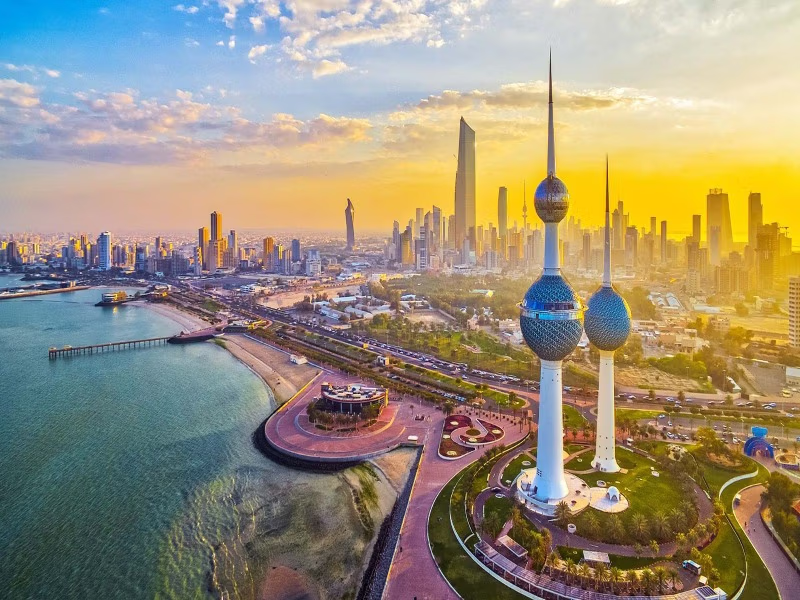
Kuwait anticipates that its fiscal deficit will deteriorate dramatically in the 2026-2027 budget year with declining oil revenues imposing a load on state finances, and the gap is anticipated to increase by 54.7 percent to 9.8 billion dinars ($31.9 billion).
Introducing the draft budget, the Finance Minister Yaqoub Al-Refaei projected the total anticipated revenue at 16.3 billion dinars, a decrease of 10.5 percent relative to the last fiscal year.
Kuwait is accelerating Vision 2035 reforms to diversify the economy and enhance non-oil growth, but remains vulnerable to oil price fluctuations despite moderate inflation and robust non-oil growth.
The Kuwait News Agency, known as KUNA, stated, “The minister disclosed that oil revenues were budgeted at 12.8 billion dinars, a 16.3 percent contraction compared to the current budget ending March 31, 2026.”
However, indicating the positive outlook in terms of diversification of the budget, non-oil revenues will be 19.6 percent to 3.5 billion dinars.
He reported that the total expenditure will amount to 26.1 billion dinars, comprising salaries and subsidies accounting to 76 percent, capital spending 11.8 percent, and other expenditures 12.2 percent.
The FY 2026-2027 budget is prepared using a conservative oil price forecast of $57 per barrel. The minister emphasized that the break-even price of Kuwait, the price that will balance the budget, is much higher, at $90.5 per barrel.
According to a release by the Ministry of Finance, the draft budget, which is applicable between April 1, 2026, and March 31, 2027, has capital spending of 3.1 billion dinars with large budgets on infrastructure and strategic project expenditure.
This will constitute 318 million dinars of the Ministry of Public Works that will be utilized in developments like the Mubarak Al-Kabeer Port, the expansion of the Umm Al-Hayman plant, the North Kabd station, and the expansion of Terminal 2 of the Kuwait International Airport.
There are other allocations in support of the health ministry cancer control center, the defense ministry military equipment, and the interior ministry of military equipment.
Increased expenditures are also motivated by an increase of 741.2-million-dinar contribution of the public treasury to social insurance to cater to the deficits of the pension funds.
Meanwhile, refined products and fuel used in power generation support were down by 449.2 million dinars since the global oil prices were low.
The ministry added that the budget would generate 14,518 new jobs, as part of the move to increase employment and retain the need to diversify revenue sources.