
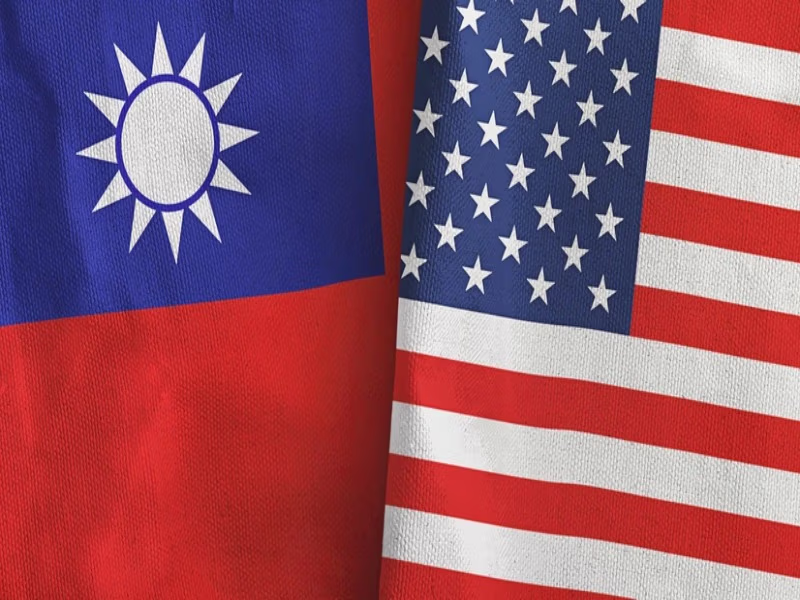
Washington and Taipei have signed a trade agreement that will reduce tariffs on the Taiwanese exports to 15 percent, equal to those of the Asian allies, Japan and South Korea, and the island will also open its market to U.S goods.
Taiwan will either eliminate or cut 99 percent of tariff barriers on U.S. goods, and also grant “preferential market access” for U.S. industrial and agricultural exports. These will be autos, beef products, and minerals.
Taiwan intends to buy over $84 billion of U.S. products between 2025 and 2029, such as liquefied natural gas and crude oil, aircraft, and power equipment.
The office of the U.S. Trade Representative reported that Taiwan had made a commitment to “resolve longstanding non-tariff barriers,” such as accepting U.S. vehicles built to U.S. Federal Motor Vehicle Safety Standards without any additional requirements.
This agreement was initially declared in January when Taiwanese chip and technology firms declared their intention to invest at least $250 billion in production capacity in the United States, with the same sum of government credit “to facilitate additional investment by Taiwanese enterprises.”
However, Taiwan and the U.S. have had different opinions on chip supply chains. Commerce Secretary Howard Lutnick told CNBC last month that it aims to offer 40 percent of Taiwan’s entire semiconductor supply chain to the U.S. under the U.S. President.
He also indicated that Taiwan-based chip firms that fail to construct in the U.S will more likely be levied with a 100 percent tariff. According to Taipei’s top tariff trade negotiator, Taiwan had withdrawn the thought of the proposal, informing Washington that moving 40 percent of the island’s semiconductor supply chain to the U.S. was “impossible.”
Vice Premier Cheng Li-chiun reported to local media that Taiwan’s semiconductor ecosystem, built over decades, could not simply be relocated.
Taiwan’s global development, such as its investments in the U.S., is expected on the notion that the industry remains rooted in Taiwan and continues to extend domestic investments, she said in Mandarin, translated by CNBC.
China, which regards Taiwan under democratic rule as one of its constituents, had condemned the January agreement, claiming that the deal would “only drain Taiwan’s economic interests,” adding that the ruling Democratic Progressive Party was letting the U.S. “hollow out” the island’s key industry.
Therefore, Chinese President Xi Jinping regards Taiwan’s reunification with the mainland “a historical inevitability,” but Taiwan rejects those claims.
Although the United States has no mutual defense treaty with Taiwan and has no responsibility to defend the island, the 1979 Taiwan Relations Act provides that the U.S. “will make available to Taiwan such defense articles and defense services” as may be necessary to “enable Taiwan to maintain sufficient self-defense capabilities.”
The U.S. in December authorized the sale of arms amounting to $11.15 billion to Taiwan, its biggest transaction with the island since it faces increasing threats posed by China, which sparked a sharp response from Beijing, with its foreign affairs spokesperson, Guo Jiakun, accusing the U.S. of violating the “one-China principle.”