

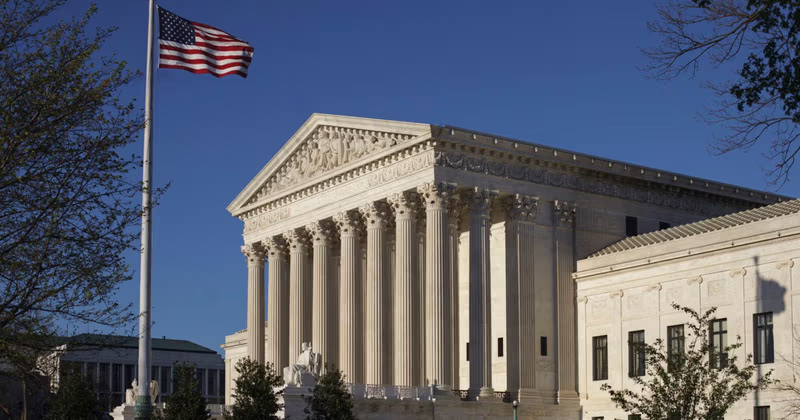
The United States Supreme Court has struck down sweeping global tariffs imposed under President Donald Trump, ruling that the executive branch exceeded its statutory authority in implementing the measures. The decision marks a significant moment in US trade policy and has triggered an immediate response across financial markets.
In a 6-3 ruling, the United States Supreme Court held that the administration overstepped its powers under the International Emergency Economic Powers Act. The statute, originally designed to address national emergencies involving foreign threats, was used to justify broad tariffs on imports from key trading partners.
The majority opinion emphasized that the authority to levy tariffs and taxes lies with Congress under the US Constitution. The court concluded that the emergency powers framework did not grant the president unlimited discretion to restructure global trade through sweeping import duties.
The tariffs, introduced during the presidency of Donald Trump, targeted multiple countries and were positioned as measures to correct trade imbalances and protect domestic industries. Critics had long argued that the scope of the tariffs stretched beyond the intended limits of the emergency statute.
Market Reaction Reflects Investor Relief
Financial markets responded positively to the ruling. Major US indices, including the S&P 500, Dow Jones Industrial Average, and Nasdaq, moved higher in early trading following the announcement. Investors interpreted the decision as reducing uncertainty around trade policy and global supply chains.
Companies reliant on imported components, particularly in manufacturing, consumer goods, and technology sectors, are expected to benefit from the removal of tariff-related cost pressures. Analysts suggest the ruling could ease inflationary pressures tied to higher import prices, though broader macroeconomic conditions will continue to influence market direction.
According to reporting by Reuters and the Associated Press, legal experts view the decision as a reaffirmation of congressional authority over trade policy. The ruling does not eliminate all presidential tools related to trade enforcement, but it narrows the scope for invoking emergency powers to impose broad-based tariffs.
Legal And Policy Implications
The judgment carries implications beyond immediate market reaction. By clarifying limits on executive authority, the court has reinforced the separation-of-powers framework that governs fiscal and trade decisions in the United States.
Businesses affected by the tariffs may now explore legal avenues to recover duties paid under the invalidated framework. Any refund process would likely require administrative coordination and could involve further litigation.
For policymakers, the ruling underscores the need for clearer legislative backing when pursuing structural trade reforms. Future administrations seeking to impose tariffs may need to rely on more specific statutory mechanisms or secure explicit congressional approval.
Global Trade Outlook
Internationally, the decision may ease tensions that had built up around unilateral tariff measures. Trading partners previously impacted by the duties are expected to view the ruling as a stabilizing development for cross-border commerce.
While the broader geopolitical landscape continues to shape trade relationships, the Supreme Court’s intervention resets the legal boundaries within which US trade policy must operate. Markets, lawmakers, and global counterparts will now watch closely to see how Washington recalibrates its approach in the months ahead.