
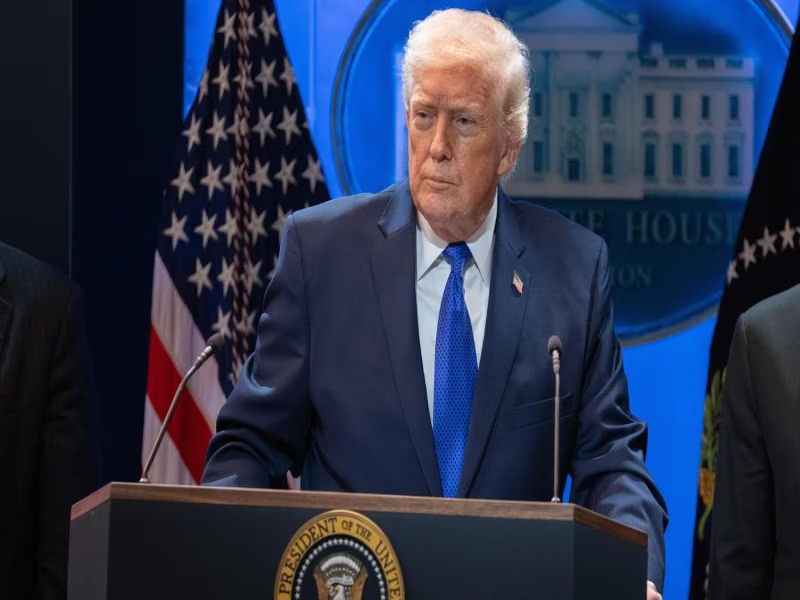
President Donald Trump announced on Saturday that he will increase a temporary tariff from 10 percent to 15 percent on U.S. imports from all countries, the maximum level allowed under the law, following the U.S. Supreme Court rejected his previous tariff program.
The action was less than 24 hours following the announcement of a 10 percent across-the-board tariff by Trump on Friday, following the ruling of the court. The court ruled that the president had overstepped his power in the issuance of a variety of increased rates on the basis of an economic emergency law.
These new levies are based on a separate but untested law, referred to as Section 122, that enables tariffs up to 15 percent but requires congressional approval to extend them after 150 days.
Section 122 has not been invoked by any previous president, and its invocation may bring about more legal setbacks.
An extension of the tariffs by the Republican-dominated Congress is doubted by trade experts and congressional aides, who cite polls that indicate increasing numbers of Americans attribute the higher prices to the duties.
Trump wrote in a social media post on Saturday that the 150 days would be spent on additional issuance of other “legally permissible” tariffs.
The administration plans to use two other laws that allow the imposition of taxes on certain products or nations, depending on the inquiry of national security or unfair trade competition.
He wrote in a Truth Social post, “I, as President of the United States of America, will be, effective immediately, raising the 10% Worldwide Tariff on Countries, many of which have been ‘ripping’ the U.S. off for decades, without retribution (until I came along!), to the fully allowed, and legally tested, 15% level.”
According to the White House, the Section 122 tariffs will have exemptions on some products, such as critical minerals, metals, and energy products.
Former senior U.S. trade official and senior vice president of the Asia Society think tank, Wendy Cutler, remarked that she was surprised Trump had not chosen the maximum rate of Section 122 on Friday and said his change came in rapid-fire fashion, highlighting the uncertainty trading partners experienced.
The ruling by the Supreme Court, as written by Chief Justice John Roberts, ended with the finding that the law through which Trump had mostly performed his tariffs, the International Emergency Economic Powers Act, did not give the president the powers that he had proclaimed.
The other three conservative justices, Neil Gorsuch and Amy Coney Barrett, both Trump nominees, voted in the majority alongside Roberts and the three liberal justices.
Trump responded to the ruling with fury, and he referred to the justices who voted in the majority opinion as “fools,” and he said Gorsuch and Barrett, more specifically, are “embarrassments,” and he pledged to carry on his trade war around the world.
However, the decision was applauded by some foreign leaders. French President Emmanuel Macron added on Saturday that the ruling demonstrated that it is healthy that democracies have checks and balances on power and the rule of law.
German Chancellor Friedrich Merz said he hoped the decision would alleviate the pressure on German companies. He said he would use his upcoming U.S. trip to reiterate that “tariffs harm everyone.”
Therefore, Trump has employed the tariffs, or the threat of applying them, to secure trade deals with foreign countries. Following the ruling of the court, Trump trade representative, Jamieson Greer, informed Fox News on Friday that such nations should respect agreements despite their demand for a tariff that exceeds the Section 122 tariffs.
Greer said that exports to the U.S. by other countries like Malaysia and Cambodia would still be taxed at their negotiated rates of 19 percent, although the general rate is lower.
The chief negotiator of U.S. tariffs by Indonesia, Airlangga Hartarto, indicated that the trade agreement between the two nations that placed U.S. tariffs at 19 that was signed on Friday, will continue to apply even after the court ruling.
The decision will give optimism to countries such as Brazil, which has never agreed to a deal with Washington to reduce its 40 percent tariff rate, but may be in luck to see its tariff rate reduced to 15 percent at least in the short term.
Trump has been on a low approval rating of 34 percent regarding his economic performance in office, with 57 percent of the respondents responding that they disapprove and 34 percent with a yes in a Reuters/Ipsos poll, which closed Monday, just ahead of the midterm elections in November.
Affordability remains a top concern for voters. Democrats, who only need to turn around three Republican seats in the U.S. House of Representatives in November to secure a majority, have charged Trump with his tariffs to increase the cost of living.