
The Roads and Transport Authority (RTA) has contracted Hessa Street Development for Phase II, in implementation of the directives of the wise leadership to further develop the road infrastructure network to keep up with the sustained urban development and the population growth of Dubai.
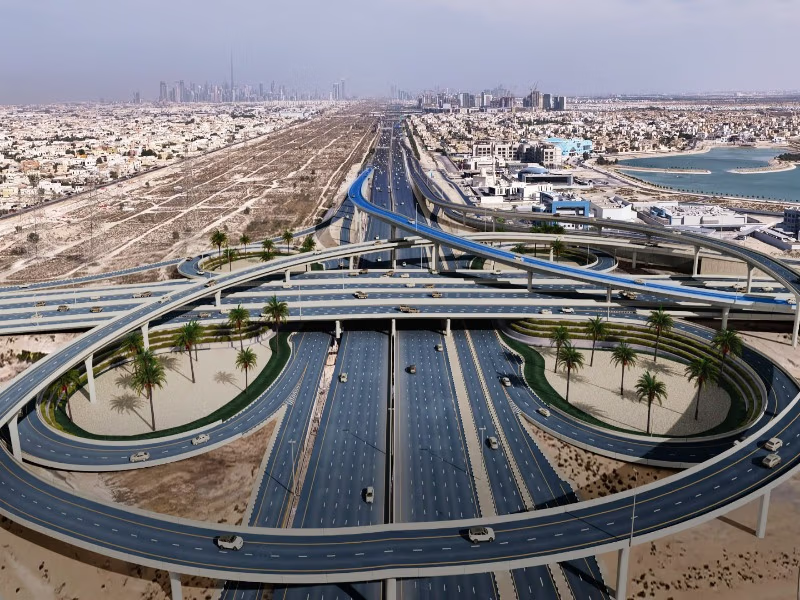
The project is on a 3km stretch between the Al Khail Road and Sheikh Mohammed bin Zayed Road. It involves the development of three large crossroads through building a bridge that covers 8,835 metres and a 480-metre tunnel, and also the development of entry and exit points of various connecting roads.
The project enhances the Hessa Street with 100 percent capacity, which was 4,000 vehicles per hour, to 8,000 vehicles per hour.
It covers 10 residential and development zones and serves up to 650,000 residents, and the journey times are minimized to five minutes, rather than 24 minutes. Phase I of Hessa Street Development will be opened in April by RTA, with completed bridges, enhanced intersections, and dedicated cycling tracks.
Phase II
His Excellency Mattar Al Tayer, Director General, Chairman of the Board of Executive Directors of the Roads and Transport Authority, said: “Phase II of Hessa Street Development complements Phase I, which will be fully completed in the first quarter of 2026.”
He stated, “Phase II extends along Hessa Street from Al Khail Road to Sheikh Mohammed bin Zayed Road and includes upgrading Al Khail Road–Hessa Street interchange through expanding Hessa Street from two lanes to four lanes in each direction. The scope also includes constructing grade-separated collector roads to accommodate loop movements, a two-lane second-level direct ramp serving traffic from Hessa Street to Al Khail Road towards Abu Dhabi, and a third-level two-lane flyover facilitating traffic from Al Khail Road to Hessa Street in the direction of Sheikh Mohammed bin Zayed Road.”
Mattar Al Tayer said, “The total length of bridges reaches 2,215 metres, with the upgraded interchange expected to accommodate 18,200 vehicles per hour. The project further provides for a 525-metre, two-lane braided ramp to eliminate traffic overlap between Al Khail Road and Al Khamila Street. The ramp will accommodate about 2,800 vehicles per hour.”
He added, “The project also includes upgrading Al Khamila Street junction with Al Khail Road and Al Asayel Street. Works comprise a 1,650-metre second-level directional ramp serving traffic from Al Khamila Street to Al Khail Road towards Sharjah, with a two-lane capacity.”
He noted, “Works include constructing a 780-metre bridge providing entry to and exit from Al Khamila Street to Jumeirah Village Circle (JVC), with three lanes in each direction, in addition to elevated link ramps extending 1,050 metres to serve traffic movements from Al Khamila Street to Al Khail Road towards Abu Dhabi. The upgraded junction will accommodate approximately 16,800 vehicles per hour.”
Al Tayer stated, “The scope also includes an 885-metre-long direct elevated ramp with a two-lane capacity serving traffic from Hessa Street to Al Barsha South 1. In addition, a 1,050-metre second-level direct directional two-lane ramp facilitates traffic from JVC towards Al Barsha South. The upgraded intersection will accommodate approximately 11,200 vehicles per hour. A 680-metre directional two-lane ramp from JVC to Hessa Street in the direction of Al Khail Road will generate a capacity of 16,800 vehicles per hour.”
Al Tayer, on the context, reported, “Works also include constructing a 480-metre, two-lane tunnel serving traffic from JVC towards Sheikh Mohammed bin Zayed Road, and widening Al Hadaeq Street from its intersection with Hessa Street to its junction at the entrance of Dubai Science Park, extending 2.5 km. The corridor will be upgraded to a dual carriageway with three lanes in each direction. All existing roundabouts will be converted into signalised intersections with an estimated capacity of 4,400 vehicles per hour.”
He indicated, “The project also covers a 10.4 km cycling and e-scooter track linking Dubai Hills and Dubai Motor City, serving several residential and development areas, including Al Barsha South, Arjan, Dubai Science Park, and Motor City.”
#RTA has awarded a contract for Phase II of Hessa Street Development, serving 650,000 residents across 10 residential and development areas.
— RTA (@rta_dubai) February 22, 2026
The project doubles Hessa Street’s capacity by 100%, reduces journey time from 24 minutes to 5 minutes, and features 10.4 km cycling and… pic.twitter.com/SoIEvnZDc5
Projects and their benefits
His Excellency Mattar Al Tayer also highlighted the developmental strategies of Phase II and several projects intended to expand in various paths.
Al Tayer said: “The roads covered under Phase II of Hessa Street Development currently accommodate approximately half a million trips per day. The upgrade works increase road capacity by 100%, from 4,000 vehicles per hour in each direction to 8,000 vehicles per hour in each direction, while reducing journey time from 24 minutes to five minutes. The project serves 10 key residential and development areas, including JVC, Arjan, Dubai Science Park, Al Barsha South, Jumeirah Lakes Towers, Jumeirah Islands, Barsha Heights, The Greens, and Emirates Hills. The total number of beneficiaries is estimated at approximately 650,000 residents.”
Phase I of Hessa Street Development involved the improvement of four major intersections along Hessa Street, particularly at Sheikh Zayed Road, First Al Khail Street, Al Asayel Street, and Al Khail Road.
Hessa Street has expanded from two lanes to four lanes in each direction, doubling the capacity to 8,000 vehicles per hour, in addition to a 13.5 km cycling track.
RTA recently opened a major two-lane bridge that is 1,000 metres long in December 2024 as part of Phase I.
The structure accommodates traffic flow that links Hessa Street with the Al Khail Road and offers free-flow connectivity to the city centre and Dubai International Airport, and shortens the duration of travel time between the two corridors to a range of three minutes to 15 minutes.
Construction is already in progress at the Hessa Street-First Al Khail Street crossing, which will involve expansion of the existing intersection bridges of Hessa Street bridge to four lanes in both directions, and the traffic improvement at the signalised at-grade intersection.
Meanwhile, construction is ongoing at the intersection of Hessa Street and Al Asayel Street, with the existing bridge being widened to four lanes in each direction on Hessa Street. Traffic upgrades to the at-grade junction that is controlled using signals are also part of the scope.
Cycling and E-Scooter Track
Phase I will also provide a 13.5 km cycling and e-scooter-only track across Hessa Street, connecting Al Sufouh and Dubai Hills. The corridor connects multiple residential areas, such as Al Barsha and Barsha Heights, and improves the first- and last-mile connectivity by connecting with Dubai Internet City Metro Station, along with the adjacent business and service destinations.
The track is characterized by two architecturally unique cycling and pedestrian bridges. The first spans Sheikh Zayed Road, while the second crosses Al Khail Road.
However, each bridge has a width of five metres, including three metres for cycling and e-scooter use and two metres for pedestrian movement. The project improves the connectivity with the first and last mile by incorporating the Dubai Internet City Metro Station and the commercial and service destinations of the area.
The estimated capacity of the track is around 5,200 users per hour, which would facilitate smooth multimodal mobility within the region.