

Asia-Pacific markets surged Monday amid tariff uncertainty after U.S. President Donald Trump announced over the weekend that he would raise global tariffs to 15 percent from 10 percent.
This action followed shortly after the U.S. Supreme Court ruled that invalidated a wide expanse of the trade agenda of the president under the International Emergency Economic Powers Act of 1977, or IEEPA. It was stated that U.S. trading partners are not specific, said Rystad Energy’s chief economist Claudio Galimberti.
He wrote in a note following the announcement, “While the Supreme Court’s ruling invalidates a large share of existing tariffs and weakens the ability to target individual countries, it does not dismantle the broader tariff framework.”
Galimberti stated that beyond the upper tariff limit, where there have been no IEEPA exemptions, the average rate may rise still higher than it was before the arrangement the Supreme Court has just overthrown.
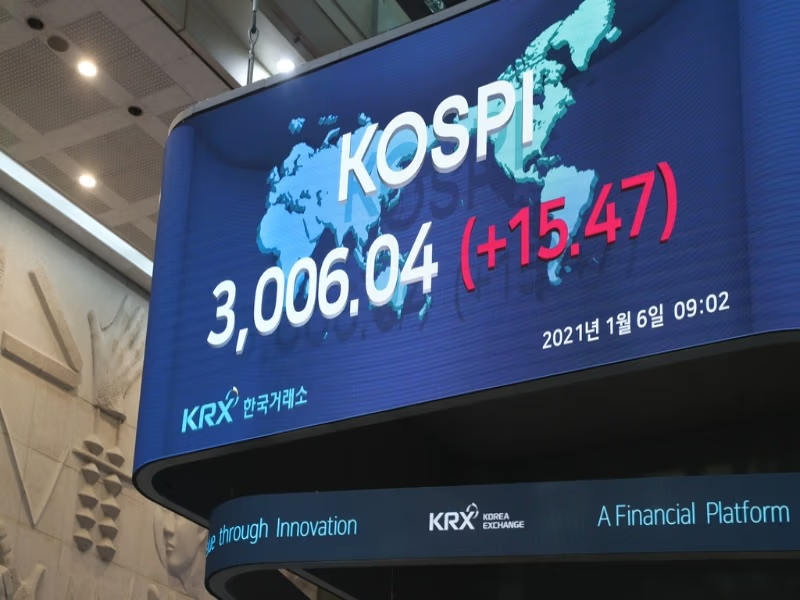
The Kospi of South Korea rose in a three-day streak by leaping 1.7 percent to a new record high. SK Hynix and Samsung Electronics are the index heavyweights that climbed by more than 3 percent and 2 percent, respectively.
However, the small-cap Kosdaq gained 0.74 percent. The S&P/ASX 200 of Australia has surged 0.17 percent in the initial trade. The Hang Seng index of Hong Kong surged more than 2 percent. Markets in China and Japan were closed for a holiday.
Bitcoin dropped more than 3 percent to below $65,000 after U.S. President Donald Trump announced plans to increase global tariffs to 15 percent.
Christopher Hamilton, Head of Client Investment Solutions, APAC ex-Japan, added, “The move lower in bitcoin looks less like a crypto‑specific shock and more like a classic risk‑sentiment reset.”
He said, “Bitcoin has become increasingly sensitive to global liquidity conditions. When markets reprice growth, inflation, or policy risks as we’re currently seeing with tariffs, bitcoin often acts as a high‑beta expression of risk rather than a defensive asset.”
Oil prices have recently been trading in a downward direction, eliminating previous gains. International benchmark Brent crude futures slipped 0.6 percent to $71.33 a barrel, while U.S. West Texas Intermediate futures were 0.78 percent lower at $65.96.
Arthur Laffer, Jr., President of Laffer Tengler Investments, reported, “The Supreme Court ruling is a setback … but it is not an end to his policy agenda.”
Laffer advised nations, including Vietnam and India, that have entered into trade agreements with the U.S. to consider twice before abandoning the agreements, claiming that trade is a key component in the political and economic approach of Trump and that the president is willing to continue insisting on the matter.