
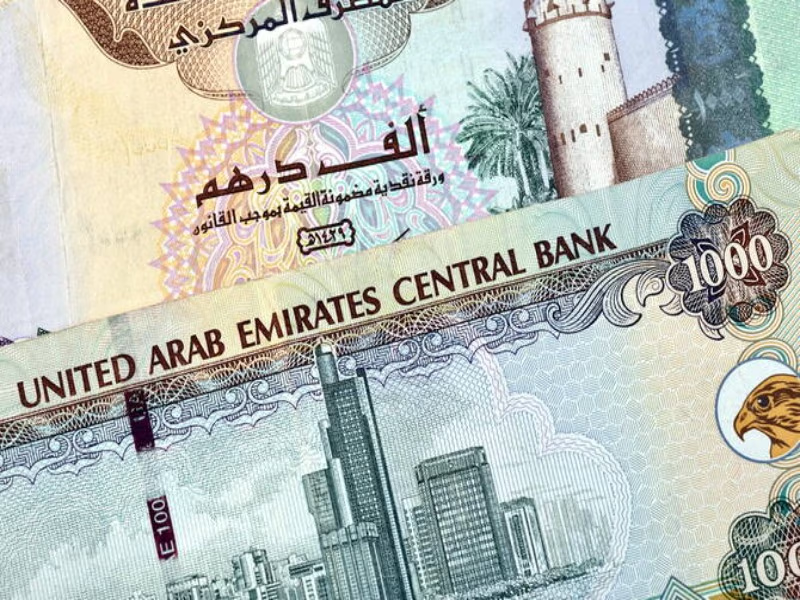
The UAE increased 550 million dirhams ($150 million) from its first 7-year Islamic treasury sukuk, part of a dual-tranche auction, attracting high investor interest, and an indication of rising interest in the dirham-denominated Islamic debt.
According to the Emirates News Agency, the February auction was conducted by the Ministry of Finance in line with the Central Bank of the UAE. It had witnessed 5.88 billion dirhams for securities worth 1.1 billion dirhams, an oversubscription ratio of 5.3 times.
The issuance is in the midst of rapid expansion in Gulf debt markets. Fitch Ratings stated in the previous month that the debt capital market of the Gulf Cooperation Council is projected to reach above $1.25 trillion in the year 2026 due to the projects’ financing requirements, the economic diversification programme, and the government-funding programs.
The ratings agency added that the region would continue to be among the biggest sources of US dollar debt and sukuk issuance among the emerging markets, with Islamic instruments comprising more than 40 percent of outstanding GCC debt.
The newly issued 7-year tranche alone received a demand of approximately 3.1 billion dirhams, almost six times the issue amount, indicating investor confidence in the credit profile of the UAE and the ongoing development of the Islamic finance industry.
WAM said, “The issuance forms part of the Islamic Treasury Sukuk Program for 2026, as published on the Ministry’s official website.” The involvement was high among eight main dealers, including tranches that will reach their maturity in May 2030 and February 2033.
The auction resulted in competitive, market-based pricing, with the May 2030 tranche yielding 3.53 percent and the February 2033 tranche yielding 3.779 percent, priced lower than the corresponding US Treasury yields when they were issued.
WAM added that the sukuk are traded on Nasdaq Dubai as the UAE Treasury Islamic Sukuk Program, which enhances the access of investors on the secondary market.
Islamic finance and debt capital markets in the UAE have further been solidified with Nasdaq Dubai reporting a record year in 2025, in cases where the outstanding sukuk listings were more than $100 billion.
This expansion was a result of persistent issuance by sovereign, financial, and corporate issuers, and high global demand for Shariah-compliant instruments.
The milestone highlights how the UAE is increasingly becoming a regional center of Islamic fixed-income products and indicates strong investor confidence in the financial system in the country.