
Source : WAM
Dubai International Financial Centre (DIFC) on Tuesday unveiled the first report in its 2026 Future of Finance series.
Titled “Global Wealth Outlook: Rethinking Growth in a Changing World,” the report explores how global wealth is being reshaped by market volatility, demographic shifts, and changing capital flows.
The global high-net-worth individual (HNWI) population, numbering nearly 23 million and collectively holding around US$87 trillion, underscores the scale and influence of this cohort on international capital markets.
Within this context, the report highlights Dubai’s rise as a preferred destination for HNWIs, family offices, and global private capital, as investors seek markets and portfolios offering diversification, flexibility, and resilience.
The report points to a structural shift in global wealth management. Amid persistent market volatility, geoeconomic uncertainty, and uneven investment outcomes, wealthy individuals and families are re-evaluating how and where capital is deployed. Geography is now increasingly considered alongside asset allocation, as jurisdictional risk plays a key role in long-term wealth preservation.
A central driver of this shift is the $124 trillion intergenerational wealth transfer projected by 2048. As younger heirs gain influence, investment strategies are evolving to emphasize private markets, artificial intelligence, sustainability, and impact alongside traditional financial returns.
Next-generation wealth holders now pursue multi-dimensional prosperity—financial growth paired with resilience against drawdowns and inflation, portfolio flexibility, family unity, tangible environmental and societal impact, and the preservation of family reputation.
The report also notes that women, now representing over 10 percent of ultra-high-net-worth individuals (UHNWIs), are expected to inherit 95 percent of $54 trillion in inter-spousal transfers. Female heirs tend to prioritize investments aligned with ethics and social impact, including sustainable, philanthropic, or innovative projects.
Following AI, renewable energy is anticipated to see the fastest growth, with sustainable investments increasingly integrated into UHNWI portfolios. The ultra-wealthy are actively backing sustainability with significant financial commitments.
Wealth advisers are now required to go beyond portfolio construction and valuations. They must navigate private deal structures, identify credible venture and growth-stage partners, and incorporate data-driven analytics and insights into their advisory practices.
Despite technological advancements, wealth management remains people-centric. Advisers must build trust, manage complex family dynamics, and understand the unique goals and values of each family.
Arif Amiri, Chief Executive Officer of DIFC Authority, said, “The global wealth landscape is undergoing a structural shift. In an environment of volatility, regulatory divergence and generational change, families are thinking about risk, resilience and long-term growth. Increasingly, geographical allocation is becoming as important as how wealth is invested.
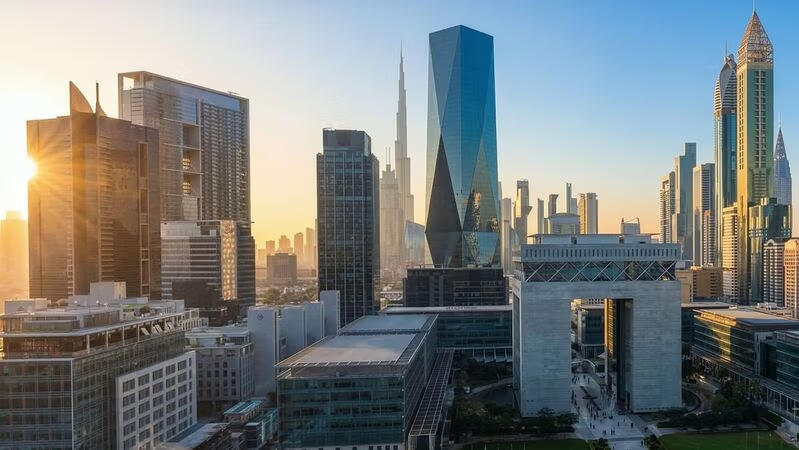
“Dubai, and in particular DIFC, has anticipated this shift and offers a stable and globally connected environment with regulatory clarity in which families and private investors can make long-term decisions with confidence.”
The report reinforces Dubai’s position as a leading hub for private and family wealth, combining the institutional depth of established financial centres with the agility, stability, and tax efficiency sought by globally mobile investors.
Henley & Partners estimates that the UAE attracted about 9,800 new millionaires in 2025 most of them in Dubai representing the highest net inflow globally amid shifting tax and policy environments in traditional financial hubs.
With over 1,289 family-related entities, representing the UAE’s largest family wealth ecosystem, DIFC supports Dubai’s growing appeal to private wealth.
Backed by a comprehensive ecosystem spanning private banking, wealth and asset management, legal, and advisory services, this growth aligns with the UAE’s designation of 2026 as the Year of Family, highlighting the central role families play in global wealth stewardship.
The report also emphasizes the professionalization of family offices and wealth managers, as clients increasingly demand private market access, AI-enabled analytics, and sophisticated governance and advisory capabilities.
DIFC is expanding its wealth infrastructure to meet these evolving needs, notably through the DIFC Family Wealth Centre, a world-first initiative supporting multi-generational families. The centre serves as a hub for thought leadership, networking, and next-generation engagement, reinforcing DIFC as more than a financial centre—a long-term partner for families.
Global Wealth Outlook: Rethinking Growth in a Changing World demonstrates how Dubai is not only responding to shifts in global wealth but actively shaping the environment for private and family capital to thrive.