
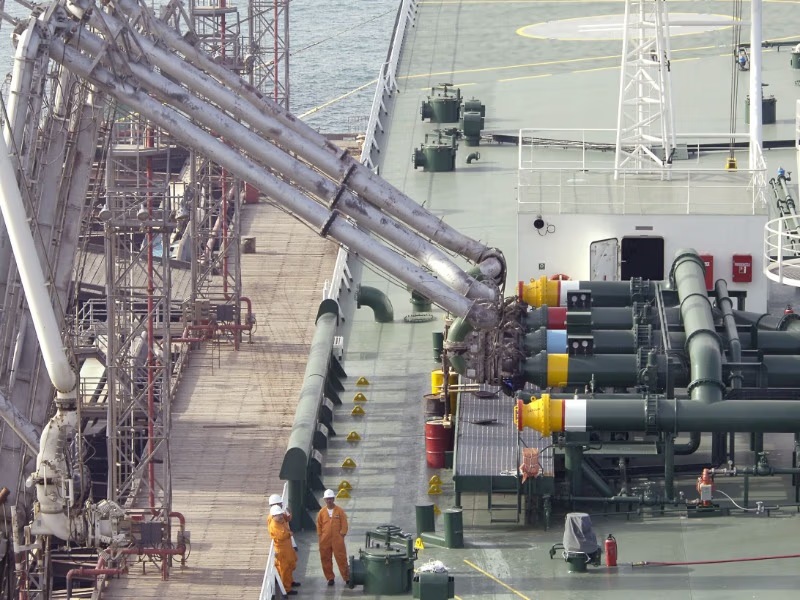
A source familiar with the matter reported that the Kuwait Petroleum Corporation (KPC), the national oil company, has had preliminary discussions with a large group of potential investors regarding a $7 billion stake sale in its crude oil pipelines.
The sources stated that BlackRock, Brookfield Asset Management, EIG Partners, and buyout group KKR are among those that have shown interest. Chinese state enterprises China Silk Road Fund and China Merchants Capital, as well as I Squared Capital and Macquarie Infrastructure Partners, are also showing interest.
The transaction is organized with around $1.5 billion in equity, and the remainder is financed through debt. Sheikh Nawaf Saud Al-Sabah, KPC’s Deputy Chairman and Chief Executive, has a steering committee that manages the process, and sources indicated that the process is being managed with close hands-on supervision, with the steering committee meeting after every few weeks to review the process.
He stated, “We are studying the possibility of leasing and re-leasing (oil) pipelines in the country,” Al-Sabah told reporters in September. “The pipelines are assets owned by KPC, and do not generate direct financial returns. If there is an opportunity to secure additional financing through these assets… then welcome.”
However, BlackRock, Brookfield, Macquarie, KKR, EIG, and I Squared declined to comment. KPC, China Silk Road Fund, and China Merchants Capital did not reply to the request to comment.
Two of the sources said that KPC is currently in discussions with other banks to come on board with HSBC in underwriting the debt part of the deal.
Two of the sources indicated that the formal process of launching the stake sale of the oil pipeline network may begin immediately after the conclusion of this month, as reported by Reuters last month.
Meanwhile, the concession, which reportedly has a span of 25 years, is contested against a testing backdrop. The price of crude oil, currently around $71 per barrel, is dragging on estimated volumes and returns, and geopolitical tensions in the Gulf region are another complexity.
The decision mirrors recent years’ purchases by Saudi Aramco, Abu Dhabi National Oil Company, and Bahrain pipeline infrastructure Bapco Energies to monetise their pipeline infrastructure networks. These arrangements offer short-term cash with payment of tariffs in the long run.
Kuwait Petroleum Corp in late 2023 added that it will spend $410 billion through 2040 on a strategy that aims to increase production capacity to 4 million barrels per day.
Kuwait’s state news agency said in September that BlackRock, which signed a similar deal with Aramco last year on the Jafurah processing plants of the gas plant in Saudi Arabia, will establish a Kuwait office and appoint Ali AlQadhi to head operations in the country.