
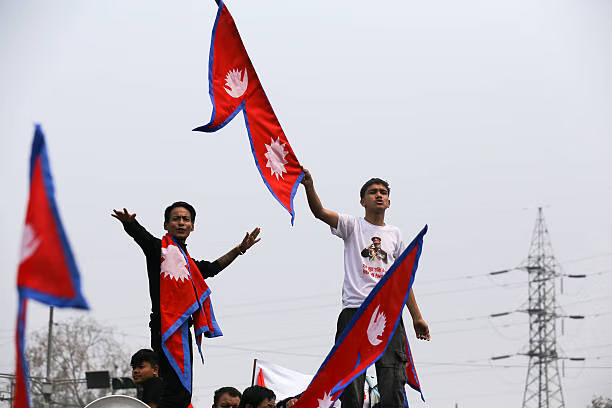
Nepal will head to the polls on March 5 in its first national election since youth-led anti-corruption protests toppled the government of K. P. Sharma Oli in September. The vote comes at a politically sensitive moment for the Himalayan nation, as public frustration over governance, unemployment, and corruption reshapes the country’s political landscape.
Nearly 19 million of Nepal’s 30 million people are eligible to vote in the election for the 275-member House of Representatives. Around one million of those voters — largely young citizens — were added after last year’s unrest, which resulted in 77 deaths and more than 2,000 injuries. The protests significantly altered the political environment and injected new urgency into calls for reform.
The electoral system combines direct contests and proportional representation. Of the 275 seats, 165 will be decided through first-past-the-post races, while the remaining 110 will be allocated to parties based on their overall vote share. Election authorities say more than 60 political parties are competing, making the race highly fragmented and unpredictable.
The Leading Contenders
Among the most closely watched candidates is Balendra Shah, the 35-year-old prime ministerial contender from the Rastriya Swatantra Party. A former rapper turned politician and former mayor of Kathmandu, Shah has positioned himself as a reformist voice appealing strongly to younger voters. His campaign centers on governance reform, accountability, and breaking from traditional political structures.
प्रतिनिधि सभा सदस्य निर्वाचन, २०८२ pic.twitter.com/X8SJ29usnE
— Election Commission Nepal (@ECNOfficial) February 26, 2026
Facing him in the Jhapa 5 constituency is K. P. Sharma Oli, 74, leader of the Communist Party of Nepal (Unified Marxist–Leninist). A four-time prime minister, Oli is attempting a political comeback after being ousted following the protests. While he retains support among traditional party loyalists, analysts say he faces challenges in regaining trust among younger voters who were instrumental in last year’s political upheaval.
Other significant figures in the race include Gagan Thapa of the Nepali Congress and Pushpa Kamal Dahal of the Nepali Communist Party. Thapa, 49, is viewed as a centrist reform advocate within Nepal’s established political system. Dahal, 71, is a three-time prime minister and former Maoist insurgency leader who entered mainstream politics in 2006 after leading a decade-long conflict.
The presence of multiple experienced leaders alongside a younger reform candidate underscores the broader generational and ideological divide shaping the election.
Key Issues Driving the Vote
Corruption remains a dominant issue. The protests that led to the government’s collapse were fueled by public anger over governance failures and allegations of misconduct. Voters are expected to scrutinize candidates’ commitments to transparency and institutional reform.
Economic concerns are equally central. Approximately one-fifth of Nepal’s population lives in poverty, and youth unemployment remains high. Many young Nepalis continue to seek employment opportunities abroad, reflecting persistent structural weaknesses in the domestic economy. Job creation, economic modernization, and investment are therefore major campaign themes.
Foreign policy considerations also carry weight. Nepal’s geographic position between India and China requires careful diplomatic balancing. India accounts for nearly two-thirds of Nepal’s international trade, while China represents about 14 percent and has extended more than $130 million in loans, according to World Bank data. The next government will need to manage economic ties and strategic relations with both neighbors while maintaining political independence.
A Defining Political Moment
This election represents more than a routine transfer of power. It is a referendum on how Nepal responds to public demands for reform and how its political class adapts to generational change. The addition of a significant number of young voters could influence outcomes in closely contested constituencies.
The fragmented party landscape means coalition-building will likely play a decisive role in forming the next government. Even if a single party emerges with momentum, alliances will be necessary to secure parliamentary control.
Ultimately, the March 5 vote will determine whether Nepal continues under established leadership structures or shifts toward a newer political direction shaped by reformist momentum. The result will influence governance standards, economic strategy, and regional diplomacy for years to come.
For a country emerging from unrest and navigating complex economic and geopolitical pressures, this election stands as one of the most consequential in recent years.