

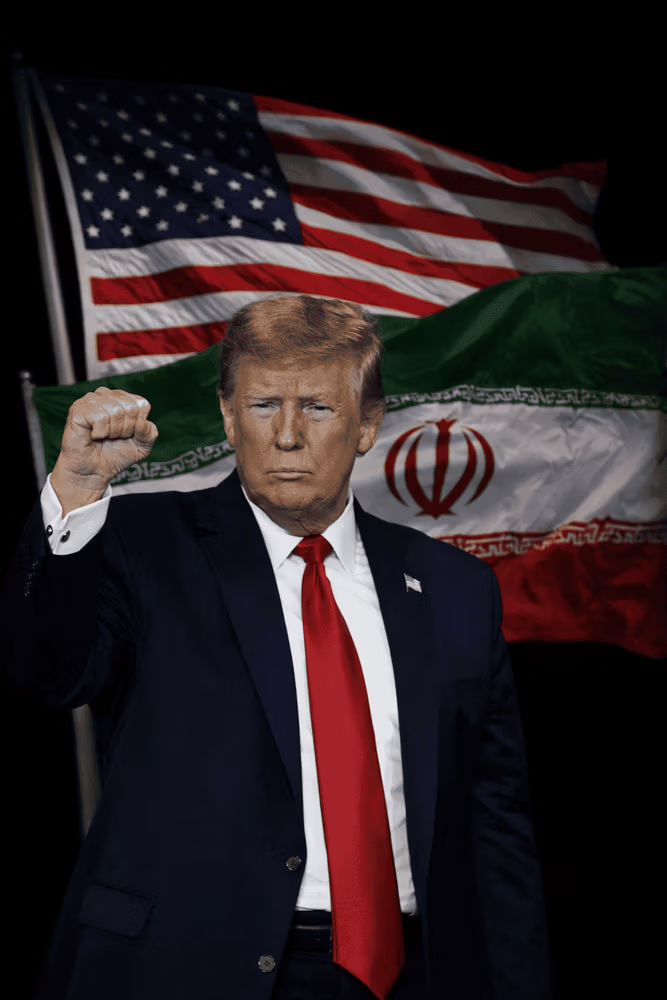
US strikes on Iran oil market risk have intensified concerns about global supply disruption, rising crude prices, and instability in the Strait of Hormuz. Energy markets are highly sensitive to geopolitical escalation in the Middle East, particularly when a major producer such as Iran is involved. While the military dimension dominates headlines, the larger economic question is whether physical oil flows will be affected.
Iran currently produces approximately 3.3 million barrels per day, representing close to 3 percent of global oil supply. That makes it one of the larger producers within OPEC. Although sanctions have limited its formal access to Western markets, Iran has maintained steady exports, with nearly 90 percent of shipments heading to China. This steady production means any sudden disruption would immediately remove meaningful barrels from the global system.
Key oil infrastructure inside Iran includes large producing fields in Khuzestan province such as Ahvaz and Marun. These fields contribute significantly to national output. On the export side, Kharg Island serves as the country’s primary oil terminal. Historically, it has handled more than 2 million barrels per day in crude exports and holds extensive storage capacity. If this facility were damaged or temporarily shut down, global supply balances would tighten rapidly.
Oil markets tend to react quickly to perceived supply threats. Historical patterns show that even a 1 percent drop in global supply can push prices up by around 4 percent. That pricing sensitivity explains why traders focus not only on confirmed damage but also on potential escalation scenarios. The US strikes on Iran oil market risk narrative is therefore not just about immediate loss but about probability and uncertainty.
How US Strikes on Iran Increase Oil Market Risk and Strait of Hormuz Tensions
The most critical variable in assessing US strikes on Iran oil market risk is the Strait of Hormuz. Approximately 20 percent of global crude oil flows through this narrow maritime corridor each day. It is one of the most important chokepoints in the global energy system.
🚨🚨🚨 BREAKING
— Iran Observer (@IranObserver0) February 28, 2026
Several major oil companies and trading houses have suspended oil and fuel shipments through the Strait of Hormuz pic.twitter.com/HLRIkNT5mS
Major exporters that depend on the Strait of Hormuz include:
• Saudi Arabia
• Iraq
• United Arab Emirates
• Kuwait
• Qatar for liquefied natural gas exports
Iran has previously indicated that it has the capability to restrict traffic through the strait in response to military aggression. While a complete closure would likely trigger international intervention and may be difficult to sustain, even limited interference could disrupt global oil supply.
Potential escalation scenarios include:
• Harassment or detention of oil tankers
• Naval confrontations near shipping lanes
• Deployment of sea mines
• GPS and navigation system interference
• Increased insurance costs that slow tanker movement
Even without a full blockade, these actions could reduce effective export capacity and drive crude prices higher. Oil markets price in risk quickly, especially when nearly one fifth of global supply moves through a single corridor.
Historical precedent reinforces these concerns. In 2019, an attack on Saudi Arabia’s Abqaiq processing facility temporarily disrupted nearly 7 percent of global oil supply. Prices spiked sharply in response before stabilizing once output resumed. That event demonstrated how concentrated and vulnerable regional energy infrastructure can be.
Recent export data also suggests that Gulf producers may be accelerating shipments amid rising tensions. Higher export volumes often indicate precautionary moves designed to move crude to market ahead of potential escalation. Such behavior reflects the understanding that once infrastructure becomes a target, logistics can become far more complicated.
At the same time, global oil markets have been balancing concerns about demand growth and supply adequacy. Earlier fears of oversupply had kept price gains contained. However, geopolitical shocks can override fundamental trends. When US strikes on Iran oil market risk intersect with a critical energy chokepoint, the market reaction can be swift.
The central question now is whether military escalation will directly impact energy infrastructure. If Iranian production sites, export terminals, and regional facilities remain operational, price spikes may prove temporary. If the conflict spreads to physical assets or shipping lanes, volatility could persist and potentially intensify.
Energy markets operate on narrow margins, and spare capacity is not unlimited. A sudden removal of several million barrels per day would require rapid adjustments from other producers, which may not be immediately feasible.
For investors, policymakers, and consumers, the situation highlights the fragility of global oil supply chains. Developments in a single region can influence fuel prices, inflation, and economic stability worldwide. As tensions evolve, oil markets will continue to monitor whether the risk remains theoretical or becomes a measurable supply shock.