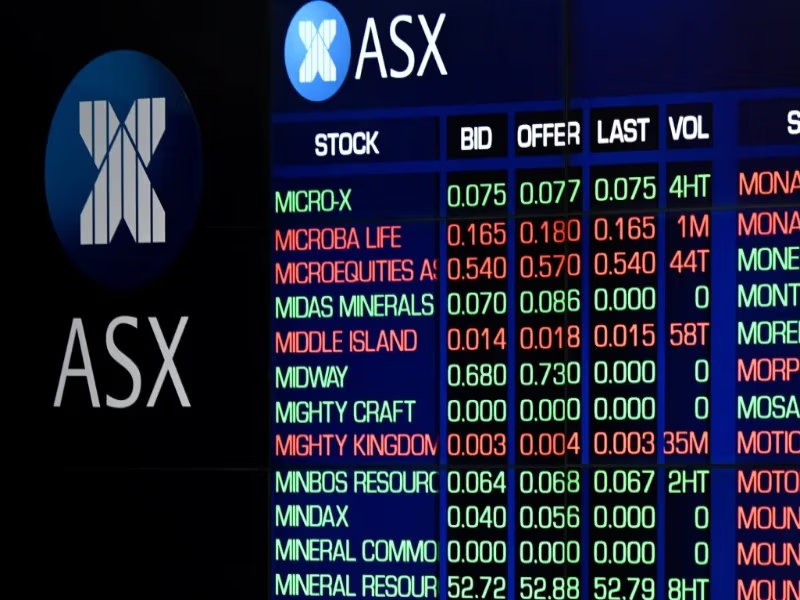
With a looming change of guard of the embattled Australian stock exchange ASX, the new chief will hardly get a smooth sail with a lawsuit being tied to the reformation of a trade settlement system and several regulatory overhangs that taint its prospects.
In the case of ASX, Chief Executive Helen Lofthouse announced her departure at the bourse in May after 11 years, four facing the top position. A search for a new CEO, led by a global headhunting firm, is underway.
The new CEO will have an uphill task of regaining credibility of the exchange according to investors and other players in the local market, as regional and international bourses vie to secure new listings and additional institutional investors.
The shift in leadership at the Australian exchange is also timely, with increased concerns that the global financial market structure has been strengthened due to the fast-changing technologies and increased trading volumes.
ASX’s average daily trading volume remained at A$6.9 billion ($4.9 billion) in January, from HK$272.3 billion ($34.81 billion) at the Hong Kong stock exchange.
According to the World Federation of Exchanges, it is ranked as the ninth-largest exchange in the Asia-Pacific region in terms of aggregate market capitalization.
Omkar Joshi, the founder of Opal Capital Management, said, “You need someone that restores credibility and really does focus on understanding the problems that they are facing, and really just going from the bottom up to fix those issues.”
He added, “They’ve been making mistakes which have been of their own accord. And to stop doing that, they need to first understand what’s actually driving that and get on top of that.”
The ASX declined to comment on the CEO search. ASX Chair David Clarke said the next CEO needs to have previous experience to “have strong credentials in financial markets, transformation and risk management.”
Sean Sequeira, the Australian Eagle Asset Management chief investment officer and an investor in ASX, indicated that identifying a leader who has dealt with regulators should be the priority.
He reported, “While shareholders would love near-term returns, for the longevity of the company, the most important part for them at the moment is to manage the regulatory risk, which would mean keeping those regulators that they are in touch with very happy with what they’re doing.”
He said, “That’s probably the reason why (Lofthouse) was encouraged to move on … regulators have picked up several missteps. Those missteps probably resulted in a requirement for ASX to make some sort of change.”
According to regulatory sources, ASX dominates approximately 80 percent of A$9.9 billion daily Australian equity market turnover against a smaller rival, CBOE Australia, which owns the remaining 20 percent.
This turned out to be the largest issue of the company as in 2022, it reported that it planned to write down A $250 million it had spent to have its old software rebuilt under blockchain technology that would have seen it increase its trading volumes and become a more aggressive competitor to other companies around the world.
That project, known as CHESS, is the focus of a legal proceeding initiated by the Australian Securities and Investments Commission (ASIC), which has alleged that the ASX made false statements to investors concerning the schedule and implementation of the project.
However, the Federal Court of Australia hearings are to begin in the middle of June. ASX has since experienced a series of issues, such as installing a new software system that is not expected to be fully functional until 2029 and numerous regulatory investigations that have agitated investors and market participants.
ASX suffered an outage, which postponed the processing of trades and cast doubt on its capacity to sustain essential market infrastructure at the end of 2024. The announcements platform of the exchange was frozen on 1st December in the previous year.
Emanuel Datt, managing director of Datt Capital, a fund manager, reported, “The ASX’s near-monopoly means they don’t face the pressures that other businesses in Australia deal with, which reduces the urgency of change.”
He added, “The errors we’ve seen, such as consistent outages for the announcement platform, suggest a culture of sloppiness that tarnishes the reputation of such an important piece of financial market infrastructure.”