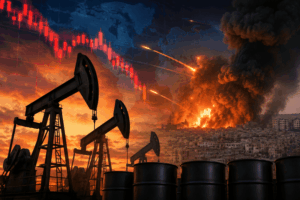

U.S. stocks plummeted drastically on Tuesday as investors worried the Middle East conflict might continue long enough to ramp up inflation.
A broad-based selling took place, and the Cboe Volatility Index recorded its top closing since November. The indexes closed far above their intra-day lows, with the S&P 500 closing down 0.9 percent after declining over 2 percent at the start of the day.
The investors are worried about the impact of the conflict, which is in its fourth day, on inflation as oil-based gains were stretched sharply. Israeli and US troops struck targets in Iran, and Iranian retaliatory attacks were around the Gulf, and the conflict expanded to Lebanon.
Chuck Carlson, Chief Executive Officer of Horizon Investment Services in Hammond, Indiana, said, “There seems to be some notion that perhaps (the Iran war) will persist longer than people thought 24 hours ago, because it’s spreading and starting to potentially impact energy infrastructure.”
However, was a second day when indexes sliced through early losses acutely on Tuesday. Jed Ellerbroek, Portfolio Manager at Argent Capital, stated that the market’s reaction to the conflict “so far is very tame,” which suggests investors’ tolerance for risk remains somewhat intact.
He observed software stocks that had dropped in the recent past to perform well. The S&P 500 software and services index improved by 1.6 percent.
The Dow Jones Industrial Average dropped 403.51 points, or 0.83 percent, to 48,501.27, the S&P 500 lost 64.99 points, or 0.94 percent, to 6,816.63, and the Nasdaq Composite lost 232.17 points, or 1.02 percent, to 22,516.69.
The first time the S&P 500 has closed below its 100-day moving average since November 20, the index hit a potentially bearish section.
Oliver Pursche, Senior Vice President and advisor at Wealthspire Advisors in Westport, Connecticut, added, “Investors are grappling with the volatility and the news, and they’re looking at their portfolios and saying, wow, this could get worse… This is the fear of it getting worse.”
He indicated, “But our advice to clients is to take a step back and wait and see.” Stocks of Blackstone fell 3.8 percent as its flagship credit fund, BCRED, experienced an increase in redemption requests.
The threat by Tehran to attack any shipping vessel that tries to pass through the Strait of Hormuz, coupled with the halting of production by several oil and gas producers in the Middle East, has increased world shipping rates and crude and natural gas prices. The strait is a key chokepoint that transports approximately one-fifth of all global oil consumption.
President Donald Trump declared on Tuesday that he had instructed the U.S. International Development Finance Corporation to supply political risk insurance and financial guarantees to maritime commerce passing the Gulf and that the U.S. Navy would begin escorting oil tankers through the Strait of Hormuz in case the need arose.
The investors are concerned that the increased oil prices may cause inflation and make central bank policy decisions already stretched by rising prices due to tariffs even harder. U.S. Treasury yields increased in a second consecutive session.
Declining issues outnumbered advancers by a 4.1-to-1 ratio on the NYSE. The NYSE recorded 137 new highs and 167 new lows.