
Iran has said that restrictions in the strategic Strait of Hormuz are directed specifically at vessels linked to the United States, Israel, and European countries, clarifying earlier warnings about the closure of the vital maritime route.
Statements attributed to Iran’s Islamic Revolutionary Guard Corps indicated that ships belonging to or supporting those countries would be considered hostile if they attempted to pass through the strait. Iranian media quoted officials as saying vessels from these countries “will certainly be hit” if they are observed transiting the waterway.
The clarification suggests that Iran is not imposing a blanket shutdown on all international shipping but is instead framing the restrictions as targeted measures against adversaries involved in the current confrontation with Tehran.
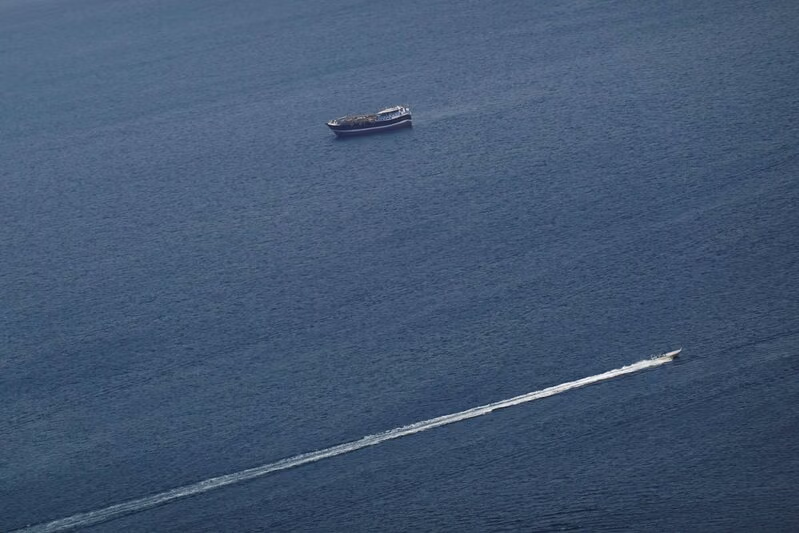
The Strait of Hormuz, located between Iran and Oman, is one of the world’s most important energy chokepoints. Roughly one-fifth of global oil shipments pass through the narrow waterway each day, making any disruption there a major concern for energy markets and global trade.
Despite Iran’s statement that the restrictions are selective, tanker traffic through the strait has reportedly fallen sharply as shipping companies avoid the region due to security risks and rapidly rising war-risk insurance premiums. Maritime tracking data indicates that many vessels are waiting outside the Gulf or rerouting to alternative ports while the situation remains uncertain.
Security analysts say that even limited threats in the strait can effectively halt commercial activity because ship owners, insurers, and crews are unwilling to risk operating in a potential conflict zone.
Western governments have not formally confirmed Iran’s latest statement, and independent verification of the exact conditions of the restriction remains limited. However, the warnings have heightened concern among energy traders and shipping companies about the safety of navigation in the Gulf.
The situation comes amid escalating tensions between Iran and a coalition led by the United States and Israel, raising fears that disruptions in the Strait of Hormuz could tighten global oil supplies and push energy prices higher.
For now, the strait remains legally open under international maritime law, but the combination of security threats and insurance constraints has brought tanker movements close to a standstill, underlining how geopolitical tensions can quickly ripple across the world’s most critical trade routes.