

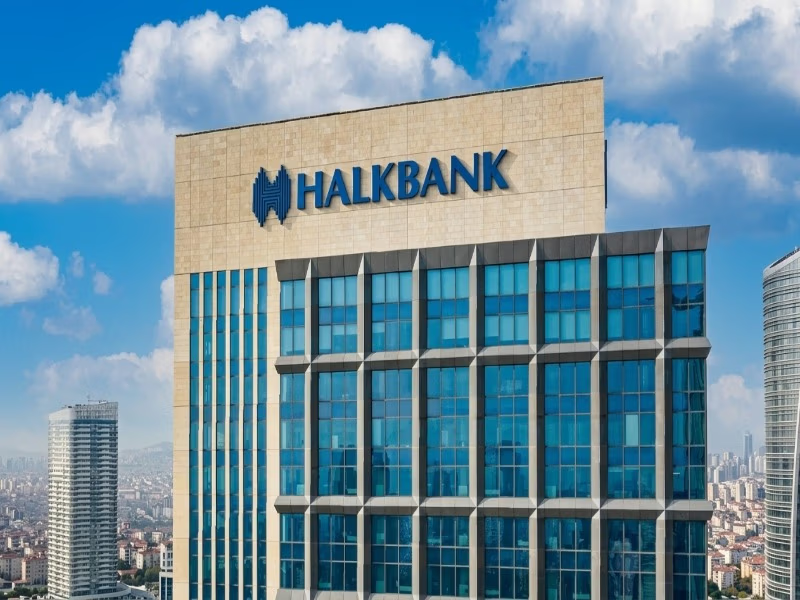
The U.S. government agreed to resolve its long-standing criminal prosecution of Turkish state-run lender Halkbank, opens new tab, stating the accord advances the interest of Washington in deterring Iran’s support.
The deferred prosecution pact announced on Monday, with the consent of a judge, would relieve one of the main irritants between the United States and Turkey, as the NATO allies experience their best relationship in decades after Donald Trump returned to the U.S. presidency last year.
It would also put an end to a years-long saga which had been focused on accusations that Halkbank had assisted Iran evade American economic sanctions. Turkish President Tayyip Erdogan once described the case as unlawful and “ugly.”
The agreement filed in Manhattan federal court prohibits engaging in transactions benefiting Iran and compels it to appoint a monitor to audit its sanctions and anti-money-laundering adherence.
As per the agreement, no funds will be exchanged, and the charges are probably to be dropped once the monitor checks the compliance of Halkbank.
U.S. Attorney Jay Clayton in Manhattan said in a letter to U.S. District Judge Richard Berman, who oversees the case, said, “This agreement by Halkbank furthers the United States’ compelling interests in combatting terrorist financing and financial support for the Government of Iran.”
Clayton also added that the agreement strongly serves the public interest by advancing the U.S. government’s national security interests in fighting against money laundering and terror finance.
The Halkbank agreement would need the approval of Berman. Clayton asked the judge to adjourn a scheduled March 11 status conference.
The U.S. Supreme Court upheld a decision by a federal appeals court that had permitted prosecution to continue in October. The agreement of Halkbank was revealed in the course of the continuity of the U.S.-Israeli war with Iran.
Two sources told Reuters in October that Turkish officials had proposed resolving the case for some $100 million during a September meeting between Erdogan and Trump at the White House. Halkbank, in a statement, claimed it is not pleading guilty to any criminal offense, and the agreement would fully terminate the case.
Halkbank’s Istanbul-traded shares on Monday ended up to 10 percent, the exchange’s maximum permitted increase, following Berman’s filing of an order adding a deferred prosecution agreement.
U.S. prosecutors charged Halkbank in 2019, during Trump’s first term as president, with fraud, money laundering, and conspiracy for allegedly helping Iran use money servicers and front companies in Iran, Turkey, and the United Arab Emirates.
Hakan Akbas, Managing Director at Strategic Advisory Services, a consultancy firm, said the agreement “closes a long and costly legal chapter while strengthening compliance standards. Trump and Erdogan appear to be steadily clearing major disputes from the U.S.–Turkey agenda.”
Prosecutors stated that the bank secretly transferred $20 billion of restricted funds, converted oil revenue into gold and cash to benefit Iranian interests, and documented fake food shipments to justify transfers of oil proceeds. Halkbank pleaded not guilty.
Deferred prosecution agreements allow the defendant to escape criminal charges provided they fulfill a number of conditions, usually in a few months or years.
However, the government rejects cases after the defendants comply. U.S. judges do not have much discretion to examine such agreements.
Kaleb Byars, a Professor at Mercer University School of Law, “Courts cannot substantively review and reject deferred prosecution agreements. The court really has no discretion but to accept it unless it does something that is not supported by precedent.”
Following the meeting with Trump in September, Erdogan said he was optimistic that the meeting would address the many disagreements between the two nations.
The Turkish president said Trump informed him at the White House and in a subsequent phone call that “the Halkbank problem is finished for us.”
The case of Halkbank was a continuation of a series of similar criminal trials, such as the Turkish-Iranian gold trader. Reza Zarrab case and the case of Halkbank executive Mehmet Hakan Atilla.
Zarrab pleaded guilty to bank fraud, money laundering, and conspiracy charges in 2017, but has not been sentenced. He also testified against Atilla, who was found guilty of bank fraud and conspiracy charges in 2018.
Atilla was released in 2019 and returned to Turkey after serving the majority of a 32-month prison term. Halkbank’s case has taken a circuitous path through the U.S. courts.
It was initially presented to the Supreme Court in 2023, when the highest U.S. judicial body temporarily invalidated the case, even after acknowledging that the intent of Congress to protect foreign countries and their instrumentalities against civil liability did not extend to criminal cases.
The most recent Supreme Court appeal was a ruling by a federal court of appeals that immunity under centuries-old common law did not protect Halkbank.