

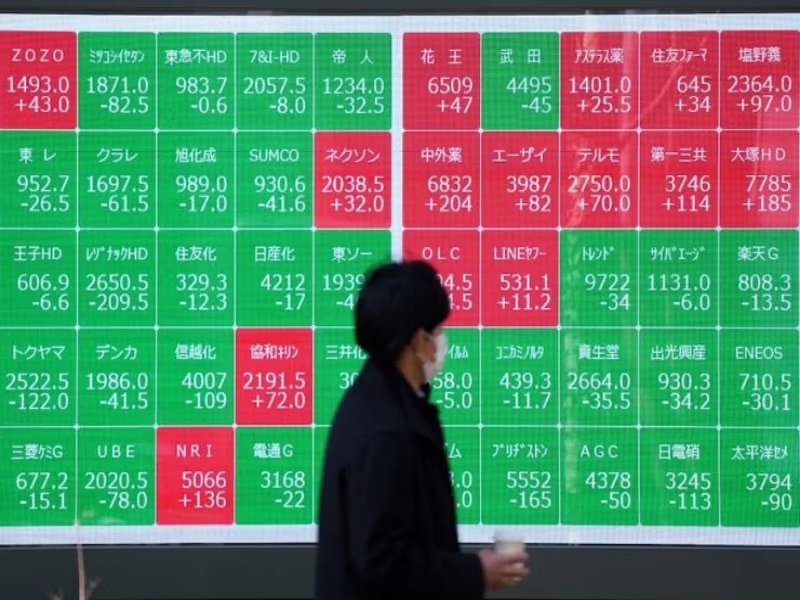
Asia-Pacific markets were trading higher on Wednesday, with traders evaluating the current war in the Middle East. Australia’s S&P/ASX 20 rose 0.35 percent in early trade.
Japan’s Nikkei 225 surged 1.36 percent, while the Topix added 1.22 percent. South Korea’s Kospi gained 3.2 percent, while the small-cap Kosdaq soared 1.39 percent. The Hong Kong Hang Seng index increased by 0.43 percent, and the CSI 300 increased by 0.19 percent.
Oil prices, which hit an unprecedented high of almost $120 a barrel on Monday as the market succumbed to fear over the Iran war, fell to their peak as traders thought that a group of countries was going to tap into the emergency crude reserves to ensure that there is a way out of the conflict. The U.S. crude oil was most recently up 3.24 percent to $86.15 per barrel.
David Johnson, CEO of financial services firm Vervent, said, “The most immediate impact of an oil shock is that it acts like a tax on the economy. When energy prices surge, households spend more on fuel and utilities and less on everything else, which quietly slows consumer demand across the broader economy.”
Hong Kong-listed shares of Chinese electric vehicle developer Nio were up over 15 percent after the company announced a significant rise in fourth-quarter performance, aided by soaring deliveries, improved product mix, and cost reduction.
Fourth-quarter vehicle deliveries climbed 71.7 percent from the previous year to 124,807 units, while revenue rose 75.9 percent to 34,650.2 million yuan ($4,954.9 million) and vehicle margin gained to 18.1 percent from 13.1 percent in the previous year.
In the U.S. overnight, the S&P 500 was slightly lower in choppy trading, with oil prices drawing back as traders monitored the Iran war.
However, the broad market index fell 0.21 percent to end at 6,781.48. The Dow Jones Industrial Average dropped 34.29 or 0.07 and closed at 47,706.51. The Nasdaq Composite rose by 0.01 percent to close at 22,697.10.
The Dow had fallen up to 296.57 points or 0.6 percent, and the S&P 500 and Nasdaq were down 0.5 percent and 0.4 percent, respectively, at their lowest point earlier in the session.