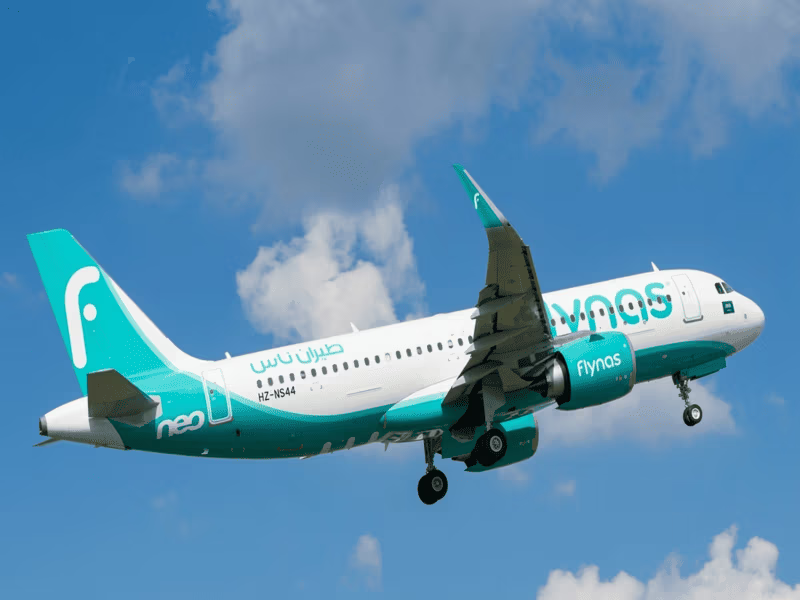
Saudi low-cost carrier flynas has provided 28 percent growth in adjusted annual profit to 2025, as passenger growth and fleet expansion derived earnings amid a statutory loss affected by one-off expenses associated with its public listing.
According to a filing on the Saudi Exchange, adjusted net profit reached SR556 million ($148.1 million), compared with SR434 million in the previous year.
The airline indicated a statutory net loss of SR527 million, compared to a net profit of SR434 million in 2024, after booking SR1.08 billion in non-recurring IPO-related charges, such as a one-time employee share-based payment expense and listing fees.
However, the Saudi carrier in the previous year surged by SR4.1 billion in what was signified as one of the region’s biggest aviation listings.
The robust financial performance of flynas is a contributor to the objective of Saudi Arabia to become a global tourist destination and a business destination. The Kingdom seeks to receive more than 150 million visitors by the end of this decade.
Bander Al-Mohanna, CEO and managing director, said, “2025 was a year of disciplined execution and strategic progress for flynas. Despite external headwinds, including aircraft availability constraints and regional disruptions, we stayed focused on operational reliability, cost discipline, and network expansion.”
He stated, “Our low-cost model continues to prove resilient, enabling us to serve growing demand for affordable travel while maintaining margin discipline.”
Adjusted earnings before interest, taxes, depreciation, and amortization surged 15 percent annually to SR2.51 billion, and margin rose 3.2 percentage points to 32.1 percent, an indication of the scale of operation and retained cost discipline. There was an increase in total revenue by 4 percent to SR7.84 billion.
The company generated revenue using three different operating segments. The low-cost carrier segment, which contributed 90 percent of total revenue, brought SR7.09 billion, an increase of 4 percent compared to a year prior, helped by route expansion and increased operating capacity.
However, the revenue of Hajj and Umrah continued to stabilize widely at SR584 million, as opposed to SR587 million in the year 2024. The general aviation revenue dropped by 6 percent to SR174 million, which is 2 percent of the total revenue.
Passenger traffic rose by 7 percent to 15.8 million, and available seat kilometers by 11 percent, largely because of international expansion and capacity deployment on major markets.
Cost of revenue grew 4 percent to SR6.36 billion, which is generally in line with growth in revenue. Selling general and administrative expenses were at the same level of SR510 million. Meanwhile, the sale-and-leaseback gains amount to SR76 million as opposed to SR131 million in 2024.
This decline represents a calculated strategic change that was initiated in 2025, with the company starting to directly finance a segment of its aircraft, as part of its long-term strategy to improve unit cost efficiency.
The statement reported, “This marks the implementation of a more balanced fleet funding model, combining owned and leased aircraft, and is expected to enhance long-term capital efficiency and support structural CASK improvement.”
The fleet size reached 71 aircraft as of the end of the year, including eight A320neo deliveries in the year and five wet-leased aircraft to aid network development and address supply chain limitations.
The flynas launched 25 new routes and 12 destinations in 9 countries in 2025, targeting broader network coverage and increased international presence to reach a total of 80 destinations in 38 countries.
Total assets went up by 27 percent to SR17.22 billion, and total equity more than doubled to SR3.55 billion, which can be traced mainly to increased retained earnings and to the recognition of IPO proceeds.
Flynas’s Chief Financial Officer, Ramzi Zaroubi, added, “We delivered margin expansion across the board, with adjusted EBITDA margin improving to 32.1 percent and adjusted net profit margin reaching 7.1 percent, ahead of our guidance.”
He stated, “Beyond the income statement, we made important strides in strengthening the balance sheet, ending the year with significantly enhanced liquidity of SR4.1 billion in cash and equivalents and reducing net debt by 27 percent year on year.”
Moving forward, flynas claimed that it is committed to sustainable growth through effective capacity scaling, intensifying market penetration in major markets, and improving guest experience.
At the start of 2026, the company reported the creation of a new operating base at Abha International Airport, its fifth base in Saudi Arabia, and signed a term sheet to create flynas Syria, a new low-cost carrier platform, pending regulatory approvals.