
The Biden and bipartisan shock from the U.S. Supreme Court’s rejection of broad presidential tariff authority has triggered a major pivot in U.S. trade strategy this week with potentially far‑reaching implications for global markets, supply chains, and investor sentiment.
On Wednesday, the Trump administration launched two expansive trade investigations spanning roughly 60 countries, setting up the possibility of new tariffs or other remedies if the United States finds that key trading partners are engaging in unfair trade practices.
The probes mark a strategic effort to rebuild tariff leverage after the Supreme Court ruled in February that the president lacked authority under the International Emergency Economic Powers Act (IEEPA) to impose wide‑ranging trade duties. In response, the administration has imposed a temporary 10 percent import surcharge under Section 122 of the Trade Act of 1974, which is set to expire later this summer, and is now launching two Section 301 investigations to identify long‑standing unfair practices that could justify more durable measures.
What the Investigations Are Targeting
Section 301 of the Trade Act of 1974 allows the U.S. Trade Representative (USTR) to investigate foreign policies that are unjustified, unreasonable, or discriminatory and burden U.S. commerce, and to recommend tariffs or other remedies if violations are confirmed.
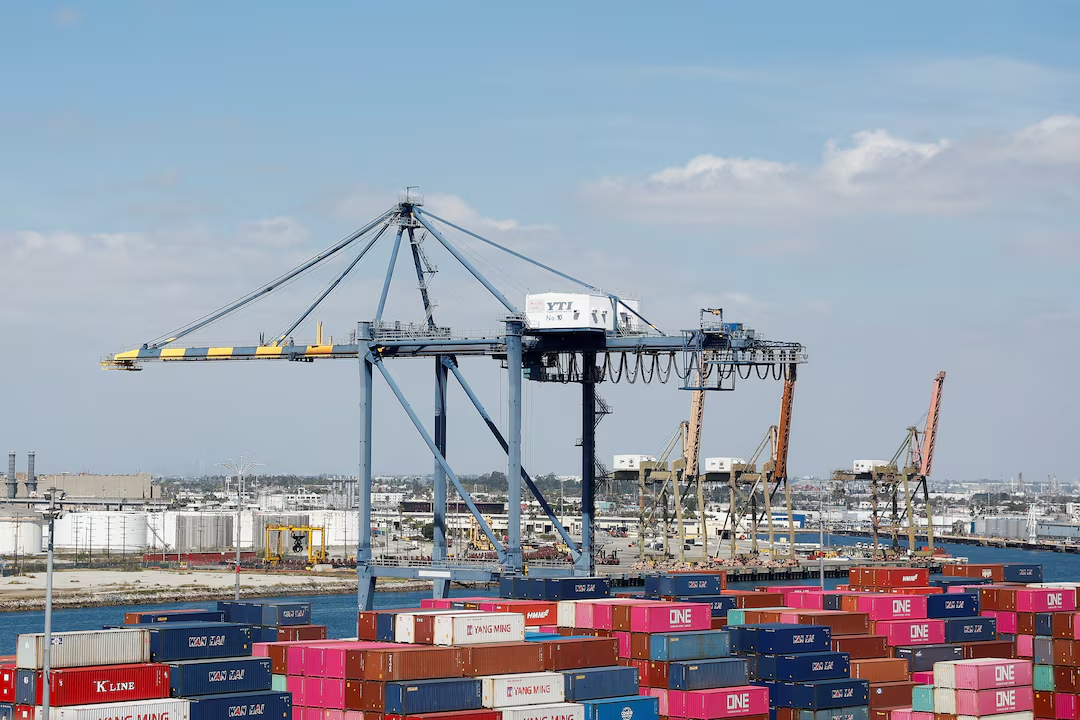
The first investigation focuses on structural excess industrial capacity and production in manufacturing sectors in major export economies. Officials say this can manifest as large persistent trade surpluses, unused or underutilized capacity, and production detached from genuine market demand. “Our view is that key trading partners have developed production capacity that is really untethered from the market incentives of domestic and global demand,” U.S. Trade Representative Jamieson Greer told reporters, listing subsidies, suppressed worker wages, and subsidized lending as possible contributors.

Countries subject to this manufacturing capacity probe include China, the European Union, India, Japan, South Korea, Mexico, Taiwan, Vietnam, Thailand, Malaysia, Cambodia, Singapore, Indonesia, Bangladesh, Switzerland, and Norway. Analysts say the focus on broad trading partners, not just historical targets like China, underscores a concerted push to tackle global imbalances rather than isolated disputes.
The second investigation, expected to be formally announced Thursday, will scrutinize laws and enforcement actions related to the import of goods made with forced labor. This initiative covers roughly 60 countries and expands on existing measures such as the Uyghur Forced Labor Protection Act, which already restricts imports tied to forced labor in China’s Xinjiang region. Greer said this investigation is “not about domestic conditions of particular countries,” but about whether trading partners have external‑facing laws that ban goods produced with forced labor under U.S. law.
A Shift in U.S. Trade Enforcement Tools
The new probes come as the Trump administration recalibrates after a series of legal setbacks and rising political pressure. After the Supreme Court struck down tariffs imposed under emergency powers, Trump shifted to Section 122 to sustain some protectionist pressure while building legal cases under Section 301 that could pave the way for more traditional tariff remedies grounded in statute.
Greer indicated that the objective is to complete the excess capacity investigation before the temporary global tariff expires, signaling an accelerated timeline in hopes of maintaining negotiating leverage. The first probe’s docket for public comments opens this month, with a deadline of April 15, followed by hearings beginning May 5. Findings and recommendations — which could include new tariffs, quotas, or non‑tariff barriers — are expected by late May or early June.
Market and Policy Implications
For financial markets, the renewed focus on trade enforcement adds a layer of uncertainty to global supply chains and investor expectations. Targeted industries — including automotive, technology, semiconductors, and industrial goods — could face higher costs and supply disruptions if tariffs are imposed on major trading partners. Economists warn that such measures, while intended to protect domestic industries, can also lead to higher input costs for U.S. firms and inflationary pressure on consumer prices.
Moreover, multinational companies with significant exposure to exports in China, the EU, and Asia may need to reassess production footprints and hedging strategies. Global equities and commodity markets could react to escalating trade tensions, especially if tariff measures lead to retaliatory actions by affected countries.
Trade experts note that Section 301 investigations are detailed and often complex, sometimes taking a year or more to conclude. The compressed timeline sought by the Trump administration reflects political as well as economic drivers, as lawmakers, industry groups, and investors closely watch how the trade agenda unfolds amid broader geopolitical tensions and the 2026 midterm elections.
Broader Context and Next Steps
This new wave of trade probes underscores a broader shift in U.S. trade policy, blending traditional tariff tools with contemporary concerns about labor standards, supply chain fairness, and industrial overcapacity. While specific outcomes remain uncertain, the investigations signal a continuation of the robust enforcement era that began with Trump’s first term and has persisted across administrations.
Further investigations under Section 301 are anticipated, including reviews of digital services taxes, pharmaceutical pricing, and environmental practices, illustrating the U.S. government’s expansive approach to trade enforcement. Trade analysts say the results of these probes could influence negotiations at the World Trade Organization and reshape how global economic partners engage with U.S. commerce in the years ahead.