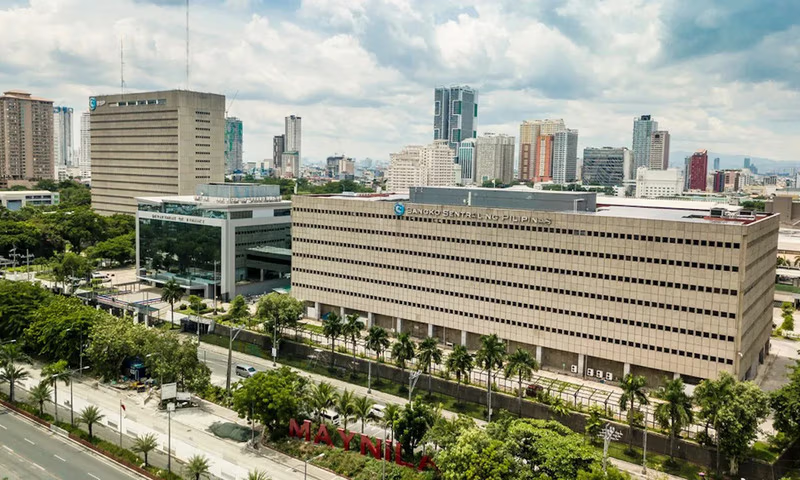
The Philippines’ central bank has warned that monetary policy alone will not be sufficient to contain inflationary pressures, as the ongoing conflict in Iran drives up global energy prices and complicates the economic outlook.
Officials from the Bangko Sentral ng Pilipinas (BSP) signalled that while interest rates remain a key tool, they have limited ability to offset external shocks such as rising oil prices and supply disruptions. The warning reflects a broader concern among policymakers that inflation is increasingly being driven by factors beyond domestic control.
The surge in energy costs linked to geopolitical tensions has emerged as a key risk. Higher fuel prices are feeding into transport, food, and utility costs, creating what economists describe as cost-push inflation, a type that central banks find harder to manage through traditional rate adjustments.
The BSP indicated it may adopt a more cautious, wait-and-watch approach, balancing inflation risks against the need to support economic growth.
The challenge underscores a growing dilemma for central banks across Asia. While raising interest rates can help anchor inflation expectations, it does little to address supply-side disruptions caused by geopolitical events or commodity price spikes.
Recent global trends have reinforced this constraint. Analysts note that monetary policy “cannot prevent the war from having an initial impact” on inflation, highlighting the limits of central bank action during external shocks.
For the Philippines, the situation is further complicated by currency pressures and reliance on imported energy, which amplify the transmission of global price increases into the domestic economy.
The central bank’s stance suggests that managing inflation in the current environment will require a broader policy mix, including fiscal measures, supply-side interventions, and targeted subsidies, rather than relying solely on interest rate changes.
The warning highlights a shifting macroeconomic landscape in which central banks are increasingly constrained by global factors, leaving policymakers to navigate a more complex balance between inflation control and economic stability.