

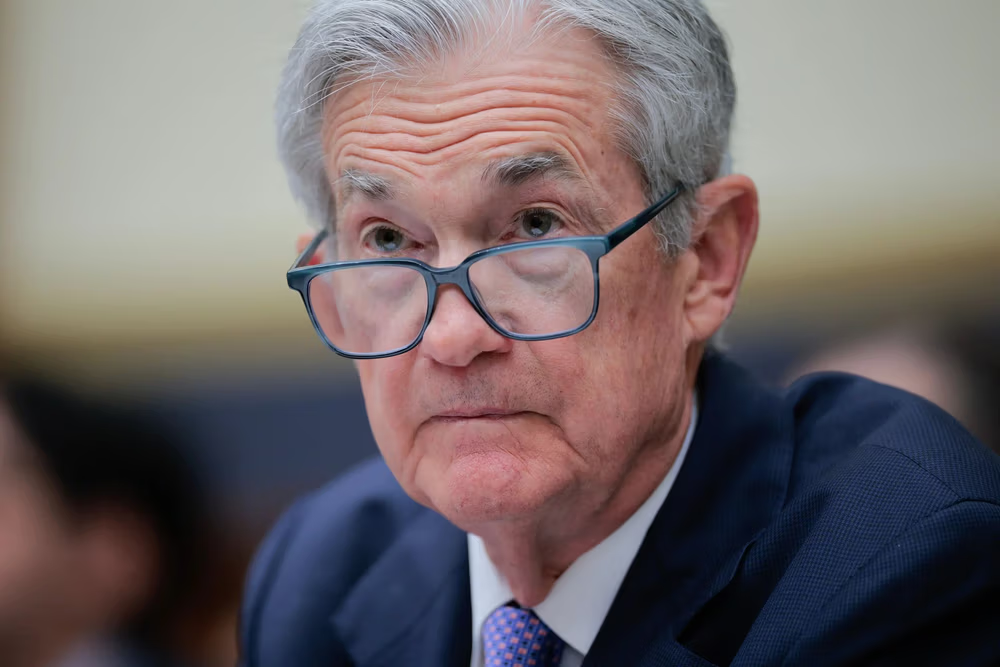
The U.S. Federal Reserve is confronting a renewed policy dilemma as rising inflation risks intersect with concerns over slowing economic momentum, prompting Chair Jerome Powell to signal a cautious, wait-and-see approach to monetary policy.
Speaking at Harvard University, Powell indicated that the central bank is closely monitoring the economic fallout from escalating geopolitical tensions, particularly the recent surge in energy prices, which has complicated the outlook for both inflation and growth. His remarks suggest that policymakers are reluctant to act prematurely amid heightened uncertainty.
At the centre of the challenge is a sharp increase in oil prices, driven by supply disruptions linked to tensions in the Middle East. Higher energy costs are feeding into inflation at a time when price pressures have already remained above the Fed’s long-term target, raising concerns about the persistence of inflationary trends.
At the same time, elevated oil prices risk dampening consumer spending and business activity, creating a potential drag on economic growth. This dual impact places the Federal Reserve in a difficult position, as policy tools designed to curb inflation could further slow the economy, while a more accommodative stance risks allowing inflation to become entrenched.
Powell emphasised that the Fed has the flexibility to hold rates steady while assessing how these dynamics evolve, noting that monetary policy is less effective in responding to supply-driven shocks such as energy price spikes. The current stance reflects an effort to avoid overreacting to short-term volatility while preserving the option to adjust policy as needed.
Interest rates are currently in a relatively restrictive range, following a cycle of tightening aimed at containing inflation. However, Powell indicated that future decisions remain data-dependent, with the possibility that rates could move either higher or lower depending on how inflation, employment, and broader economic indicators develop.
Financial markets have interpreted the Fed’s messaging as a signal of patience, with expectations shifting away from immediate rate changes. Investors are increasingly focused on incoming economic data and geopolitical developments as key determinants of the policy trajectory.
The broader backdrop remains complex. Inflation expectations, which have historically been well anchored, are showing signs of strain, while global uncertainty continues to weigh on financial conditions. A stronger U.S. dollar and rising bond yields have added to the pressure on global markets, particularly in emerging economies.
For the Federal Reserve, the current environment represents a delicate balancing act. Maintaining credibility in the fight against inflation while avoiding an unnecessary slowdown in growth will require careful calibration of policy.
As Powell’s remarks suggest, the central bank is opting for flexibility over immediacy, a stance that reflects both the unpredictability of external shocks and the high stakes involved in navigating the next phase of the economic cycle.