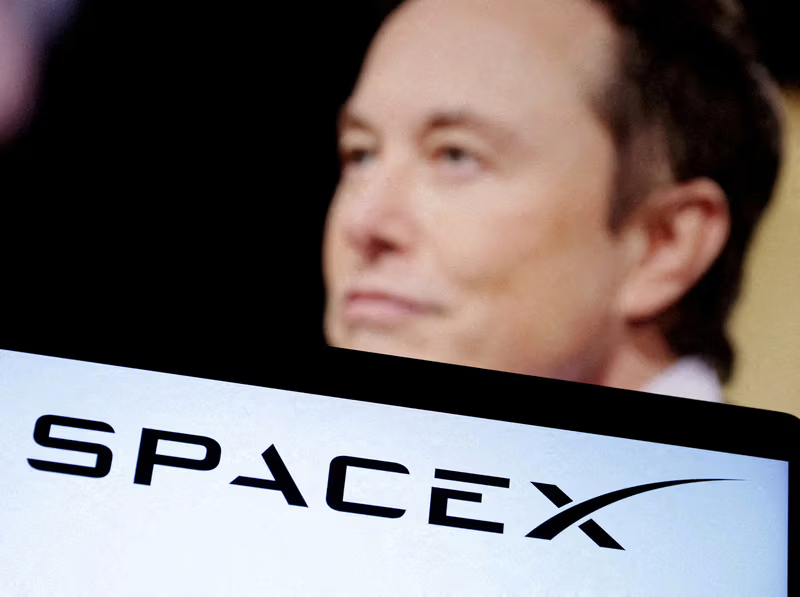
SpaceX has confidentially filed for a U.S. initial public offering, setting the stage for what could become the largest stock market debut in history and marking a turning point in the commercialization of space.
The Elon Musk-led company submitted draft registration documents to regulators, according to people familiar with the matter, in a move that could value the business at more than $1.7 trillion. If realized, the listing would surpass previous records and cement SpaceX’s position as the world’s most valuable privately held company.
The IPO is expected to raise tens of billions of dollars, with estimates suggesting proceeds could exceed $50 billion, providing fresh capital to fund ambitious expansion plans spanning satellite internet, artificial intelligence, and next-generation space infrastructure.
At the core of SpaceX’s valuation is Starlink, its satellite internet division, which has emerged as a dominant revenue driver. The business now accounts for a significant share of the company’s earnings, supported by millions of global subscribers and growing defense-related contracts.
The listing also reflects a broader strategic shift. SpaceX is increasingly positioning itself at the intersection of space, connectivity, and artificial intelligence, following its integration with Musk’s AI venture xAI. The IPO proceeds are expected to support plans to build large-scale computing infrastructure, including proposals for orbital data networks.
The company has assembled a large syndicate of global investment banks to manage the offering, underscoring the scale and complexity of the transaction. The deal, internally referred to as “Project Apex,” could launch as early as mid-2026, subject to market conditions.
Beyond its financial significance, the IPO marks a broader evolution in the space industry. Once considered a speculative frontier, space is increasingly being treated as an investable sector, with recurring-revenue models such as satellite connectivity reshaping the industry’s economics.
Despite strong investor interest, questions remain about valuation sustainability, execution risk, and the feasibility of some of SpaceX’s long-term ambitions, particularly in space-based computing infrastructure.
For markets, the listing represents more than a single corporate event. It signals the emergence of a new asset class in which space, artificial intelligence, and global connectivity converge, with SpaceX positioned at the center of that transformation.