

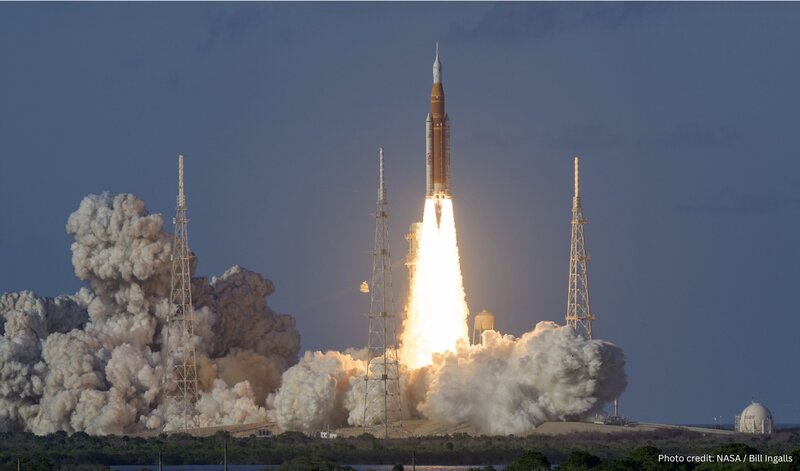
NASA has launched its Artemis II mission, sending four astronauts on a historic journey around the Moon and marking the first crewed mission beyond low Earth orbit in more than half a century.
The spacecraft lifted off from the Kennedy Space Center in Florida aboard the Space Launch System rocket, carrying a multinational crew on a 10-day mission designed to test systems critical for future lunar landings.
Artemis II represents the first time humans have ventured toward the Moon since the Apollo era, underscoring a renewed push by the United States and its partners to establish a sustained presence in deep space.
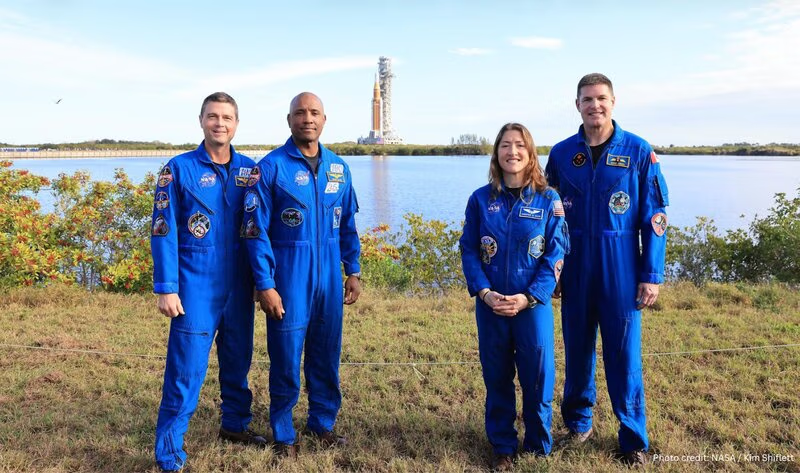
The crew, comprising NASA astronauts Reid Wiseman, Victor Glover, and Christina Koch, along with Canadian astronaut Jeremy Hansen, will conduct a lunar flyby without landing, traveling farther from Earth than any human mission in history.
Following launch, the Orion spacecraft completed initial orbital checks before executing a key maneuver known as translunar injection, propelling it out of Earth’s orbit and onto a trajectory toward the Moon.
The mission is intended as a critical test of life-support systems, navigation, and re-entry capabilities, laying the groundwork for future missions that aim to return astronauts to the lunar surface later this decade.
Beyond its technical objectives, Artemis II carries symbolic significance. The mission includes the first woman, the first person of color, and the first non-American astronaut to travel beyond low Earth orbit, reflecting a broader shift toward international collaboration in space exploration.
The launch also comes amid intensifying global competition in space, with the United States seeking to maintain leadership as other nations accelerate their own lunar ambitions.
If successful, Artemis II will pave the way for subsequent missions under the Artemis program, including planned crewed landings and the development of a long-term lunar base, positioning the Moon as a stepping stone for future missions to Mars.
For policymakers and investors alike, the mission highlights the growing intersection of government-led space programs and commercial opportunities, as deep space exploration increasingly becomes a domain of strategic and economic importance.